


Indonesian President Megawati Sukarnoputri urged Southeast Asia yesterday to push forward a security community to battle international terrorism amid moves to prevent militant strikes on ships in the vital Malacca Strait.
The host of the annual meeting of ASEAN foreign ministers alluded to the international embarrassment caused to the group by member Myanmar's repressive policies and urged the junta to embrace democracy.
"We in ASEAN have no reason to be complacent," she said in an opening speech that stressed the need to boost cooperation on security to address threats in a region struck by several deadly extremist militant attacks since the Sept. 11, 2001 strikes in the US.
"We must also be at the forefront in the fight against the most inhuman of multinational crimes: international terrorism," she told ministers, who will try to narrow differences on tackling militancy without diluting sovereignty.
The ASEAN Security Community was launched at a summit last year in Bali, months after nightclub bombings on the Indonesian tourist island killed 202 people and were blamed on al-Qaeda-linked Jemaah Islamiah. It was the deadliest attack since the Sept. 11, 2001 attacks.
littoral states
The Indonesian initiative on security is a leap for the group of kingdoms, communists, juntas and democracies that has long stood by a principle of non-interference in each other's affairs.
It envisions cooperation on maritime security, particularly in the Malacca Strait, through which pass one-quarter of the world's trade.
A day earlier, littoral states Indonesia, Malaysia and Singapore set up a new task force to patrol the sea lane, but were careful to retain national commands and to voice opposition to US suggestions that it play a role in the channel.
The security pact would address defense cooperation and international peacekeeping missions, but without a formal pact or alliance since some ASEAN members are unhappy with an initiative that is seen as encroaching on individual states.
Megawati took note of those concerns.
"Contrary to the misgivings of many, we shall not form a military alliance nor conclude a defense pact, because that is not what an ASEAN Security Community is about," she said.
Any progress could be overshadowed by Myanmar's detention of opposition leader Aung San Suu Kyi since May of last year.
losing patience
That has tested the principle of non-interference and risks becoming an irritant again in this week's forum of Asia-Pacific foreign ministers that follows the ASEAN talks, when US Secretary of State Colin Powell is likely to voice displeasure.
With Myanmar due to take over the ASEAN chair in 2006 and to play host to regional meetings, the EU in particular has threatened to boycott some group meetings if Myanmar attends.
"We should be able to hold dialogue among ourselves openly and frankly even on internal or domestic issues that ... can have a severe impact on the region," Megawati said.
Western nations have imposed sanctions on Myanmar for keeping the Nobel peace laureate under house arrest.
In a sign ASEAN was losing patience, the bloc censured the junta last year in a historic departure from its long-standing policy on non-interference. Suu Kyi remains under house arrest.
Yangon may be warned this week that it may lose the ASEAN chairmanship in 2006 if it does not make satisfactory progress on its "road map to democracy", conference sources said.
Megawati urged Myanmar's generals to do more. "We do encourage Myanmar to take every action that will add substance to the expression of its democratic aspiration," she said.
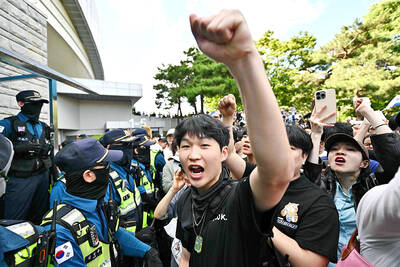
‘ABSURD MISTAKE’: The election commission said that there had been a failure to anticipate turnout after 14 polling stations ran short of ballot papers South Korean riot police yesterday cleared protesters from a Seoul polling station after a 35-hour blockade sparked by a shortage of ballot papers during local elections earlier this week. Wednesday’s election was the first nationwide vote since South Korean President Lee Jae-myung took office following the ouster of Yoon Suk-yeol over his short-lived martial law declaration. Lee’s ruling Democratic Party swept most races, but failed to flip the crucial Seoul mayoral seat. The South Korean National Election Commission apologized, blaming a failure to anticipate turnout after 14 polling stations in Seoul ran short of ballot papers. Some polling stations stayed open until 10pm to

France experienced its hottest spring on record, the French weather service said on Tuesday, after an exceptional early heat wave that also broke highs for the season in England and Wales. Meteo-France said the average nationwide temperature over March to May was 13.8°C — about 1.7°C above the norm, and surpassing records set in 2011 and 2020. “The warmest spring since records began in 1900,” it said in a bulletin. All three months were warmer than average, but the onset of an “unprecedented heatwave” late last month pushed the mercury to highs typically seen at the height of the summer. “Our country had never

A Sherpa guide was found crawling to base camp on Mount Everest a week after he went missing and was reunited with his family, who had given up hope he would return. Dawa Sherpa was last seen on Friday last week descending the mountain, but he did not reach base camp even though his client did. The pair were among the last climbers on the mountain as the climbing season came to an end and the route was dismantled. Dawa was located by a cleaning crew on Thursday morning as he was crawling down the snowy slopes around the Khumbu Icefall, just above
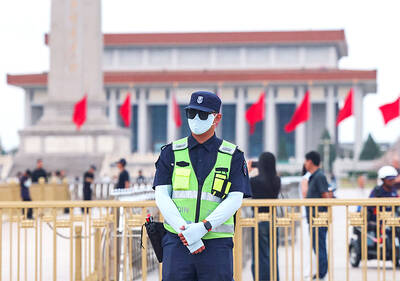
Chinese authorities are snuffing out any remembrance of the deadly 1989 military crackdown on student-led pro-democracy protests in Tiananmen Square, which happened 37 years ago yesterday, in a further tightening of a years-long campaign to erase what happened from public memory. Police told relatives of the victims they would not be allowed to visit a cemetery in Beijing on the anniversary of the crackdown, a person with knowledge of the matter said. Relatives of the victims visited the cemetery on the anniversary for more than 30 years to read memorial statements with police keeping watch, Amnesty International said. Hundreds of people,


 RSS
RSS