


A 28-year-old Moroccan aeronautical engineering student was charged on Monday with involvement in the train bombings last month in Madrid, and the police announced the arrest of three more Moroccans in connection with the attacks.
After two hours of questioning on Monday, Judge Juan del Olmo, who is leading the investigation of the train bombings, formally charged the student, Fouad el-Mourabit, with "collaborating with an armed group."
Underscoring the complexity of the inquiry into Spain's terror networks, another Spanish judge and a team from the FBI were questioning suspects at the same time in the same courthouse in two separate but related terror investigations.
Del Olmo had already detained, questioned and released Mourabit twice since March 11. But the police concluded from Mourabit's mobile phone records that he had spoken with most of the men who had thus far been identified at the core of the plot.
The calls, an official with the National Court told reporters, "proved he had close relations with almost all those who are under arrest or dead."
Mourabit, she added, made phone calls to them before and on the day of the bombings on March 11.
She added that Mourabit was well acquainted with Sarhane Ben Abdelmajid Fakhet, 37, a Tunisian who is believed to have been the operational head of the plot and who died along with several others in a suicide bombing as the police were closing in on their apartment.
Until last year Mourabit shared an apartment with one of the suicide bombers, and then he moved in with Basel Ghayoun, a Syrian who is also under arrest on charges of involvement in the March 11 bombings, the official said.
Mourabit maintained his innocence on Monday, telling the judge in Spanish that he had no idea his friends had been involved in the plot. One floor above, Judge Baltasar Garzon was continuing his examination of Muhammad Galeb Kalaje Zouaydi, accused of financing attacks by al-Qaeda, at Zouaydi's request.
Garzon indicted Osama bin Laden and 34 others, including Zouaydi, in connection with the Sept. 11, 2001, attacks in the US, which were partly planned in Spain. Zouaydi's lawyer, Manuel Tuero, explained that his client, who has been held since November 2001, had asked to respond to various charges against him.
On the same floor, a group of lawyers and investigators of the George W. Bush administration began a week of questioning in connection with a terrorist inquiry in the US, under a treaty that the US has with Spain and other close allies.
One US official said that inquiry was unrelated to the Madrid train bombings, which he called "a completely Spanish investigation." He declined to give more information.
But a Spanish lawyer familiar with the case said the Americans were in Madrid to question two Algerians, Khaled Madani, 33, and Moussa Laouar, 36, about their possible involvement in the Sept. 11 plot. They are suspected of providing false passports to Mohamed Atta and Ramzi Binalshibh, two of the central Sept. 11 plotters.
In another development on Monday, the police announced the arrests of Ibrahim al-Fallah, Hassan Belhadj and Said Aharouch, all of whom had been linked to the men who blew themselves up on April 3.
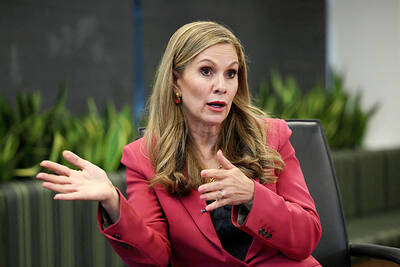
Australians were downloading virtual private networks (VPNs) in droves, while one of the world’s largest porn distributors said it was blocking users from its platforms as the country yesterday rolled out sweeping online age restriction. Australia in December became the first country to impose a nationwide ban on teenagers using social media. A separate law now requires artificial intelligence (AI)-powered chatbot services to keep certain content — including pornography, extreme violence and self-harm and eating disorder material — from minors or face fines of up to A$49.5 million (US$34.6 million). The country also joined Britain, France and dozens of US states requiring
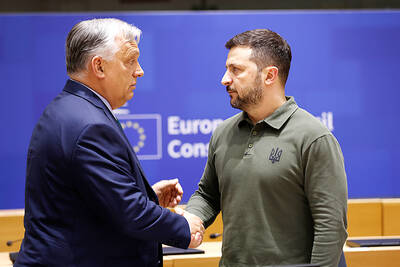
Hungarian authorities temporarily detained seven Ukrainian citizens and seized two armored cars carrying tens of millions of euros in cash across Hungary on suspicion of money laundering, officials said on Friday. The Ukrainians were released on Friday, following their detention on Thursday, but Hungarian officials held onto the cash, prompting Ukraine to accuse Hungary’s Russia-friendly government of illegally seizing the money. “We will not tolerate this state banditism,” Ukrainian Minister of Foreign Affairs Andrii Sybiha said. The seven detained Ukrainians were employees of the Ukrainian state-owned Oschadbank, who were traveling in the two armored cars that were carrying the money between Austria and
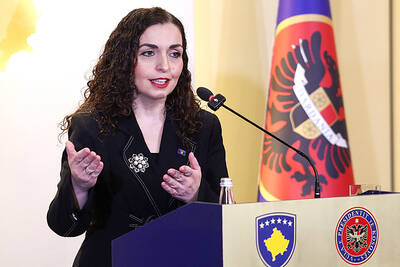
Kosovar President Vjosa Osmani on Friday after dissolving the Kosovar parliament said a snap election should be held as soon as possible to avoid another prolonged political crisis in the Balkan country at a time of global turmoil. Osmani said it is important for Kosovo to wrap up the upcoming election process and form functional institutions for political stability as the war rages in the Middle East. “Precisely because the geopolitical situation is that complex, it is important to finish this electoral process which is coming up,” she said. “It is very hard now to imagine what will happen next.” Kosovo, which declared

MORE BANS: Australia last year required sites to remove accounts held by under-16s, with a few countries pushing for similar action at an EU level and India considering its own ban Indonesia on Friday said it would ban social media access for children under 16, citing threats from online pornography, cyberbullying, online fraud and Internet addiction. “Accounts belonging to children under 16 on high-risk platforms will start to be deactivated, beginning with YouTube, TikTok, Facebook, Instagram, Threads, X, Bigo Live and Roblox,” Indonesian Minister of Communications and Digital Meutya Hafid said. “The government is stepping in so that parents no longer have to fight alone against the giants of the algorithm. Implementation will begin on March 28, 2026,” she said. The social media ban would be introduced in stages “until all platforms fulfill their


 RSS
RSS