


Tired of spending evenings with men drunk on whisky and rum, Nina Kanjirath decided three years ago to bring together fellow Indian women who would appreciate one of the finer things in life.
What started as a club of 20 friends and family members has now taken off and become a roaring success, mirroring the rapid growth of India's nascent wine culture.
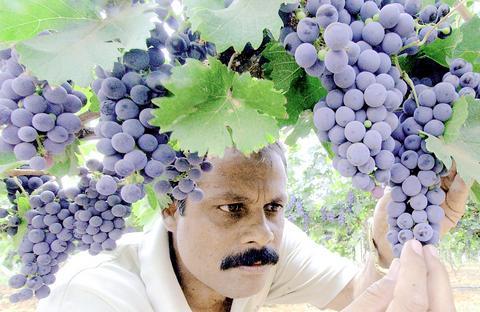
PHOTO: AFP
"Wine is magical," said Kanjirath, a 48-year-old socialite in the country's technology hub, Bangalore.
"It allows you to get to know people in a much nicer atmosphere," she said.
"In Indian parties the men get high on whisky and rum and they go on drinking and drinking," she said. "Women have to either have their dinner or wait for their partners to go home. But with wine women can join in."
In just over two years the club has capped its membership at 100, most of them women, with Kanjirath saying it cannot handle any more people joining.
Indian winemakers say women like Kanjirath with high disposable incomes are key to building the domestic wine market, which is growing at 20 percent a year.
India is still far from being a wine-drinking country. With 6 million bottles sold a year, its annual consumption is .006 bottles a head against a world average of five bottles, said Alok Chandra, president of the Bangalore Wine Club co-founded by Kanjirath.
But he said the industry was being driven by Indians who had tasted wine while working abroad.
"There is a realization that wine is not just a product but it is a suave and sophisticated healthy drink. With changing lifestyles and high disposable incomes women are taking to wine more than men," Chandra said. "Also now there is a wider choice."
Local companies such as Grover Vineyards, Chateau Indage and Sula Vineyards have hit the market with more varieties to take advantage of the growing demand.
"Grover produced 500,000 bottles last year and this year the production is slated to be 600,000," said Abhay Kewadkar, general manager of Bangalore-based Grover Vineyards.
Grover also exports wine to Indian restaurants in Britain and France and last month the firm's Sauvignon Blanc and Cabernet Shiraz hit the shelves of France's prestigious Galleries Lafayette.
Kewadkar said wine clubs were instrumental in pushing sales.
"In India people are afraid to drink wine as there is an aura surrounding it. They are in fear when they order wine as they are scared whether they are holding the glass right and chose the right wine," Kewadkar said.
"After these clubs cropped up, people are not bothered about the nitty-gritty and they have started understanding the product," he said.
Chateau Indage, which exports its wine to 18 countries, plans to set up two new wineries in India, up from just one now.
"It was believed that wines should be drunk only on special occasions. This is the single largest myth in our country and the clubs are demolishing that myth," said Anjali Gaekwar, a spokeswoman for Chateau Indage.
"There is a greater awareness due to these clubs," she said.
She added that Chateau Indage had a bar in Bombay which sells 32 different types of wines.
Bangalore Wine Club chief Chandra said in the next 10 years the wine industry would grow to 5 million cases -- meaning 60 million bottles, or a 10-fold increase from now.
"It is growing at a fast pace as younger women and men are taking to drinking wine," he said.
His friend Kanjirath agreed.
"When I hold a glass of wine I look more respectable," she said.

Chinese President Xi Jinping (習近平) is to visit Russia next month for a summit of the BRICS bloc of developing economies, Chinese Minister of Foreign Affairs Wang Yi (王毅) said on Thursday, a move that comes as Moscow and Beijing seek to counter the West’s global influence. Xi’s visit to Russia would be his second since the Kremlin sent troops into Ukraine in February 2022. China claims to take a neutral position in the conflict, but it has backed the Kremlin’s contentions that Russia’s action was provoked by the West, and it continues to supply key components needed by Moscow for

Japan scrambled fighter jets after Russian aircraft flew around the archipelago for the first time in five years, Tokyo said yesterday. From Thursday morning to afternoon, the Russian Tu-142 aircraft flew from the sea between Japan and South Korea toward the southern Okinawa region, the Japanese Ministry of Defense said in a statement. They then traveled north over the Pacific Ocean and finished their journey off the northern island of Hokkaido, it added. The planes did not enter Japanese airspace, but flew over an area subject to a territorial dispute between Japan and Russia, a ministry official said. “In response, we mobilized Air Self-Defense

CRITICISM: ‘One has to choose the lesser of two evils,’ Pope Francis said, as he criticized Trump’s anti-immigrant policies and Harris’ pro-choice position Pope Francis on Friday accused both former US president Donald Trump and US Vice President Kamala Harris of being “against life” as he returned to Rome from a 12-day tour of the Asia-Pacific region. The 87-year-old pontiff’s comments on the US presidential hopefuls came as he defied health concerns to connect with believers from the jungle of Papua New Guinea to the skyscrapers of Singapore. It was Francis’ longest trip in duration and distance since becoming head of the world’s nearly 1.4 billion Roman Catholics more than 11 years ago. Despite the marathon visit, he held a long and spirited

The pitch is a classic: A young celebrity with no climbing experience spends a year in hard training and scales Mount Everest, succeeding against some — if not all — odds. French YouTuber Ines Benazzouz, known as Inoxtag, brought the story to life with a two-hour-plus documentary about his year preparing for the ultimate challenge. The film, titled Kaizen, proved a smash hit on its release last weekend. Young fans queued around the block to get into a preview screening in Paris, with Inoxtag’s management on Monday saying the film had smashed the box office record for a special cinema


 RSS
RSS