


British police have freed all five Britons flown home from Guantanamo Bay prison camp -- and the former terror suspects began denouncing their US captors yesterday amid questions about why they were held for two years.
The US turned over the five detainees to British custody on Tuesday, and by late Wednesday British police and prosecutors decided to release all of them without charges.
This could cause trouble for British Prime Minister Tony Blair, who will face public dismay as to why it took so long for Washington's closest ally to win its citizens' freedom if authorities at home concluded they should not face trial.
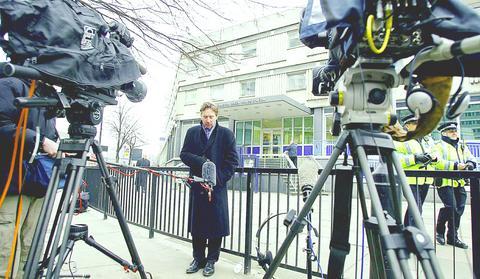
PHOTO: AFP
One of the five freed men was released on Tuesday and the other four on Wednesday, while a further four Britons remain at the Guantanamo prison in Cuba. Washington says they are more dangerous than the five it decided to send home.
Greg Powell, lawyer for one of the freed men, said 21-year-old Rhuhel Ahmed was on his way to a reunion with his family early yesterday after being released just before midnight. He was one of three prisoners from Tipton, a small industrial town in central England.
"He's on his way to meet his family and obviously that's a tremendous moment for all of them, because they haven't seen each other since 2001," Powell said.
Powell said he had met his client at the London jail where he was released and found him in good health. But his treatment at the hands of the Americans had amounted to "torture."
"What I have learned from him is Guantanamo Bay is a kind of experiment in interrogation techniques and methods, really. And they do have extremely interesting stories to tell about what went on there," Powell said.
He declined to give further details about the prisoners' treatment, or explain what his client was doing in Afghanistan when he was arrested.
Powell said Ahmed's family wanted privacy. But the former prisoners will be at the center of a media frenzy -- which could prove a money-spinner if they opt to sell their stories.
None of the five appeared in public immediately.
Britain's most famous publicist, Max Clifford, whose client list ranges from top nobility to O.J. Simpson, said he had been hired by the family of former detainee Terek Dergoul, 24, and expected tabloids would bid six figures for prisoners' stories.
Jamal al Harith, 35, from the northern city of Manchester, was the first to go free shortly after the group landed at a British air base on Tuesday.
Dergoul, a Londoner, was freed on Wednesday, followed by the Tipton detainees, including Ahmed and his friends Asif Iqbal, 20, and Shafiq Rasul, 24. Their families said they had traveled to Pakistan in late 2001 to find one of them a wife.
A fourth youth from Tipton, Monir Ali, had traveled with them and disappeared. His family has hoped the others will provide clues to his fate.
While Blair's supporters see the prisoners' return as a peace dividend for his support of US President George W. Bush, the Guantanamo issue could remain a major political headache.
Britons will want to know why it took more than two years to get them out. Meanwhile, the fate of the four still in Guantanamo will stay high on the political agenda.
Britain says the Bush administration's plans for special military tribunals to try Guantanamo suspects do not measure up to basic fairness standards. It wants either the rules to be modified or the suspects sent back to Britain for trial.


Through the noise of rushing papers and whirring belts at a print factory in Kyoto, two creators watch their photo essay come to life in broadsheet form — part of an effort to win new audiences in the age of artificial intelligence (AI). Despite the decline of the publishing industry, self-publication and handmade “zine” magazines are growing in popularity in Japan, reflecting the nation’s enduring love of paper in the digital era. While speaking to Agence France-Presse at the plant, his hands black with ink, one of the creators, Kazuma Obara, said: “I think [paper] is a medium that engages all five
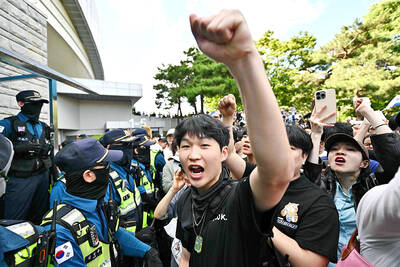
‘ABSURD MISTAKE’: The election commission said that there had been a failure to anticipate turnout after 14 polling stations ran short of ballot papers South Korean riot police yesterday cleared protesters from a Seoul polling station after a 35-hour blockade sparked by a shortage of ballot papers during local elections earlier this week. Wednesday’s election was the first nationwide vote since South Korean President Lee Jae-myung took office following the ouster of Yoon Suk-yeol over his short-lived martial law declaration. Lee’s ruling Democratic Party swept most races, but failed to flip the crucial Seoul mayoral seat. The South Korean National Election Commission apologized, blaming a failure to anticipate turnout after 14 polling stations in Seoul ran short of ballot papers. Some polling stations stayed open until 10pm to

France experienced its hottest spring on record, the French weather service said on Tuesday, after an exceptional early heat wave that also broke highs for the season in England and Wales. Meteo-France said the average nationwide temperature over March to May was 13.8°C — about 1.7°C above the norm, and surpassing records set in 2011 and 2020. “The warmest spring since records began in 1900,” it said in a bulletin. All three months were warmer than average, but the onset of an “unprecedented heatwave” late last month pushed the mercury to highs typically seen at the height of the summer. “Our country had never

A Sherpa guide was found crawling to base camp on Mount Everest a week after he went missing and was reunited with his family, who had given up hope he would return. Dawa Sherpa was last seen on Friday last week descending the mountain, but he did not reach base camp even though his client did. The pair were among the last climbers on the mountain as the climbing season came to an end and the route was dismantled. Dawa was located by a cleaning crew on Thursday morning as he was crawling down the snowy slopes around the Khumbu Icefall, just above


 RSS
RSS