


US President George W. Bush called on Congress on Tuesday to approve a constitutional amendment that would ban gay marriage as he leaped into a divisive issue that could bolster his support among conservatives in the November election.
The decision was immediately condemned by gay-rights groups and many Democrats. Even some Republicans cast doubt on the move, which would likely take years to bring to fruition.
The Republican president expressed alarm at events in San Francisco, where thousands of marriage licenses have been issued to gays and lesbians, and in Massachusetts, where the state's highest court ruled gay couples had the right to wed.
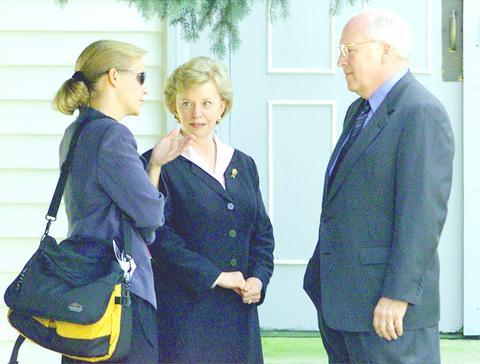
PHOTO: REUTERS
Bush denounced "some activist judges and local officials" for attempting to "redefine marriage." He did not endorse a specific bill but offered to work with Congress on the language.
"If we are to prevent the meaning of marriage from being changed forever, our nation must enact a constitutional amendment to protect marriage in America," he said.
His appearance in the White House Roosevelt Room came a day after Bush abandoned his above-the-fray position and opened a campaign attack on Democrat John Kerry, who aims to run against him in the general election.
Recent polls show the gay marriage issue could be a winner for Bush, who has long courted Christian conservatives as a key element of his political base.
Kerry, in a statement, accused Bush of "looking for a wedge issue to divide the American people."
He said he opposed a constitutional amendment and believed marriage was between a man and a woman but that he supported gay civil unions.
Gay Republicans were outraged.
Patrick Guerriero, executive director of the Log Cabin Republicans, said: "Log Cabin considers support for this amendment a declaration of war on gay and lesbian families and an attack on our sacred Constitution."
Vice President Dick Cheney's stance was unclear and his office had no comment. Cheney's daughter, Mary, who works for the Bush-Cheney re-election campaign, is openly gay.
White House spokesman Scott McClellan, asked if Bush had discussed his decision with Cheney, said only that Cheney was "very well aware of the decisions the president makes."
Same-sex marriage opponents said it would destroy the institution of marriage. Proponents said gays should have the same rights as others to marry and that the move would enshrine discrimination in the Constitution.
"It is wrong to write discrimination into the US Constitution and it is shameful to use attacks against gay and lesbian families as an election strategy," said Democratic National Committee Chairman Terence McAuliffe.
Recent polls show about two-thirds of Americans oppose same-sex marriages, but the nation is more evenly divided on the question of civil unions.
Pennsylvania Republican Senator Rick Santorum, who backs an amendment, said he believes support will grow when Americans realize what is at stake.
"We really haven't had the debate. It's premature to look at numbers and look at polls," he said.
US Representative David Dreier of California, a member of the Republican leadership in the House of Representatives, said he would not support an amendment.
"I believe this should go through the courts, and I think we are at a point where this is not necessary," Dreier said.

Chinese President Xi Jinping (習近平) is to visit Russia next month for a summit of the BRICS bloc of developing economies, Chinese Minister of Foreign Affairs Wang Yi (王毅) said on Thursday, a move that comes as Moscow and Beijing seek to counter the West’s global influence. Xi’s visit to Russia would be his second since the Kremlin sent troops into Ukraine in February 2022. China claims to take a neutral position in the conflict, but it has backed the Kremlin’s contentions that Russia’s action was provoked by the West, and it continues to supply key components needed by Moscow for

Japan scrambled fighter jets after Russian aircraft flew around the archipelago for the first time in five years, Tokyo said yesterday. From Thursday morning to afternoon, the Russian Tu-142 aircraft flew from the sea between Japan and South Korea toward the southern Okinawa region, the Japanese Ministry of Defense said in a statement. They then traveled north over the Pacific Ocean and finished their journey off the northern island of Hokkaido, it added. The planes did not enter Japanese airspace, but flew over an area subject to a territorial dispute between Japan and Russia, a ministry official said. “In response, we mobilized Air Self-Defense

CRITICISM: ‘One has to choose the lesser of two evils,’ Pope Francis said, as he criticized Trump’s anti-immigrant policies and Harris’ pro-choice position Pope Francis on Friday accused both former US president Donald Trump and US Vice President Kamala Harris of being “against life” as he returned to Rome from a 12-day tour of the Asia-Pacific region. The 87-year-old pontiff’s comments on the US presidential hopefuls came as he defied health concerns to connect with believers from the jungle of Papua New Guinea to the skyscrapers of Singapore. It was Francis’ longest trip in duration and distance since becoming head of the world’s nearly 1.4 billion Roman Catholics more than 11 years ago. Despite the marathon visit, he held a long and spirited

China would train thousands of foreign law enforcement officers to see the world order “develop in a more fair, reasonable and efficient direction,” its minister for public security has said. “We will [also] send police consultants to countries in need to conduct training to help them quickly and effectively improve their law enforcement capabilities,” Chinese Minister of Public Security Wang Xiaohong (王小洪) told an annual global security forum. Wang made the announcement in the eastern city of Lianyungang on Monday in front of law enforcement representatives from 122 countries, regions and international organizations such as Interpol. The forum is part of ongoing


 RSS
RSS