


The World Health Organization (WHO) is investigating whether bird flu in Vietnam has jumped to humans after the deaths of 12 people.
The biggest concern was the bird flu virus latching on to the human influenza virus, a WHO spokesman in Manila said on Monday, who warned of dire consequences if this occurred.
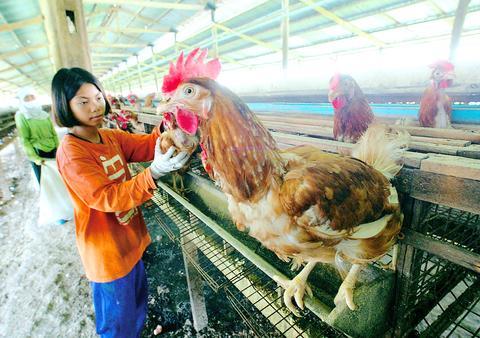
PHOTO: REUTERS
"There is no evidence at the moment that this is the H5N1 virus, which is the avian virus," Peter Cordingley, a spokesman for the WHO's Western Pacific headquarters in Manila, said.
Cordingley said of 14 people who fell ill with influenza in Hanoi and surrounding provinces, 11 of the 13 children and the mother of one of the children had died.
The H5N1 virus spreads rapidly among poultry but rarely infects humans. It did so in Hong Kong in 1997 when an outbreak of bird flu killed six people and again last year when it infected a father and son.
"The point of concern is not so much that those tests will show that those kids have got this virus. We're worried that the virus will latch on to a normal human influenza virus, which is extremely contagious, and then we'll have a big problem."
Meanwhile, in South Korea, hopes that bird flu may be subsiding have been dashed, after officials confirmed yesterday the first new case in more than a week.
The Agriculture Ministry confirmed in a statement the latest outbreak in South Korea was at a chicken farm in Yangsan, about 380km southeast of the capital Seoul.
Authorities had completed the slaughter of 18,000 birds at the farm in Yangsan that had not died from the disease, officials said by telephone, adding that roughly 900,000 more chickens and ducks at around 30 farms within a 3km radius of the farm would be killed.
About 1.8 million birds have been culled in South Korea since the start of the outbreak was first reported on Dec. 10, the agriculture ministry said. Sixteen outbreaks have been reported so far across the country, including yesterday's case.
The outbreak has prompted South Korean consumers to stop eating poultry and exports of chickens and chicken meat to Japan, Hong Kong and China have been halted.
In Thailand, a Thai livestock official yesterday denied allegations that the government had been trying to cover up the bird flu outbreak.
Veterinarian Nirundorn Aungtragoolsuk, acting director of the Livestock Disease Control Bureau, said lab tests had shown that some chickens at local farms had suffered from a bacterial infection called fowl cholera, but that there was no evidence of bird flu.
He said the Livestock Department had issued a statement on Dec. 16 saying some poultry farms had been affected by the illness.
The department also ordered the slaughter of 14,000 chickens in Chachoengsao province and 20,000 in Ang Thong province and prohibited people from moving the dead birds from those areas.
"Many times, chicken farmers face outbreaks of a similar disease [to bird flu] because of poor hygiene at their farms," Nirundorn said.
The Bangkok Post newspaper yesterday quoted several poultry farmers as saying the Livestock Department was trying to hide the outbreak.
They said the government wants to protect the country's poultry exports.
"This is the most horrible disease we've ever seen. It attacks our farms very fast. We are shocked and have no idea how to handle it," said one farmer, who claims he lost 10,000 chickens to the disease at his farm in Nakhon Pathom province, about 50km west of Bangkok.
The chickens that died had symptoms similar to those of avian influenza, or bird flu, he was quoted as saying on condition of anonymity.
However, a staff member of the Thai Poultry Farmers Promotion Association said on condition of anonymity that they were unaware of the complaints.
A local farm organization representative said they had also not heard about the complaints.

‘GROSS NEGLIGENCE?’ Despite a spleen typically being significantly smaller than a liver, the surgeon said he believed Bryan’s spleen was ‘double the size of what is normal’ A Florida surgeon who is facing criminal charges after allegedly removing a patient’s liver instead of his spleen has said he is “forever traumatized” by that person’s death. In a deposition from November last year that was recently obtained by NBC, 44-year-old Thomas Shaknovsky described the death of 70-year-old William Bryan as an “incredibly unfortunate event that I regret deeply.” Bryan died after the botched surgery; and last month, a grand jury in Tallahassee indicted Shaknovsky on a charge of manslaughter. “I’m forever traumatized by it and hurt by it,” Shaknovsky added, also saying that wrong-site surgeries can happen “during

Former Chinese ministers of national defense Wei Fenghe(魏鳳和) and Li Shangfu (李尚福) were both sentenced to death with a two-year reprieve over graft charges, state news agency Xinhua reported on Thursday, underscoring the severity of the purge in the military. The armed forces have been one of the main targets of a broad corruption crackdown ordered by Chinese President Xi Jinping (習近平) after coming to power in 2012. The purges reached the elite Rocket Force, which oversees nuclear weapons as well as conventional missiles, in 2023. Earlier this year they escalated further, resulting in the removal of the top general in

‘PERSONAL MISTAKES’: Eileen Wang has agreed to plead guilty to the felony, which comes with a maximum sentence of 10 years in federal prison A southern California mayor has agreed to plead guilty to acting as an illegal agent for the Chinese government and has resigned from her city position, officials said on Monday. Eileen Wang (王愛琳), mayor of Arcadia, was charged last month with one count of acting in the US as an illegal agent of a foreign government. She was accused of doing the bidding of Chinese officials, such as sharing articles favorable to Beijing, without prior notification to the US government as required by law. The 58-year-old was elected in November 2022 to a five-person city council, from which the mayor is selected

The Philippine Coast Guard yesterday said it deployed aircraft to issue radio warnings to a Chinese research ship in a disputed area of the South China Sea “swarming” with vessels from Beijing’s so-called maritime militia. The research vessel Xiang Yang Hong 33 (向陽紅33), which is capable of supporting submersible craft, was operating near a reef in the contested Spratly Islands (Nansha Islands, 南沙群島), which Taiwan also claims, the Philippine Coast Guard said. The Chinese ship was deploying a service boat toward the Spratly’s Iroquois Reef on Wednesday when it was spotted by a coast guard plane, “confirming ongoing unauthorized [marine scientific research]


 RSS
RSS