


Japanese Prime Minister Junichiro Koizumi made a surprise New Year visit to the controversial Yasukuni Shrine commemorating the country's war dead in Tokyo yesterday.
The move, likely to provoke an outcry from China and other nations who suffered from Japan's war-time aggression, came as Tokyo is in the process of sending military personnel to Iraq despite fierce opposition at home.
Dressed formally in "hakama" pleated skirt and traditional "kimono" bearing his family crest, Koizumi walked solemnly into the shrine, which was surrounded by hundreds of well-wishers to mark the New Year's Day.
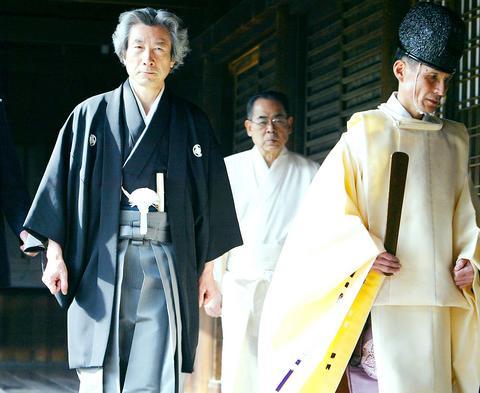
PHOTO: REUTERS
He bowed deeply at the main chamber before being escorted inside by a Shinto priest and spent a few minutes paying his respects out of sight from the media.
"I prayed for peace and prosperity in Japan ... which has been built based on the people who lost their lives against their will during the war," Koizumi said.
Defending the visit to the war shrine, he said: "No country interferes in other countries' respect for history, tradition, custom. Since I am visiting here every year, I hope to gain understanding gradually."
Honoring 2.5 million Japanese war dead, Yasukuni is widely seen as a symbol of Japan's former militarism, particularly since 1978 when it enshrined 14 Class-A war criminals, including wartime prime minister General Hideki Tojo.
Koizumi is only the third prime minister since 1978 to visit the shrine adjacent to the Imperial Palace.
It was Koizumi's first visit to the shrine on a New Year's Day, the nation's most important national holiday, since he took office in 2001.
The nationalist premier has pledged to make a pilgrimage once a year to "dedicate on peace" but has avoided visiting there on sensitive days such as Aug. 15, the anniversary of the end of World War II.
Commenting on the reason for visiting the shrine on New Year's Day, Koizumi said he followed "Japanese tradition," adding: "I had been wondering when I should visit. I made the decision today and it was a good choice."
Koizumi made his third trip on Jan. 14 last year, drawing harsh criticism from China, South and North Korea, and other nations.
As recently as October, China reiterated that it was "difficult to understand" Koizumi's repeated remarks that he planned to continue visiting the Tokyo shrine.
"China-Japan relations are in an important period of development. We find the Japanese leader's recent comments difficult to understand," Chinese foreign ministry spokeswoman Zhang Qiyue said.
The move may further delay the restart of mutual visits by the two countries' leaders, which were suspended after Koizumi's previous visits to the shrine between 2001 and last year.
The visit may also fuel criticism against Japan's dispatch of troops to Iraq.
An advance party from Japan's military contingent left for the Middle East on Dec. 26 to set the stage for a humanitarian mission in the war-torn nation, Tokyo's most dangerous deployment of personnel since World War II.

When a hiker fell from a 55m waterfall in wild New Zealand bush, rescuers were forced to evacuate the badly hurt woman without her dog, which could not be found. After strangers raised thousands of dollars for a search, border collie Molly was flown to safety by a helicopter pilot who was determined to reunite the pet and the owner. A week earlier, an emergency rescue helicopter found the woman with bruises and lacerations after a fall at a rocky spot at the waterfall on the South Island’s West Coast. She was airlifted on March 24, but they were forced to
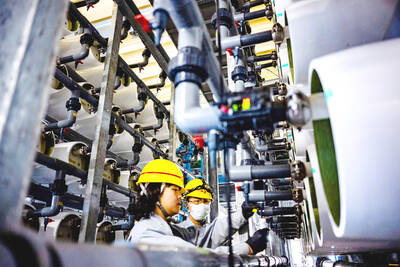
HIGH HOPES: The power source is expected to have a future, as it is not dependent on the weather or light, and could be useful for places with large desalination facilities A Japanese water plant is harnessing the natural process of osmosis to generate renewable energy that could one day become a common power source. The possibility of generating power from osmosis — when water molecules pass from a less salty solution to a more salty one — has long been known. However, actually generating energy from that has proved more complicated, in part due the difficulty of designing the membrane through which the molecules pass. Engineers in Fukuoka, Japan, and their private partners think they might have cracked it, and have opened what is only the world’s second osmotic power plant. It generates

Hundreds of Filipinos and tourists flocked to a sun-bleached field north of Manila yesterday, on Good Friday, to witness one of the country’s most blood-soaked displays of religious fervor, undeterred by rising fuel prices. Scores of bare-chested flagellants with covered faces walked barefoot through the dusty streets of Pampanga Province’s San Fernando as they flogged their backs with bamboo whips in the scorching heat. Agence France-Presse (AFP) journalists said they saw devotees deliberately puncturing their skin with glass shards attached to a small wooden paddle to ensure their bleeding during the ritual, a way to atone for sins and seek miracles from
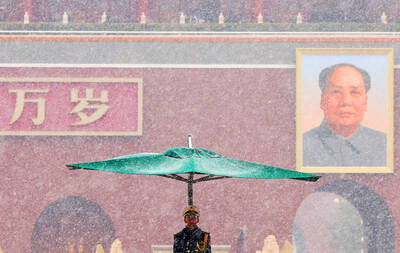
Chinese dissident artist Gao Zhen (高兟), famous for making provocative satirical sculptures of former Chinese leader Mao Zedong (毛澤東), was tried on Monday over accusations of “defaming national heroes and martyrs,” his wife and a rights group said. Gao, 69, who was detained in 2024 during a visit from the US, faces a maximum three-year prison sentence, said his wife, Zhao Yaliang (趙雅良), and Shane Yi, a researcher at the Chinese Human Rights Defenders group which operates outside the nation. The closed-door, one-day trial took place at Sanhe City People’s Court in Hebei Province neighboring the capital, Beijing, and ended without a


 RSS
RSS