


Palestinian children are collecting cards showing gunmen and soldiers the way kids in the US trade baseball cards, and some educators are concerned that the hobby is helping to breed a new generation of militants.
The cards are an enormous hit, according to Majdi Taher, who makes them. He said that 6 million cards have been sold over two years and 32,000 albums this month alone in the two main population centers of the northern West Bank -- huge numbers for a territory in which about 1 million Palestinians live -- and he plans to expand his business.
The card craze reflects reality in the West Bank, where three years of Palestinian-Israeli violence has become the dominant reality for children. Israeli soldiers enforce curfews, confining residents to their homes, and often carry out raids in towns and villages looking for militants.
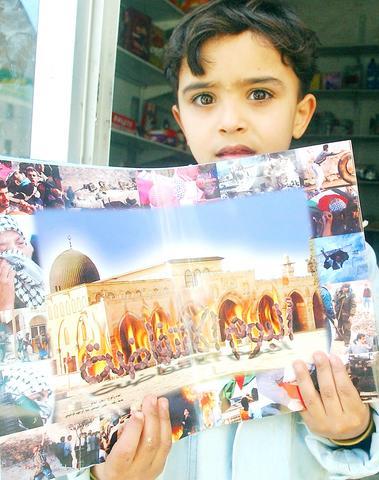
PHOTO: AP
Sometimes children throw rocks at Israeli soldiers or are caught up in exchanges of gunfire. At least 319 Palestinian children under the age of 18 have been killed in the conflict.
In the West Bank, Palestinian militants carry their weapons openly on the streets and gain the adulation of the young. More than 100 Palestinian suicide bombers have carried out attacks against Israelis, becoming folk heroes in their home towns.
The collectible cards depict real-life Middle East action figures familiar to the children: An Israeli soldier shooting a large gun, a soldier forcing Palestinians off their land, a small Palestinian child dressed in militant's clothing holding a toy gun and Palestinian boys throwing stones.
The albums are sold in cardboard boxes shaped like Israeli tanks and include a dedication from Nablus governor Mahmoud Alul.
A child who fills an album with all 129 pictures can win a computer, a bicycle, a watch or a hat.
Some teachers and parents are concerned about the new fad, trying to forbid their children from buying the pictures, saying they are teaching children violence and forcing them to grow up too quickly.
"I take hundreds of these pictures from children every day and burn them," said Saher Hindi, 28, a teacher at a Nablus elementary school. "They turn children into extremists," she said.
The desire to fill the albums has captivated children in Nablus and Ramallah, teachers say, keeping them from their homework as they spend all their money on the cards.
It's a business success for Taher, who said he plans to expand the sale of the cards and albums to other West Bank towns.
The former candy salesman said he means for the album and pictures to be a history lesson.
Children who are now seven cannot remember incidents from the start of the fighting three years ago, he said.

It began as a satirical online project. Now millions of young people in India are flocking to it as an outlet for their frustration. A parody political party called the Cockroach Janta Party, with the insect as its symbol, has exploded across India’s social media by turning absurdist humor into protest. Memes and short videos mocking corruption, joblessness and political dysfunction have flooded social media sites, where millions of users are embracing the cockroach — known for its ability to survive harsh conditions — as a tongue-in-cheek symbol of endurance. The online movement’s rise has been unusually rapid. The Cockroach Janta Party (CJP)

SPEAKING OUT: After Siranudh Scott’s allegations surfaced, celebrities and public figures took to social media to share their own experiences of sexual misconduct and abuse A high-profile alleged sexual abuse case within a wealthy Thai beer brewing family has prompted a wave of painful accounts from survivors of unconnected abuse in the conservative nation. Siranudh Scott, a member of the billionaire Thai family that founded the ubiquitous Singha beer brand, posted an emotional video this month accusing his elder brother Sunit of repeatedly abusing him when he was a teenager. Sunit, who is in his 30s, later denied the allegations in a video posted online, but Singha parent Boonrawd dismissed him from his executive role with the company on Tuesday last week. “I felt I needed to speak

A Hong Kong astronaut is to join a Chinese space mission for the first time as part of a three-person crew launching today, as Beijing edges closer to its goal of landing people on the moon. The Tiangong space station — crewed by teams of three astronauts that are typically rotated every six months — is the crown jewel of China’s space program, boosted by billions in state investment in a bid to catch up with the US and Russia. The Shenzhou-23 mission is to blast off at 11:08pm from the Jiuquan Satellite Launch Center in northwestern China, carrying three astronauts to
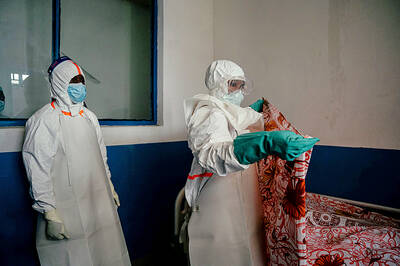
UPGRADED ALERT: The risk inside DR Congo is now considered ‘very high,’ while neighboring countries face a ‘high’ threat as the outbreak continues, the WHO said Ebola is spreading faster than responders can track it in eastern Congo, where health workers managed to follow up with barely one in five identified contacts in a single day. Authorities in the Democratic Republic of the Congo (DR Congo) reported 83 confirmed infections, 746 suspected cases and 1,603 identified contacts as of Thursday, but health workers were able to follow up on only 342 contacts that day — about 21 percent of the total under monitoring — data released by the DR Congo Ministry of Public Health on Friday showed. The figures suggest the response is falling behind the outbreak itself,


 RSS
RSS