


Central America's massive crackdown on the street gangs has drawn a bloody response: some gangs are dismembering young women to send police a message of defiance. Others are fleeing to Mexico and neighboring countries, bringing their violence with them.
Honduran President Ricardo Maduro, who was elected in 2001 on a "zero tolerance" anti-crime platform, estimates that more than 2,000 gang members have fled since August, when his government outlawed street gangs and started rounding up their members. El Salvador followed suit in October.
The wave of escaping gang members has wreaked havoc in Mexico. On Tuesday, armed with guns and machetes, gang members killed two women and wounded five other illegal migrants riding a train in southern Mexico. Seventy people have died in such attacks so far this year, Mexican officials say.
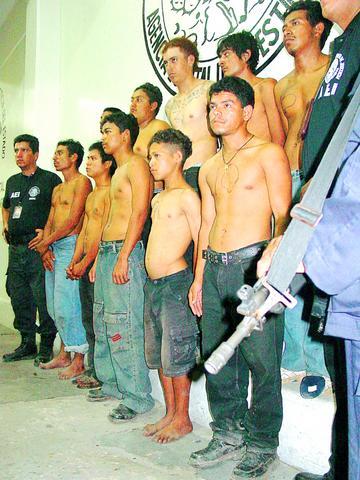
PHOTO: AP
The violence has also reached as far north as the US border. Gang members in border towns like Nuevo Laredo rob and kill fellow Central American migrants, recruit Mexican youths and may be allying themselves with Mexican drug traffickers.
Mexican police have rounded up gang members in Nuevo Laredo -- south of Laredo, Texas -- and along the Guatemalan border, deporting hundreds.
Central American gangs are known as "maras," a name derived from a species of aggressive swarming ants. Their members are easily spotted because their heads, necks and arms are often covered with elaborate tattoos bearing symbols of the three main gangs -- "MS," "13," "18" and dice, death's heads or daggers.
"A lot of us have come here because of the problems with the government," said Lorenzo Maldonado, 18, a member of "MS-13," at a Nuevo Laredo jail where he was being held pending deportation back to his native Tegucigalpa, Honduras.
Maldonado said that when he was caught, he was heading to San Diego "to work, not commit crimes, and send money back to my family and my homies in Honduras."
Maduro, whose son was kidnapped in 1997 and murdered by a gang of local thugs, has proposed implementing laws across Central America to stop gang members from taking refuge in neighboring countries. That could mean an even greater exodus to Mexico.
In a terrible irony, many Hondurans and others trying to escape violence in their native country have fallen victim to it in Mexico as gangs target fellow Central American migrants on their way to look for work in the US.
"I left Honduras because I didn't want any problems with the maras, because you can't even go out on the street there," said Jose Marciago Molina, 20, who was shot in the back by gang members he identified as fellow Hondurans.
Molina had crossed into Mexico illegally earlier this year and was heading for the US when he was robbed.
``I started to run, and they shot me in the back. They took everything I had, even my shoes," said Molina, who walks on crutches because the bullet is lodged near his spine.
Consular officials in Tapachula, on Mexico's southern border, described one mass assault on migrants in November by as many as 20 gang members who hacked migrants with machetes and tossed some from moving trains. At least one died and three were critically injured.
It is hard to estimate how many migrants have been killed by the Central American gang members in Mexico.
"There are hundreds who are pushed off trains by the maras if they resist the robberies," said Asdrubal Aguilar Zepeda, the Salvadoran consul in Tapachula, near the Guatemalan border.
Some of the largest and most powerful Central American gangs, like the Mara Salvatrucha, were formed in Los Angeles in the 1980s and incubated in El Salvador and Honduras after gang members were deported back to those countries.
An estimated quarter-million gang members are in Central America, and they are growing more brutal. In El Salvador in early July, suspected gang members left the decapitated heads of two young women near a police station. That same week, several body parts were found in neighboring Guatemala.
Central American authorities have reacted with tough anti-gang policies with names like "Heavy Hand" and "Operation Broom."
Many maras fled, and Mexican and Guatemalan authorities estimate 3,000 gang members operate along their border.
"The Salvatruchas are creating a serious problem for us," Mexican Attorney General Rafael Macedo de la Concha said.
The gangs have been implicated in a violent reform school uprising in Chiapas. In Tapachula, authorities believe they have recruited 700 Mexican youths.
"This is becoming a town ruled by the law of the maras," said Jose Juan Perez a city councilman in Ciudad Hidalgo, another Mexican city on the Guatemalan border.
Last year, police in Chiapas state arrested 15 Mara Salvatrucha members on suspicion of raping and murdering two Mexican girls, then throwing their bodies down a well.
In their native Honduras, the maras have begun using a grisly new form of protest against the government crackdown.
In October in northern Honduras, a note scrawled with "Mara 18 doesn't want to talk to Maduro any more" was found in a park alongside the decapitated head of a young girl.
On Nov. 7, five suspected gang members burst into a dance club in the Honduran coastal city of San Pedro Sula and shot to death two female dancers. They wrote "Maduro, we don't want to talk to you" on the walls of the club before fleeing.
A few days later, suspected members of the Mara 18 strangled a girl, cut her body into eight pieces, stuffed them into trash bags and left them in a vacant lot with an obscene message directed toward Maduro.

Chinese President Xi Jinping (習近平) is to visit Russia next month for a summit of the BRICS bloc of developing economies, Chinese Minister of Foreign Affairs Wang Yi (王毅) said on Thursday, a move that comes as Moscow and Beijing seek to counter the West’s global influence. Xi’s visit to Russia would be his second since the Kremlin sent troops into Ukraine in February 2022. China claims to take a neutral position in the conflict, but it has backed the Kremlin’s contentions that Russia’s action was provoked by the West, and it continues to supply key components needed by Moscow for

Japan scrambled fighter jets after Russian aircraft flew around the archipelago for the first time in five years, Tokyo said yesterday. From Thursday morning to afternoon, the Russian Tu-142 aircraft flew from the sea between Japan and South Korea toward the southern Okinawa region, the Japanese Ministry of Defense said in a statement. They then traveled north over the Pacific Ocean and finished their journey off the northern island of Hokkaido, it added. The planes did not enter Japanese airspace, but flew over an area subject to a territorial dispute between Japan and Russia, a ministry official said. “In response, we mobilized Air Self-Defense

CRITICISM: ‘One has to choose the lesser of two evils,’ Pope Francis said, as he criticized Trump’s anti-immigrant policies and Harris’ pro-choice position Pope Francis on Friday accused both former US president Donald Trump and US Vice President Kamala Harris of being “against life” as he returned to Rome from a 12-day tour of the Asia-Pacific region. The 87-year-old pontiff’s comments on the US presidential hopefuls came as he defied health concerns to connect with believers from the jungle of Papua New Guinea to the skyscrapers of Singapore. It was Francis’ longest trip in duration and distance since becoming head of the world’s nearly 1.4 billion Roman Catholics more than 11 years ago. Despite the marathon visit, he held a long and spirited

China would train thousands of foreign law enforcement officers to see the world order “develop in a more fair, reasonable and efficient direction,” its minister for public security has said. “We will [also] send police consultants to countries in need to conduct training to help them quickly and effectively improve their law enforcement capabilities,” Chinese Minister of Public Security Wang Xiaohong (王小洪) told an annual global security forum. Wang made the announcement in the eastern city of Lianyungang on Monday in front of law enforcement representatives from 122 countries, regions and international organizations such as Interpol. The forum is part of ongoing


 RSS
RSS