


Israeli and Palestinian peace negotiators prepared to launch their unofficial initiative to end one of the world's most intractable conflicts in the presence of former US president Jimmy Carter and other winners of the Nobel peace prize.
But the tightly guarded guest list, strong opposition from Prime Minister Ariel Sharon and last-minute dissension Sunday within Palestinian ranks underscored the problems facing the plan that resulted from two years of secret negotiations.
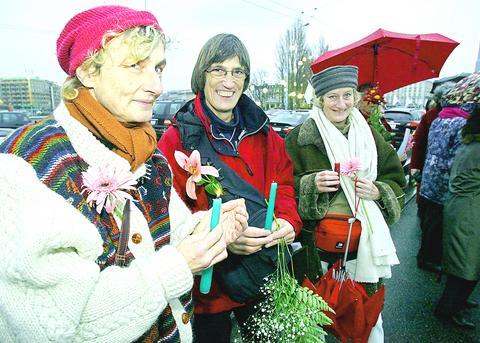
PHOTO: AFP
"For the first time in more than a hundred years of conflict a detailed and comprehensive solution was agreed upon which settles the most critical issues of this conflict," the negotiators said in a statement.
The unofficial treaty proposes borders between Israel and a future Palestinian state close to Israel's borders before the 1967 Mideast war, giving the Palestinians almost all of the West Bank and Gaza Strip and part of Jerusalem.
It calls for the removal of most Israeli settlements there and largely sidesteps the so-called "right of return" for Palestinians who fled or were driven out during the 1948-49 war that followed Israel's creation and their descendants. It also divides sovereignty in Jerusalem.
The negotiators claim their work is in line with the US "road map" for peace and other plans. The US-backed "road map" spells out a formula for negotiations but leaves the trickiest issues open.
The Geneva plan has been welcomed by US Secretary of State Colin Powell, UN Secretary-General Kofi Annan and European leaders.
Contacts began two years ago in an academic discussion at the University of Geneva between former Israeli Justice Minister Yossi Beilin and Professor Alexis Keller. They enlisted then-Palestinian Information Minister Yasser Abed Rabbo and began talks, with financial support provided by the Swiss government.
Both Beilin and Abed Rabbo had participated in earlier peace talks, when moderate Ehud Barak was Israel's prime minister. The talks broke down amid violence in early 2001, and Barak was soundly defeated by Sharon in a special election.
Sharon has charged that the plan is subversive, insisting that only governments may conduct such negotiations. The hard-line government opposes the far-reaching Israeli concessions that are key parts of the Geneva Accord.
The Israeli Foreign Ministry protested Switzerland's backing of the plan, but the Swiss government maintains it only "facilitated" the discussions and had nothing to do with the content.
The agreement was first presented Oct. 12 in Amman, Jordan. Since then the negotiators have distributed copies of the 50-page accord by mail to every Israeli home and published it in Palestinian newspapers in hopes of winning popular support.
Organizers kept tight wraps on details of the two-hour ceremony, that was to take place yesterday afternoon in Geneva, including the guest list.
But Carter, who has endorsed the accord, plans to attend, according to the Carter Center in Atlanta.
The accord "paves the way to the region's best, and perhaps last, chance for peace," said Carter in an op-ed piece published Nov. 3 in USA Today.
Officials in Geneva also said former South African president Nelson Mandela is expected to deliver a speech by video. Others in attendance would be Nobel laureates Lech Walesa of Poland and John Hume of Northern Ireland as well as Simone Veil, an ex-president of the European Parliament and a Holocaust survivor.
Senior Palestinian officials wavered Sunday before agreeing at the last minute to attend the ceremony, heightening Israeli fears about the Palestinians' ability to commit to even a nonbinding peace agreement.
"Any Palestinian distancing from the agreement cancels its very basis, because what it is selling is a Palestinian partner," said Channel Two TV diplomatic reporter Rina Mazliah. "What almost happened today strengthens the Israeli opponents of the accord."
Two Palestinian Cabinet ministers and two influential legislators who helped negotiate the plan refused to go when they were threatened by militants. They changed their minds after they said Palestinian leader Yasser Arafat backed their participation, overriding criticism from Fatah hard-liners. Publicly, Arafat has given the accord only vague support.
The Al Aqsa Martyrs' Brigades linked to Fatah called them "collaborators," a loaded term that often marks Palestinians for death. Masked gunmen also shot at the home of Abed Rabbo, who already was in Geneva.

Chinese President Xi Jinping (習近平) is to visit Russia next month for a summit of the BRICS bloc of developing economies, Chinese Minister of Foreign Affairs Wang Yi (王毅) said on Thursday, a move that comes as Moscow and Beijing seek to counter the West’s global influence. Xi’s visit to Russia would be his second since the Kremlin sent troops into Ukraine in February 2022. China claims to take a neutral position in the conflict, but it has backed the Kremlin’s contentions that Russia’s action was provoked by the West, and it continues to supply key components needed by Moscow for

Japan scrambled fighter jets after Russian aircraft flew around the archipelago for the first time in five years, Tokyo said yesterday. From Thursday morning to afternoon, the Russian Tu-142 aircraft flew from the sea between Japan and South Korea toward the southern Okinawa region, the Japanese Ministry of Defense said in a statement. They then traveled north over the Pacific Ocean and finished their journey off the northern island of Hokkaido, it added. The planes did not enter Japanese airspace, but flew over an area subject to a territorial dispute between Japan and Russia, a ministry official said. “In response, we mobilized Air Self-Defense

CRITICISM: ‘One has to choose the lesser of two evils,’ Pope Francis said, as he criticized Trump’s anti-immigrant policies and Harris’ pro-choice position Pope Francis on Friday accused both former US president Donald Trump and US Vice President Kamala Harris of being “against life” as he returned to Rome from a 12-day tour of the Asia-Pacific region. The 87-year-old pontiff’s comments on the US presidential hopefuls came as he defied health concerns to connect with believers from the jungle of Papua New Guinea to the skyscrapers of Singapore. It was Francis’ longest trip in duration and distance since becoming head of the world’s nearly 1.4 billion Roman Catholics more than 11 years ago. Despite the marathon visit, he held a long and spirited

The pitch is a classic: A young celebrity with no climbing experience spends a year in hard training and scales Mount Everest, succeeding against some — if not all — odds. French YouTuber Ines Benazzouz, known as Inoxtag, brought the story to life with a two-hour-plus documentary about his year preparing for the ultimate challenge. The film, titled Kaizen, proved a smash hit on its release last weekend. Young fans queued around the block to get into a preview screening in Paris, with Inoxtag’s management on Monday saying the film had smashed the box office record for a special cinema


 RSS
RSS