


Emergency officials ordered an additional 20,000 people to evacuate their homes in Kelowna, British Columbia, on Friday as a wildfire moved closer to the prosperous vacation city.
The additional evacuation meant that 30,000 people, or nearly one-third of Kelowna's population, had been ordered from their homes, said Bruce Smith, a local emergency operations official.
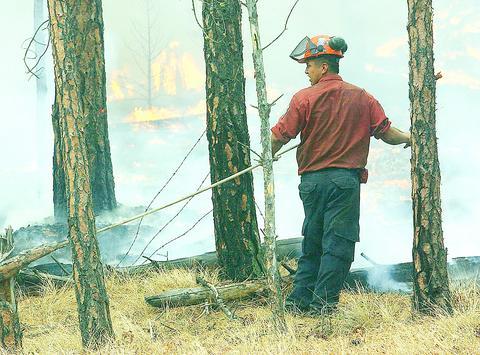
PHOTO: AP
Massive flames could be seen near the western Canadian city, as the 17,000-hectare fire raged, casting an eerie orange glow into the sky.
"I've lived here all my life, and I can't believe this," said Debbie Curylo, 44, who was watching the fires from a distance, saying they had spread to an area where her two sisters live.
"It's all up to God now."
Winds picked up late in the day, pushing the fire past containment lines that crews had struggled to build for several days. A similar situation happened on Thursday evening, prompting the first evacuations.
A thick pall of smoke had hung over the city of 96,000 throughout Friday, shrouding the mountains. Blackened pine needles and bits of ash floated down like gray snow flurries.
No deaths or injuries were reported, but 15 homes were damaged or destroyed by the flames. Witnesses told local media that they had seen additional homes being destroyed by the flames.
Many of those who fled were told they had only minutes to leave by police who went from door to door as danger mounted.
The fire outside Kelowna, in the Okanagan region about 300km east of Vancouver, began on Aug. 16 with a lightning strike in the mountains.
The region is home to Western Canada's wine industry, and the fire has forced the closure of at least one winery.
Even before the evacuations in Kelowna, as many as 2,000 people in the southern interior of Canada's westernmost province were forced from their homes by several large forest fires.
The mountainous area has had scant rainfall this summer, creating one of the most devastating fire seasons in decades.
After viewing the blaze by air, British Columbia Premier Gordon Campbell said it "seemed endless."
Since April 1, more than 1,600 sq2 of forest have burned in British Columbia, which has declared a state of emergency. More than 800 fires were burning across the province.
Residents have been warned to stay out of forests and off wilderness roads and campsites in the southern half of the province, which is Canada's third largest and roughly the size of France and Germany combined.
Dry conditions have forced most southern timber companies to withdraw logging crews, and workers will not be able to return until there is significant rain -- a factor that has driven lumber prices up on the Chicago Mercantile Exchange.

An American scientist convicted of lying to US authorities about payments from China while he was at Harvard University has rebuilt his research lab in Shenzhen, China, to pursue technology the Chinese government has identified as a national priority: embedding electronics into the human brain. Charles Lieber, 67, is among the world’s leading researchers in brain-computer interfaces. The technology has shown promise in treating conditions such as amyotrophic lateral sclerosis and restoring movement in paralyzed people. It also has potential military applications: Scientists at the Chinese People’s Liberation Army have investigated brain interfaces as a way to engineer super soldiers by boosting

Indonesian police have arrested 13 people after shocking images of alleged abuse against small children at a daycare center went viral, sparking outrage across the nation, officials said on Monday. Police on Friday last week raided Little Aresha, a daycare center in Yogyakarta on Java island, following a report from a former employee. CCTV footage circulating on social media showed children, most younger than two, lying on the floor wearing only diapers, their hands and feet bound with rags. The police have confirmed that the footage is authentic. Police said they also found 20 children crammed into a room just 3m by 3m. “So

About 240 Indians claiming descent from a Biblical tribe landed at Tel Aviv airport on Thursday as part of a government operation to relocate them to Israel. The newcomers passed under a balloon arch in blue and white, the colors of the Israeli flag, as dozens of well-wishers welcomed them with a traditional Jewish song. They were the first “bnei Menashe” (“sons of Manasseh”) to arrive in Israel since the government in November last year announced funding for the immigration of about 6,000 members of the community from the states of Manipur and Mizoram in northeast India. The community claims to descend from
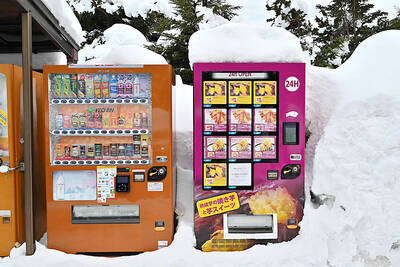
From post offices and parks to stations and even the summit of Mount Fuji, Japan’s vending machines are ubiquitous, but with the rapid pace of inflation cooling demand for their drinks, operators are being forced to rethink the business. Last month beverage giant DyDo Group Holdings announced it would remove about 20,000 vending machines — about 7 percent of their stock nationwide — by January next year, to “reconstruct a profitable network.” Pokka Sapporo Food & Beverage, based in Nagoya, also said last month it would sell its 40,000-machine operation to Osaka-based Lifedrink Co. “The strength of the vending machine


 RSS
RSS