


Japan should bolster its defense against possible nuclear and terrorist attacks through better anti-ballistic missile systems and closer cooperation with the US military, the government said yesterday in its annual defense report.
For a second straight year, terrorism dominated the Defense Agency's annual white paper, but the 393-page study also urged the military to raise its international profile and warned against the threat of North Korea's nuclear weapons and missile programs.
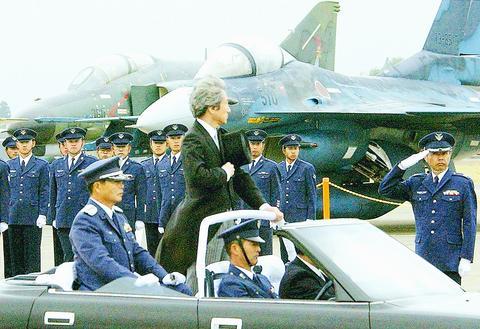
PHOTO: AP
It suggested beefed-up participation in UN peacekeeping missions, counter-terrorism activities, the policing of maritime traffic and the curbing of weapons of mass destruction, while calling for closer ties with the US, particularly in tackling terrorism, narcotics trafficking and cyberattacks.
It also cited North Korea's nuclear and missile programs as one of Japan's biggest security concerns, and recommended speeding up research on missile defense.
Japan currently has 27 Patriot anti-missile batteries. But they can only down missiles with a shorter range and slower speed than the ballistic missiles North Korea is believed to be developing -- including the Taepodong missile test-launched over Japan's main island, Honshu, in 1998.
Between fiscal 1999 and 2002, Japan spent about ?13.7 billion (US$114 million) on missile defense research. It budgeted an additional ?1.9 billion (US$15.8 million) -- or about 0.3 percent of this year's spending -- to test newer systems, the report said.
Aside from upgrading the system, Tokyo should continue relying on the 50,000 US troops stationed here under the half-century-old bilateral security pact, yesterday's report said.
It also recommended creating elite commando units versed in counterterrorism, urban and guerrilla warfare and defenses against biological and chemical weaponry.
Japan's Defense Agency also raised concerns about China's sharply expanding military budget. This year, China's military spending rose by 9.6 percent -- the first time in only 15 years that it hadn't grown by more than 10 percent -- the report said.
Japan's overall defense budget remains among the world's largest.
For this year, Japan expects to spend ?4.95 trillion (US$41 billion) on defense, down 0.1 percent from last year and less than 1 percent of its GDP.
One of the major challenges for Japanese troops will be responding to new threats and disasters, even as they face cutbacks.
Masatoshi Shimbo, the agency's defense counselor and deputy director-general for international relations, said a five-year plan through 2007 calls for a downsizing in troops from 180,000 to around 145,000, as part of a post-Cold War reshuffle.
Last month, Japan's Parliament passed legislation authorizing the government to send troops to overseas trouble spots to offer medical assistance, repatriate refugees, reconstruct buildings and roads and give administrative advice. Months earlier, lawmakers also approved legislation that defines the military's role in case of foreign attacks on Japan.
The passage of the bills was a victory for Prime Minister Junichiro Koizumi, who has campaigned hard to send peacekeeping troops overseas to broaden Japan's role in international affairs.
In November 2001, Tokyo began its missions to the Indian Ocean and Arabian Sea to provide rearguard support for the US-led war on terrorism in Afghanistan.
Japan is now reportedly considering up to 1,000 combat engineers and other troops for transport and construction duties in Iraq.
Critics say the government's backing of a more active Japanese military signals a shift toward remilitarization and violates the country's post-World War II pacifist constitution. Japan's constitution limits its military -- called the Self Defense Forces -- to non-combat roles following decades of imperialistic aggression.
Separately, Chief Cabinet Secretary Yasuo Fukuda said yesterday the Self-Defense Forces will join Russian military exercises in the Russian Far East in late August, including plans for naval search-and-rescue drills.
Fukuda said Japan's participation is part of the action plan the two countries signed in January which underscores the need for increased cooperation.

Chinese President Xi Jinping (習近平) is to visit Russia next month for a summit of the BRICS bloc of developing economies, Chinese Minister of Foreign Affairs Wang Yi (王毅) said on Thursday, a move that comes as Moscow and Beijing seek to counter the West’s global influence. Xi’s visit to Russia would be his second since the Kremlin sent troops into Ukraine in February 2022. China claims to take a neutral position in the conflict, but it has backed the Kremlin’s contentions that Russia’s action was provoked by the West, and it continues to supply key components needed by Moscow for

Japan scrambled fighter jets after Russian aircraft flew around the archipelago for the first time in five years, Tokyo said yesterday. From Thursday morning to afternoon, the Russian Tu-142 aircraft flew from the sea between Japan and South Korea toward the southern Okinawa region, the Japanese Ministry of Defense said in a statement. They then traveled north over the Pacific Ocean and finished their journey off the northern island of Hokkaido, it added. The planes did not enter Japanese airspace, but flew over an area subject to a territorial dispute between Japan and Russia, a ministry official said. “In response, we mobilized Air Self-Defense

CRITICISM: ‘One has to choose the lesser of two evils,’ Pope Francis said, as he criticized Trump’s anti-immigrant policies and Harris’ pro-choice position Pope Francis on Friday accused both former US president Donald Trump and US Vice President Kamala Harris of being “against life” as he returned to Rome from a 12-day tour of the Asia-Pacific region. The 87-year-old pontiff’s comments on the US presidential hopefuls came as he defied health concerns to connect with believers from the jungle of Papua New Guinea to the skyscrapers of Singapore. It was Francis’ longest trip in duration and distance since becoming head of the world’s nearly 1.4 billion Roman Catholics more than 11 years ago. Despite the marathon visit, he held a long and spirited

The pitch is a classic: A young celebrity with no climbing experience spends a year in hard training and scales Mount Everest, succeeding against some — if not all — odds. French YouTuber Ines Benazzouz, known as Inoxtag, brought the story to life with a two-hour-plus documentary about his year preparing for the ultimate challenge. The film, titled Kaizen, proved a smash hit on its release last weekend. Young fans queued around the block to get into a preview screening in Paris, with Inoxtag’s management on Monday saying the film had smashed the box office record for a special cinema


 RSS
RSS