


Mahdi Saleh has been looking over his shoulder for weeks, ever since his name began popping up in red graffiti threatening death for the tens of thousands of informants former Iraqi leader Saddam Hussein and his Baath party relied on to enforce a maniacal control over Iraq's population.
"With the blessing of God, we will start the campaign to execute the Baathist monkeys," reads the Arabic scrawled on a wall in Baghdad's Aden Square. A short distance away, the warning continues with a list of several names, including Saleh's.
"These are the criminal traitors," it says.
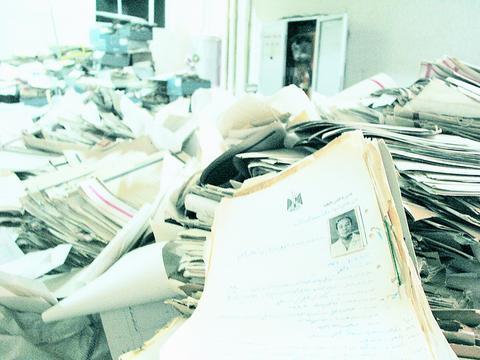
PHOTO: AP
Tens of thousands of people like Saleh have gone into hiding or are watching their backs since the fall of the regime in April. Hundreds have been killed by vigilantes taking revenge.
At Saleh's pharmacy, his wife, Nisreen, sits behind the counter waiting for customers in the afternoon heat. She insists he never informed for Saddam's regime and says she doesn't know who wrote the graffiti or who would want to hurt her husband.
"My husband is a good man and everybody loves him," says Nisreen, who is five months pregnant with the couple's fifth child. "People see that we are well off and we do not need the help of others, so they envy us and try to write these things because there is no government."
Saleh, a former mid-level Baathist official in Baghdad, has not gone into hiding, but he is rarely seen in the streets. Residents of his community say he was an informant.
In the days after the fall of Baghdad, looters gutted Saddam's Mukhabarat secret intelligence service, as well as the local Baath party offices where many informants' names were kept. Piles of intelligence files on those jailed, tortured and executed by Saddam have been returned to victims or their survivors. Many include the names of friends, colleagues, teachers -- even relatives -- that spied for the regime.
The question of how to punish such a large portion of the populace is a difficult one. Some informed to get ahead, some for the money and others because it was the only way to survive. Some have suggested a truth and reconciliation commission could help Iraq get over its bloody past. Certainly, there are not enough jails to punish everyone.
At the Committee of Free Prisoners, an independent group representing Iraqis arrested under Saddam's regime, workers are sifting through 8 million secret government files found in the basement of a shopping center shortly after Baghdad fell.
The group's director general, Abul-Fattah al-Edreesy, says the committee is making a list of informants' names but will not release them for fear of a bloodbath.
"Our goal is to rebuild Iraq, not tear it down," said al-Edreesy, who was jailed and tortured in 1986, when he was just 16. "We don't want to act like animals. We will turn the names over to an elected Iraqi government."
The aging documents, many detailing interrogations and executions, are piled chest high in room after room of the committee's offices. Each tells a story of betrayal and brutality. In one, a man informs on his brother, who is later executed. In another, 49 Shiite Muslims accused of membership in a banned group are put to death on the word of a single, unnamed informant.
The UN is investigating the alleged killings of at least 300,000 Iraqis during Saddam's 23-year reign. It will never be known exactly how many people informed on their countrymen, but Iraqis say they felt the regime had eyes everywhere.
"They made us suspicious of everyone around us," said al-Edreesy. "They made us think that if there were 24 million Iraqis, then there were 24 million informants."
Those accused of collaboration are now running scared.
"I am afraid for my life and for the lives of my children," said Colonel Raad al-Delemy, a former member of the criminal investigation police, who was shot four times while walking home in early June. Three officers from his unit have been killed.
Al-Delemy's unit was one of the few not immediately called back into service because of its alleged ties to the regime, though he insists he never informed on anyone or dealt with political prisoners. His family is hiding outside the capital, and he briefly emerged to get his back pay.
"Yes, we were linked with the regime, but we were low-level. The national intelligence services were much more important than us," he said.
Until a government is in place and institutions exist to deal with suspected informants, victims and their survivors face their own moral test. Many urge taking matters into their own hands.
On July 3, a weekly Shiite newspaper, Al-Ressala, published a fatwa, or religious edict, calling for informants and others who cooperated with the regime to be killed, have their limbs chopped off or be exiled.
"Shame in life and torture in the afterlife" for the collaborators, read the fatwa by Kadhim al-Haeri, an Iraqi Shiite cleric who lives in Iran.
Victims say many groups are willing to help them take revenge.
"Many organizations have made contact with us and asked us for the names of the informants so they can execute them," said Qasim Mejali Hashim, whose brothers Sabah and Bassem were hanged in 1997 after five childhood friends secretly taped them making anti-Saddam statements.
Hashim, surrounded by his dead brothers' wives and children, says he knows where the informants are, but refuses to reveal their names.
"I could kill them now, but I want them tried and found guilty in front of everyone," he said. "I want the entire community to see what they did. Then they can be executed."

Chinese President Xi Jinping (習近平) is to visit Russia next month for a summit of the BRICS bloc of developing economies, Chinese Minister of Foreign Affairs Wang Yi (王毅) said on Thursday, a move that comes as Moscow and Beijing seek to counter the West’s global influence. Xi’s visit to Russia would be his second since the Kremlin sent troops into Ukraine in February 2022. China claims to take a neutral position in the conflict, but it has backed the Kremlin’s contentions that Russia’s action was provoked by the West, and it continues to supply key components needed by Moscow for

Japan scrambled fighter jets after Russian aircraft flew around the archipelago for the first time in five years, Tokyo said yesterday. From Thursday morning to afternoon, the Russian Tu-142 aircraft flew from the sea between Japan and South Korea toward the southern Okinawa region, the Japanese Ministry of Defense said in a statement. They then traveled north over the Pacific Ocean and finished their journey off the northern island of Hokkaido, it added. The planes did not enter Japanese airspace, but flew over an area subject to a territorial dispute between Japan and Russia, a ministry official said. “In response, we mobilized Air Self-Defense

CRITICISM: ‘One has to choose the lesser of two evils,’ Pope Francis said, as he criticized Trump’s anti-immigrant policies and Harris’ pro-choice position Pope Francis on Friday accused both former US president Donald Trump and US Vice President Kamala Harris of being “against life” as he returned to Rome from a 12-day tour of the Asia-Pacific region. The 87-year-old pontiff’s comments on the US presidential hopefuls came as he defied health concerns to connect with believers from the jungle of Papua New Guinea to the skyscrapers of Singapore. It was Francis’ longest trip in duration and distance since becoming head of the world’s nearly 1.4 billion Roman Catholics more than 11 years ago. Despite the marathon visit, he held a long and spirited

China would train thousands of foreign law enforcement officers to see the world order “develop in a more fair, reasonable and efficient direction,” its minister for public security has said. “We will [also] send police consultants to countries in need to conduct training to help them quickly and effectively improve their law enforcement capabilities,” Chinese Minister of Public Security Wang Xiaohong (王小洪) told an annual global security forum. Wang made the announcement in the eastern city of Lianyungang on Monday in front of law enforcement representatives from 122 countries, regions and international organizations such as Interpol. The forum is part of ongoing


 RSS
RSS