


orld Bank projects costing hundreds of millions of US dollars and aimed at cutting malnutrition among children in developing countries have completely failed to make any difference, according to a report published yesterday.
The charity Save the Children UK claims that the bank has not only continued with costly but failing projects in Bangladesh and Uganda but it is planning to expand, with a scheme billed for Ethiopia. It claims the money could be better spent.
The World Bank both designs the program and lends beneficiaries the money to carry them out, which increases their debt.
Fiona Weir, the charity's policy and communication director, said, "It is a matter of deep concern that the World Bank has recently loaned Bangladesh a further US$124.6 million and a projected 10-year investment loan plan of US$1 billion dollars is under discussion.
"These projects threaten to plunge developing countries into further debt without making any substantial impact on malnutrition rates."
John Seaman, a health adviser at Save the Children, claims that the programs are based on a "widely discredited" approach, which assumes "that the child is malnourished because the mother isn't doing something right, because she doesn't know how to feed or lacks the food to support the child."
In areas where the programs operate, children are registered at birth at a center. Their mothers then bring them in each month to be weighed. If the children appear severely malnourished, they become eligible for feeding. The mother then has to bring them to the center every day and is shown how and what to feed her child while the infant gets a meal.
"It's a considerable time investment for the mother," said Anna Taylor, author of the charity report, Thin on the Ground. "The child could be receiving food for three to six months and she is supposed to go every day and receive messages about how she is supposed to be caring for her child and sitting around waiting for the meal."
The charity's research showed that only 20 percent of the children eligible for extra feeding were receiving it, concluding that the World Bank has not taken account of the pressures on the mothers to work and take care of their homes.
"Our evidence suggests that too many mothers are too poor to act on their newly acquired knowledge about nutrition: they live in unhealthy, unsanitary environments lacking adequate and safe water," the report says. "They have little or no access to health services; they are often illiterate and they have inadequate time for childcare."
The sum of money involved are large. One project in Bangladesh which ran from 1995-2002 had a US$67 million budget. It has been replaced by a second scheme with a budget of US$124 million. It could continue for ten years, spending up to US$1 billion. The Uganda project -- from 1998 to this year -- is worth US$40 million but there are further plans to expand provision.
Taylor says that malnutrition has been improved overall in Bangladesh by the slightly better economic position of the country as a whole. In six years, the World Bank program made no contribution, the charity's analysis of the data shows.
Save the Children says that the money would be better spent on improving healthcare system so that children get basic immunization, or on getting more children into school or improving sanitation and clean water supplies.
Milla McLachlan, the bank's nutrition adviser, rejected the criticism, although she said it was valuable to have "constructive dialogue around our work." New data from the Bangladesh project, not yet made public, would show that the project has an impact, she said.
"It is quite clear that the project has had very positive outcomes regarding behavior."
There had been a 35 percent rise in the number of women undergoing antenatal check-ups, a doubling of those taking iron and folate supplements and a reduction in severe stunting.
McLachlan said that the bank did not operate nutrition programs in isolation: it would also be funding projects to improve sanitation, water, health and hygiene.
The education and behavior change projects were in addition to other efforts, she said.
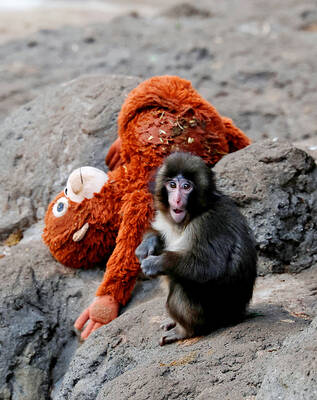
THE TRAGEDY OF PUNCH: Footage of the seven-month-old Japanese macaque has gone viral online after he was rejected by his mother and formed a bond with a soft toy A baby monkey in Japan has captured hearts around the world after videos of him being bullied by other monkeys and rejected by his mother went viral last week. Punch, a Japanese macaque, was born in July last year at Ichikawa City Zoo. He has drawn international attention after zookeepers gave him a stuffed orangutan toy after he was abandoned by his mother. Without maternal guidance to help him integrate, Punch has turned to the toy for comfort. He has been filmed multiple times being dragged and chased by older Japanese macaques inside the enclosure. Early clips showed him wandering alone with
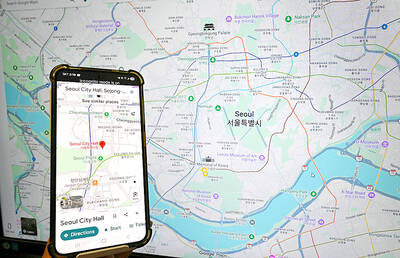
South Korea would soon no longer be one of the few countries where Google Maps does not work properly, after its security-conscious government reversed a two-decade stance to approve the export of high-precision map data to overseas servers. The approval was made “on the condition that strict security requirements are met,” the South Korean Ministry of Land, Infrastructure and Transport said. Those conditions include blurring military and other sensitive security-related facilities, as well as restricting longitude and latitude coordinates for South Korean territory on products such as Google Maps and Google Earth, it said. The decision is expected to hurt Naver and Kakao
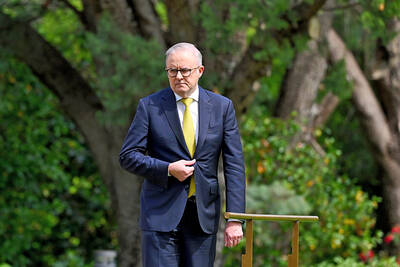
Australian Prime Minister Anthony Albanese yesterday said he did not take his security for granted, after he was evacuated from his residence for several hours following a bomb threat sent to a Chinese dance group. Albanese was evacuated from his Canberra residence late on Tuesday following the threat, and returned a few hours later after nothing suspicious was found. The bomb scare was among several e-mails threatening Albanese sent to a representative of Shen Yun, a classical Chinese dance troupe banned in China that is due to perform in Australia this month, a spokesperson for the group said in a statement. The e-mail
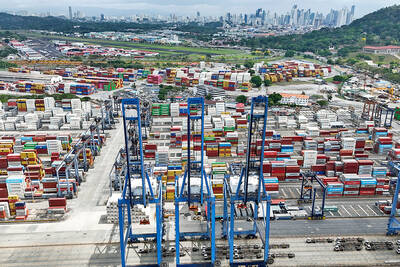
‘OCCUPATION’: Hong Kong said it had lodged ‘stern protests’ with Panama’s consulate, and would ‘staunchly support’ the rights and interests of Hong Kong companies Panamanian President Jose Raul Mulino on Monday ordered the temporary occupation of two ports run by a unit of CK Hutchison Holdings Ltd following the Supreme Court’s ruling against the firm’s concession, escalating a dispute that has become a proxy battle between the US and China in Latin America. Mulino said in a speech that the administration and operation of the two ports on the strategic Panama Canal is to revert to the country’s National Maritime Authority to ensure their uninterrupted, safe and efficient operation. The occupation covers movable equipment at the ports and does not mean a definitive loss of


 RSS
RSS