


Japan threatened yesterday to walk out of the International Whaling Commission's annual meeting next week if the group adopts a resolution Tokyo says puts too much emphasis on protecting whales.
The move would be the latest upset for an organization increasingly polarized between pro-whaling nations such as Japan and Norway and those opposed, including the US, Australia and Britain.
At issue in the upcoming IWC annual meeting, to open Monday in Berlin, is a 31-page proposal to form a conservation committee within the 48-nation IWC that would be charged with "strengthening the conservation agenda."
The resolution is sponsored by 19 countries, including Mexico, the US, Britain and Australia, and calls for, among other things, working with other global wildlife groups to better protect whales.
Japan, one of the world's leading whaling nations, says the proposal focuses too much on conservation at the expense of attaining sustainable harvests.
"We will definitely work against it," said Takanori Nagatomo, a whaling official with Japan's fisheries ministry. "It is unacceptable, and a walkout is possible if it passes."
Japan's strong talk underlines the divisions within the IWC over the state of world whale populations and whether the 1986 global ban on commercial whaling should be lifted. Pro-whaling nations say IWC membership is stacked against them and cite as evidence the group's refusal to grant membership to Iceland, a pro-whaling stronghold.
At last year's IWC meeting, hosted by Japan, delegates from Iceland stormed out following the rejection of their membership bid for the second year in a row.
Iceland has had non-voting observer status since its delegates quit an IWC meeting 10 years ago to protest the commission's anti-whaling stance.
Japan said it will also ask the IWC in Berlin for a special quota on minke whales to be hunted in the country's coastal waters. Japan likens the proposed quota to those granted to Aboriginal whale hunters in places like Alaska and Greenland.
But Japanese requests for such quotas have been rejected for the past 15 years, Nagatomo said. Last year, Japan asked for a 50-whale quota.
Although commercial whaling was banned 17 years ago, Japan is permitted by the IWC to conduct restricted "research" hunts. The country's whaling fleet kills hundreds of whales every year in far-flung waters around the world.
The Japanese government says the hunts help gauge the impact of whale herds on fisheries stocks and provide data on their migration patterns and population trends.
Critics call the program commercial whaling in disguise because the meat from the slaughtered whales is sold later to wholesalers and ends up in Japanese restaurants, where it is considered a delicacy.

A new online voting system aimed at boosting turnout among the Philippines’ millions of overseas workers ahead of Monday’s mid-term elections has been marked by confusion and fears of disenfranchisement. Thousands of overseas Filipino workers have already cast their ballots in the race dominated by a bitter feud between President Ferdinand Marcos Jr and his impeached vice president, Sara Duterte. While official turnout figures are not yet publicly available, data from the Philippine Commission on Elections (COMELEC) showed that at least 134,000 of the 1.22 million registered overseas voters have signed up for the new online system, which opened on April 13. However,
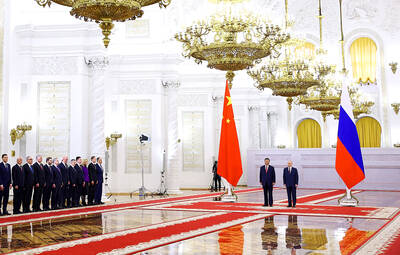
ALLIES: Calling Putin his ‘old friend,’ Xi said Beijing stood alongside Russia ‘in the face of the international counter-current of unilateralism and hegemonic bullying’ Chinese President Xi Jinping (習近平) yesterday was in Moscow for a state visit ahead of the Kremlin’s grand Victory Day celebrations, as Ukraine accused Russia’s army of launching air strikes just hours into a supposed truce. More than 20 foreign leaders were in Russia to attend a vast military parade today marking 80 years since the defeat of Nazi Germany in World War II, taking place three years into Russia’s offensive in Ukraine. Putin ordered troops into Ukraine in February 2022 and has marshaled the memory of Soviet victory against Nazi Germany to justify his campaign and rally society behind the offensive,

ENTERTAINMENT: Rio officials have a history of organizing massive concerts on Copacabana Beach, with Madonna’s show drawing about 1.6 million fans last year Lady Gaga on Saturday night gave a free concert in front of 2 million fans who poured onto Copacabana Beach in Rio de Janeiro for the biggest show of her career. “Tonight, we’re making history... Thank you for making history with me,” Lady Gaga told a screaming crowd. The Mother Monster, as she is known, started the show at about 10:10pm local time with her 2011 song Bloody Mary. Cries of joy rose from the tightly packed fans who sang and danced shoulder-to-shoulder on the vast stretch of sand. Concert organizers said 2.1 million people attended the show. Lady Gaga

CONFLICTING REPORTS: Beijing said it was ‘not familiar with the matter’ when asked if Chinese jets were used in the conflict, after Pakistan’s foreign minister said they were The Pakistan Army yesterday said it shot down 25 Indian drones, a day after the worst violence between the nuclear-armed rivals in two decades. Pakistani Prime Minister Shehbaz Sharif vowed to retaliate after India launched deadly missile strikes on Wednesday morning, escalating days of gunfire along their border. At least 45 deaths were reported from both sides following Wednesday’s violence, including children. Pakistan’s military said in a statement yesterday that it had “so far shot down 25 Israeli-made Harop drones” at multiple location across the country. “Last night, India showed another act of aggression by sending drones to multiple locations,” Pakistan military spokesman Ahmed


 RSS
RSS