


Top aides to newly elected President Chen Shui-bian (
"I not only feel happy but sober because now is the real beginning of political democracy," said Lin Chia-cheng (
"From March 18 onward the DPP needs to work together closely with the KMT to implement smoothly the handover of power to the DPP," Lin said.
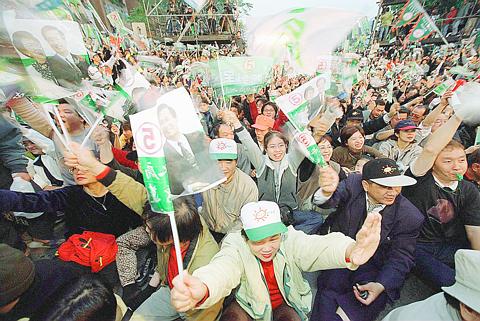
PHOTO: AFP
While recently-resigned Academia Sinica President Lee Yuan-tseh (
Lee said Chen has already said that he will be the people's president and not the party's president.
"I respect his broad-mindedness," Lee said. "I hope Chen can carry out all of the things he spoke of in his platform during the coming four years."
Lee acknowledged that ending the KMT's nearly 55-year rule would be an awesome task. He also praised the KMT for forwarding democratic reforms, especially the contributions made by President Lee Teng-hui (
"The passion of the campaign has now passed and now it's our duty and the new president's responsibility to build a new government. Let's take up this task and cooperate with the new president," Lee said.
While it is widely expected that Lee will become the next premier, Chen would only say yesterday that the option had not been ruled out.
Lee will head Chen's National Policy Advisory Committee which will help smooth the transition of power.
Chen said many voices from the grassroots level and within the DPP have urged him to invite Lee to organize his new Cabinet.
"I have not changed my hope that Lee and the honest leadership he represents will agree to lead the Cabinet," Chen said in a press conference after his victory speech.
Aides close to Chen said the new president would also attempt to establish a hotline to President Lee Teng-hui to discuss how to handle the handover of power and other important national affairs.
The aides mentioned the example of US President Bill Clinton, who was briefed by the CIA and Department of Defense immediately after winning the 1992 election, but before he was sworn in as president.
Sources close to Chen said that he would maintain a close relationship with Lee after he is inaugurated, and hoped to draw on his experiences dealing with cross-strait issues and military affairs.
During his campaign, Chen publicly announced his plan to draft Lee as an "envoy of peace" similar to the role ex-US president Jimmy Carter has played for later administrations.
Che also promised in his campaign that he would retain five important military and police officials, including Minister of National Minster Tang Fei (
Meanwhile, women's groups expressed the hope that the newly elected president would demonstrate his sincerity by recruiting more women into the ranks of government. They said that would like to see as much as a fourth of the new Cabinet made up of female members.
Chen's policy on women has been widely seen as being the most comprehensive of all of the presidential candidates.
Women's groups said that the election of Chen and his running mate, Annette Lu (
They also suggested that in the future, women should also participate in cross-strait negotiations to better balance the voices of debate.

‘NO SECURITY RISK’: The Railway Bureau reassured the public that the technicians’ activities were limited to technical guidance and did not involve sensitive systems The Railway Bureau yesterday said it had invited eight Chinese technicians to assist with an airport MRT construction project. The bureau issued the confirmation after an Internet user said Chinese nationals had entered the construction zone of Taiwan Taoyuan International Airport’s Terminal 3 project. They asked why “individuals from an enemy state” were allowed access to such a major national infrastructure project, which raised serious concerns over Taiwan’s industrial safety, sensitive systems and information security. The bureau’s Northern Region Engineering Branch Office said subcontractor Taiwan Handle Industrial Co (台灣手把工業) of the Taoyuan airport MRT’s “Contract No. CU05 Project A14 Station Civil, MEP &

A US uncrewed surface vessel (USV) encountered multiple Chinese warships during an autonomous transit of the Taiwan Strait, US defense company Seasats said in a statement on Wednesday. Seasats announced that a Lightfish USV had completed the first autonomous transit of the Taiwan Strait. Over five days, the USV traversed the entire length of the Strait while constantly monitoring surface vessel traffic, the company said. The Lightfish encountered multiple Chinese warships, one of which was a Chinese People’s Liberation Army Navy (PLAN) Type 056 corvette, it said. The Chinese vessels were operating “well within Taiwan’s exclusive economic zone without transmitting their identity via the
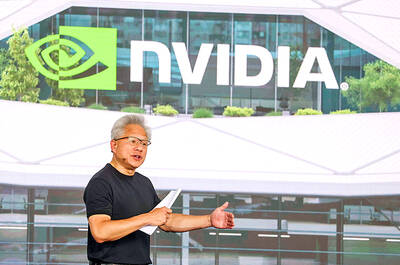
‘BOOMING’: ’ The number of partners we have here is incredible. You can see from their stock prices. They’re doing so well, they’re so happy,’ Jensen Huang said Nvidia Corp’s spending in Taiwan has ballooned to about US$150 billion a year, 10 times the US$10 billion to US$15 billion the company spent five years ago, Nvidia chief executive officer Jensen Huang (黃仁勳) said yesterday, suggesting Taiwan’s strategic importance in the global artificial intelligence (AI) supply chain. “Taiwan is the epicenter of the AI revolution. This is where the chips come, packaging comes. This is where the systems are made. This is where AI supercomputers were created,” Huang said at a meeting for the company’s employees in Beitou-Shilin Technology Park (北投士林科技園區) in Taipei, the planned site of Nvidia’s Taipei headquarters. “Taiwan
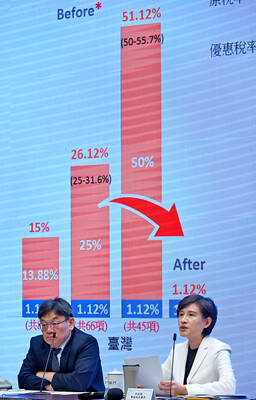
GREATER REACH? Auto parts and wood products would face tariffs of up to 15%, matching those targeting the EU, Japan and South Korea, Vice Premier said The US has announced that preferential tariff treatment for Taiwan’s non-semiconductor Section 232 goods would take effect retroactively from May 1, the Executive Yuan said yesterday. The US government yesterday posted a notice on the Federal Register’s public inspection Web site previewing tariff concessions for Taiwan under a memorandum of understanding (MOU) on Taiwan-US investment after two months of negotiations. The MOU signed on Jan. 15 stipulated three major preferential tariff arrangements: a 15 percent “reciprocal” tariff rate for Taiwan without stacking most-favored nation (MFN) rates; preferential Section 232 treatment for semiconductors and related products; and preferential Section 232 treatment for non-semiconductor


 RSS
RSS