


The government yesterday backpedaled on a plan to suspend breath alcohol tests due to fears about the spread of COVID-19, reiterating its “zero tolerance” stance on drunk driving and saying that testing would continue nationwide.
Minister of the Interior Hsu Kuo-yung (徐國勇) on Thursday told a legislative meeting that to avoid COVID-19 contagion and prevent excessive strain on personnel of the National Police Agency’s Special Police, breath alcohol testing, conducted twice per month, would be suspended.
However, local governments would still conduct “regional” testing at their discretion, he said.
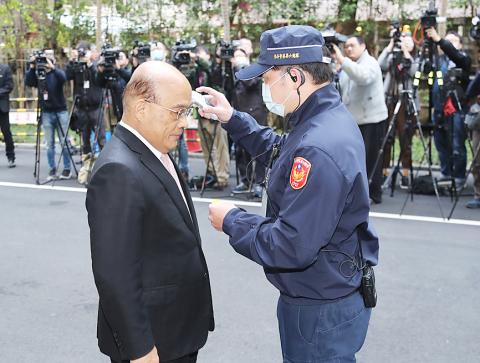
Photo: CNA
Hsu’s remarks at the legislature sparked controversy, as they came less than a week after Premier Su Tseng-chang (蘇貞昌) told the public that stiffened penalties for drunk driving were taking effect.
Prior to a question-and-answer session at the Legislative Yuan in Taipei yesterday, Su was asked by reporters whether the government would go through with the contentious policy.
There would be no suspension of breath alcohol testing conducted by the central or local governments, which have a “zero tolerance” stance on drunk driving, Su said.
Breath tests would continue, despite the COVID-19 situation, he said, urging people not to add to the government’s already heavy workload by driving under the influence of alcohol during the crisis.
Su later said on Facebook that new regulations targeting drunk drivers went into effect at the beginning of this month.
People whose driver’s license is revoked for drunk driving and obtain a new one would be required to pay for an ignition interlock device to be installed in their vehicle for a year, he said.
Repeat offenders must undergo rehabilitation and 15 hours of courses before they can take another driver’s test, he added, urging people not to try their luck.
At yesterday’s question-and-answer session, Chinese Nationalist Party (KMT) Legislator Lin Yi-hua (林奕華) said that Hsu’s remarks had angered many people, because 149 people died last year due to drunk driving, while another 293 died within a month of injuries sustained in an incident.
Hsu said that what he had meant was that breath alcohol testing would not be conducted “simultaneously” across the nation.
The Ministry of the Interior would follow the Executive Yuan’s instructions and ensure that there are no loopholes in efforts by the central and local governments to crack down on drunk driving, he added.
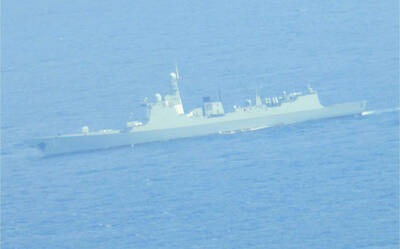
The military has spotted two Chinese warships operating in waters near Penghu County in the Taiwan Strait and sent its own naval and air forces to monitor the vessels, the Ministry of National Defense (MND) said. Beijing sends warships and warplanes into the waters and skies around Taiwan on an almost daily basis, drawing condemnation from Taipei. While the ministry offers daily updates on the locations of Chinese military aircraft, it only rarely gives details of where Chinese warships are operating, generally only when it detects aircraft carriers, as happened last week. A Chinese destroyer and a frigate entered waters to the southwest
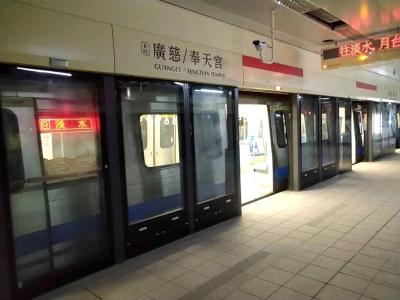
The eastern extension of the Taipei MRT Red Line could begin operations as early as late June, the Taipei Department of Rapid Transit Systems said yesterday. Taipei Rapid Transit Corp said it is considering offering one month of free rides on the new section to mark its opening. Construction progress on the 1.4km extension, which is to run from the current terminal Xiangshan Station to a new eastern terminal, Guangci/Fengtian Temple Station, was 90.6 percent complete by the end of last month, the department said in a report to the Taipei City Council's Transportation Committee. While construction began in October 2016 with an
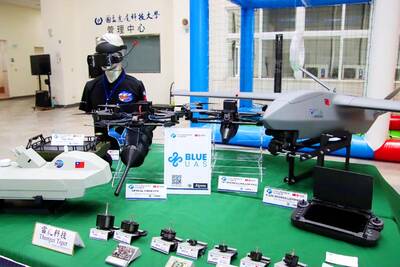
NON-RED SUPPLY: Boosting the nation’s drone industry is becoming increasingly urgent as China’s UAV dominance could become an issue in a crisis, an analyst said Taiwan’s drone exports to Europe grew 41.7-fold from 2024 to last year, with demand from Ukraine’s fight against Russian aggression the most likely driver of growth, a study showed. The Institute for Democracy, Society and Emerging Technology (DSET) in a statement on Wednesday said it found that many of Taiwan’s uncrewed aerial vehicle (UAV) sales were from Poland and the Czech Republic. These countries likely transferred the drones to Ukraine to aid it in its fight against the Russian invasion that started in 2022, it said. Despite the gains, Taiwan is not the dominant drone exporter to these markets, ranking second and fourth
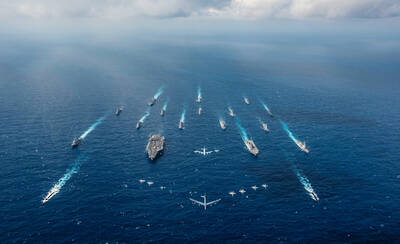
Japanese Prime Minister Sanae Takaichi’s comment last year on Tokyo’s potential reaction to a Taiwan-China conflict has forced Beijing to rewrite its invasion plans, a retired Japanese general said. Takaichi told the Diet on Nov. 7 last year that a Chinese naval blockade or military attack on Taiwan could constitute a “survival-threatening situation” for Japan, potentially allowing Tokyo to exercise its right to collective self-defense. Former Japan Ground Self-Defense Force general Kiyofumi Ogawa said in a recent speech that the remark has been interpreted as meaning Japan could intervene in the early stages of a Taiwan Strait conflict, undermining China’s previous assumptions


 RSS
RSS