


The government would use all available resources to help the nation’s two largest airlines weather a crisis caused by COVID-19, Minister of Transportation and Communications Lin Chia-lung (林佳龍) said yesterday.
The Executive Yuan last week approved a budget of about NT$16.85 billion (US$560.96 million) proposed by the Ministry of Transportation and Communications to bail out and boost the nation’s tourism industry and transport businesses, which have been severely affected by the global coronavirus epidemic.
However, there have been concerns that the budget might not be sufficient to cover all of the financial losses sustained by travel agencies and airlines.
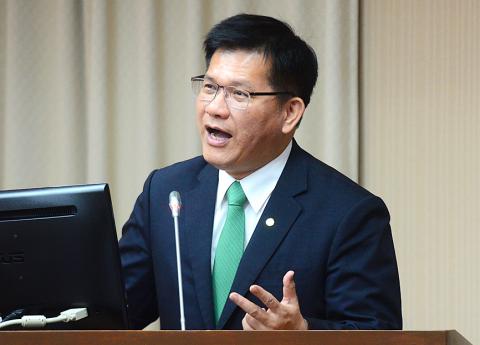
Photo: Wang Yi-sung, Taipei Times
In addition to the budget, which was appropriated under the Special Act on COVID-19 Prevention, Relief and Restoration (嚴重特殊傳染性肺炎防治及紓困振興特別條例), the Civil Aeronautics Administration and the Tourism Bureau have their own operational funds, Lin said before a meeting of the Legislative Yuan’s Transportation Committee.
The ministry would consider increasing the relief budget if there are not enough funds, he said, adding that priority should be based on the public interest.
About NT$4.2 billion of the budget would be used to support the nation’s two largest carriers — China Airlines and EVA Airways — which were forced to cancel scores of flights due to the outbreak, as well as duty-free shops in airports, Lin said.
The government would also reduce royalties, aircraft landing fees and other charges, he said, adding that the shortage in revenue would be compensated by the fund.
“They [the airlines] represent the nation. We should exhaust all possible means to support them under such a challenging situation,” Lin said.
“We also hope that they will hang in there, and not ask travel agencies and travelers to share their losses,” he said.
“Should the global COVID-19 outbreak persist, we will recommend that the government prepare a special bailout package for airlines,” he added.
Asked about the ministry’s plan to transport Taiwanese returning to the nation for next month’s Tomb Sweeping Day holiday, Lin said that the government yesterday launched a special taxi service at airports to ensure that public transportation does not become a hole in disease-prevention efforts.
This would help to more effectively control the flow of arriving travelers, particularly those from China, Hong Kong, Macau, South Korea, Italy and Iran, he said.
The service would ensure that travelers quickly arrive at their homes and begin a mandatory 14-day home quarantine after signing a health declaration or home quarantine notice, he added.
Lin expressed support for Taiwan High Speed Rail Corp’s (THSRC) decision to cancel all non-reserved seating during the holiday and to require all passengers to reserve seats under their real names.
The measures would help to prevent the spread of the virus, particularly in peak hours, when there is a lot of foot traffic in and out of high-speed rail stations, he said.
THSRC yesterday announced that it would install a total of 12 infrared thermal scanners at Taipei, Taoyuan, Taichung and Zuoying stations before the holiday.
Two in Taoyuan have begun operations, it said.
The ministry has also already discussed allowing ministry officials to work remotely and breaking down big meetings into smaller ones should the disease continue to spread, with video conferencing an option if necessary, Lin said.

Actor Darren Wang (王大陸) was sentenced to six months in prison, commutable to a fine, by the New Taipei District Court today for contravening the Personal Data Protection Act (個人資料保護法) in a case linked to an alleged draft-dodging scheme. Wang allegedly paid NT$3.6 million (US$114,380) to an illegal group to help him evade mandatory military service through falsified medical documents, prosecutors said. He transferred the funds to Chen Chih-ming (陳志明), the alleged mastermind of a draft-evasion ring, although he lost contact with him as he was already in detention on fraud charges, they said. Chen is accused of helping a

UNREASONABLE SURVEILLANCE: A camera targeted on an road by a neighbor captured a man’s habitual unsignaled turn into home, netting him dozens of tickets The Taichung High Administrative Court has canceled all 45 tickets given to a man for failing to use a turn signal while driving, as it considered long-term surveillance of his privacy more problematic than the traffic violations. The man, surnamed Tseng (曾), lives in Changhua County and was reported 45 times within a month for failing to signal while driving when he turned into the alley where his residence is. The reports were filed by his neighbor, who set up security cameras that constantly monitored not only the alley but also the door and yard of Tseng’s house. The surveillance occurred from July

SECURITY: Starlink owner Elon Musk has taken pro-Beijing positions, and allowing pro-China companies to control Taiwan’s critical infrastructure is risky, a legislator said Starlink was reluctant to offer services in Taiwan because of the nation’s extremely high penetration rates in 4G and 5G services, the Ministry of Digital Affairs said yesterday. The ministry made the comments at a meeting of the legislature’s Transportation Committee, which reviewed amendments to Article 36 of the Telecommunications Management Act (電信管理法). Article 36 bans foreigners from holding more than 49 percent of shares in public telecommunications networks, while shares foreigners directly and indirectly hold are also capped at 60 percent of the total, unless specified otherwise by law. The amendments, sponsored by Chinese Nationalist Party (KMT) Legislator Ko
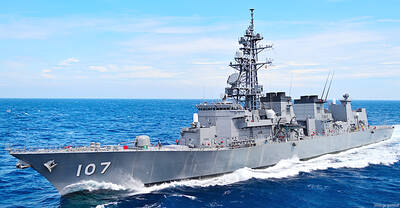
A Japan Self-Defense Forces vessel entered the Taiwan Strait yesterday, Japanese media reported. After passing through the Taiwan Strait, the Ikazuchi was to proceed to the South China Sea to take part in a joint military exercise with the US and the Philippines, the reports said. Japan Self-Defense Force vessels were first reported to have passed through the strait in September, 2024, with two further transits taking place in February and June last year, the Asahi Shimbun reported. Yesterday’s transit also marked the first time since Japanese Prime Minister Sanae Takaichi took office that a Japanese warship has been sent through the Taiwan


 RSS
RSS