


The Council of Indigenous Peoples (CIP) said that it is collaborating with the Ministry of Education to incorporate the 10 most important events in Aboriginal history into the 12-year National Education Program to give the younger generation an insight into these events from the perspective of Aborigines.
The council made the comments at a news conference on Wednesday to launch a 10-book series focused on historic events viewed through the eyes of Aborigines.
Experts and academics started work on the series in 2002, council Minister Icyang Parod said in a speech.
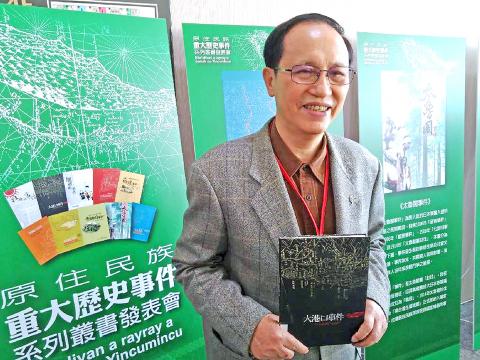
Photo: CNA
Members of the Presidential Office’s Indigenous Historical Justice and Transitional Justice Committee and the council also collaborated on the series, Executive Yuan Minister Without Portfolio Lin Wan-i (林萬億) told the news conference.
Since her first inauguration in 2016, President Tsai Ing-wen (蔡英文) has pushed to “reconstruct” history from an Aboriginal perspective, revitalize Aboriginal culture, grant increased autonomy to Aboriginal communities and ameliorate the living quality of Aborigines, Lin said.
The population, system, settlements and cartography featured in the books are based on Aboriginal knowledge at the time, Lin said, adding that the series aims to remove stereotypes about the role of Aborigines in history.
“We hope that such knowledge would allow Taiwan’s multiethnic society to come to respect each other,” Lin said.
The series would allow Taiwanese to see history from the perspective of Aborigines and understand how it affected them, Presidential Office Deputy Secretary-General Lee Chun-yi (李俊俋) said.
Many people were asked to share their experiences over the years, Lee said, adding that he hoped this is only the beginning of such efforts.
Through this project, the government hopes to share with non-Aborigines a part of history that the nation’s Han Chinese are not privy to, Lee said.
Commenting on the Dagangkou incident (大港口事件), Society of Indigenous Professors in Taiwan chairman Safulo Raranges said that Amis Aborigines had fought and stopped three waves of Qing Empire invaders before being massacred.
“After that incident, Aborigines were not allowed to speak their mother tongues, nor hold their unique annual ceremonies,” Safulo said.
The incident was a part of then-Qing imperial representative Shen Baozhen’s (沈葆禎) policy to expand into the mountains and to “pacify” Aborigines.
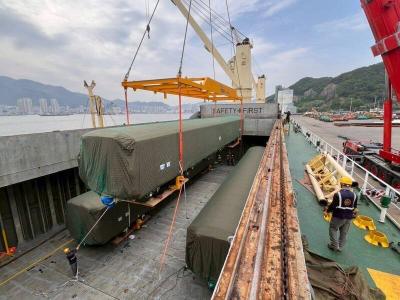
The first of 10 new high-capacity trains purchased from South Korea’s Hyundai Rotem arrived at the Port of Taipei yesterday to meet the demands of an expanding metro network, Taipei Rapid Transit Corp (TRTC) said yesterday. The train completed a three-day, 1,200km voyage from the Port of Masan in South Korea, the company said. Costing NT$590 million (US$18.79 million) each, the new six-carriage trains feature a redesigned interior based on "human-centric" transportation concepts, TRTC said. The design utilizes continuous longitudinal seating to widen the aisles and optimize passenger flow, while also upgrading passenger information displays and driving control systems for a more comfortable
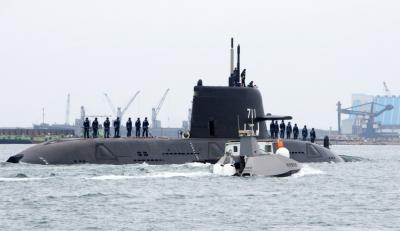
Taiwan's first indigenous defense submarine, the SS-711 Hai Kun (海鯤, or Narwhal), departed for its 13th sea trial at 7am today, marking its seventh submerged test, with delivery to the navy scheduled for July. The outing also marked its first sea deployment since President William Lai (賴清德) boarded the submarine for an inspection on March 19, drawing a crowd of military enthusiasts who gathered to show support. The submarine this morning departed port accompanied by CSBC Corp’s Endeavor Manta (奮進魔鬼魚號) uncrewed surface vessel and a navy M109 assault boat. Amid public interest in key milestones such as torpedo-launching operations and overnight submerged trials,
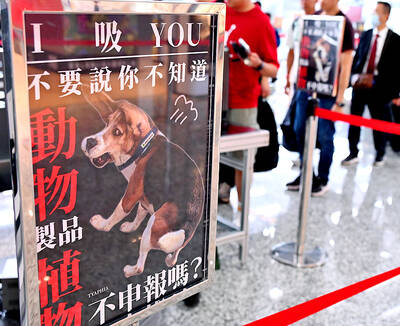
Quarantine awareness posters at Taiwan Taoyuan International Airport have gone viral for their use of wordplay. Issued by the airport branch of the Animal and Plant Health Inspection Agency, the posters feature sniffer dogs making a range of facial expressions, paired with advisory messages built around homophones. “We update the messages for holidays and campaign needs, periodically refreshing materials to attract people’s attention,” quarantine officials said. “The aim is to use the dogs’ appeal to draw focus to quarantine regulations.” A Japanese traveler visiting Taiwan has posted a photo on X of a poster showing a quarantine dog with a

Taiwan’s coffee community has launched a “one-person-one-e-mail” campaign, calling for people to send a protest-e-mail to the World Coffee Championships (WCC) urging it to redesignate Taiwanese competitors as from “Taiwan,” rather than “Chinese Taipei.” The call followed sudden action last week after the WCC changed all references to Taiwanese competitors from “Taiwan” to “Chinese Taipei,” including recent World Latte Art champion Bala (林紹興), who won the World Latte Art Championship in San Diego earlier this month. When Bala received the trophy, he was referred to as representing Taiwan, as well as in the announcement on the WCC’s Web site, until it


 RSS
RSS