


A team of National Tsing Hua University (NTHU) researchers yesterday said that they have used ultrasonic waves to treat Parkinson’s disease in mice, turning ultrasound — mainly used for medical scanning — into a treatment tool.
NTHU Institute of Molecular Medicine associate professor Lin Yu-chun (林玉俊) said that he has been looking for a safe and noninvasive way to control cell activity.
As optical waves cannot penetrate more than 2mm of human tissue and magnetic waves cannot be used for precision targeting, Lin said that he turned to ultrasonic waves, but had to first solve the problem of making human cells responsive to soundwaves.
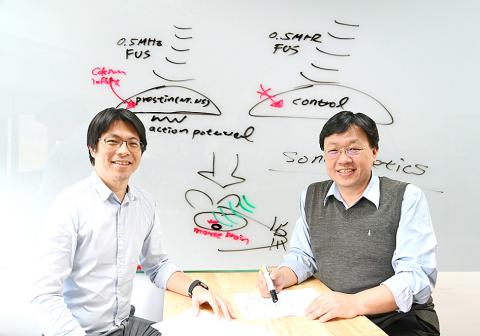
Photo courtesy of National Tsing Hua University via CNA
While prestin — a protein critical to sensitive hearing — is found in all mammals, it is insensitive to ultrasound in humans and mice, so Lin began studying the proteins of dolphins, whales and bats, which are known for their acoustic sensitivity, he said.
Humans and some other animals cannot hear sounds with frequencies higher than 20 kilohertz (kHz), he added.
After identifying the specific amino acid compositions related to sound perception in dolphins, whales and bats, Lin said that he reformed the prestin in lab mice through genetic editing and implanted the reformed protein into their cells, increasing their sensitivity to ultrasound by more than 10 times.
Yeh Chih-kuang (葉秩光), distinguished professor and director of the university’s Department of Biomedical Engineering and Environmental Sciences, designed special microbubbles — lipid droplets filled with inert gas — to envelop the reformed prestin and carry it into the blood of mice, Lin said.
The microbubbles break apart when hit by ultrasonic waves, allowing the reformed prestin to reach target cells directly, which is another form of precision medicine, he said.
The technique has proved effective in treating mice with Parkinson’s disease, with their mobility greatly improving after treatment, as shown in a video released by the team.
While ultrasonic waves are mainly used for medical examinations, the team has turned them into a treatment tool, Lin said, expressing the hope that the technique could be used to treat diabetes or cancers by activating pertinent cells.
The findings of the team, composed of members of several university departments, as well as Academia Sinica, were published last month in the journal Nano Letters.
Medical ultrasound frequencies are usually higher than 100kHz, but the team has only experimented with ultrasonic waves of up to 500kHz, Lin said.
The team will continue experimenting with different ultrasonic frequencies, improve the auditory sensitivity of cells and apply the technique to more diseases, he added.

A small number of Taiwanese this year lost their citizenship rights after traveling in China and obtaining a one-time Chinese passport to cross the border into Russia, a source said today. The people signed up through Chinese travel agencies for tours of neighboring Russia with companies claiming they could obtain Russian visas and fast-track border clearance, the source said on condition of anonymity. The travelers were actually issued one-time-use Chinese passports, they said. Taiwanese are prohibited from holding a Chinese passport or household registration. If found to have a Chinese ID, they may lose their resident status under Article 9-1

Taiwanese were praised for their composure after a video filmed by Taiwanese tourists capturing the moment a magnitude 7.5 earthquake struck Japan’s Aomori Prefecture went viral on social media. The video shows a hotel room shaking violently amid Monday’s quake, with objects falling to the ground. Two Taiwanese began filming with their mobile phones, while two others held the sides of a TV to prevent it from falling. When the shaking stopped, the pair calmly took down the TV and laid it flat on a tatami mat, the video shows. The video also captured the group talking about the safety of their companions bathing

PROBLEMATIC APP: Citing more than 1,000 fraud cases, the government is taking the app down for a year, but opposition voices are calling it censorship Chinese Nationalist Party (KMT) Chairwoman Cheng Li-wun (鄭麗文) yesterday decried a government plan to suspend access to Chinese social media platform Xiaohongshu (小紅書) for one year as censorship, while the Presidential Office backed the plan. The Ministry of the Interior on Thursday cited security risks and accusations that the Instagram-like app, known as Rednote in English, had figured in more than 1,700 fraud cases since last year. The company, which has about 3 million users in Taiwan, has not yet responded to requests for comment. “Many people online are already asking ‘How to climb over the firewall to access Xiaohongshu,’” Cheng posted on

A classified Pentagon-produced, multiyear assessment — the Overmatch brief — highlighted unreported Chinese capabilities to destroy US military assets and identified US supply chain choke points, painting a disturbing picture of waning US military might, a New York Times editorial published on Monday said. US Secretary of Defense Pete Hegseth’s comments in November last year that “we lose every time” in Pentagon-conducted war games pitting the US against China further highlighted the uncertainty about the US’ capability to intervene in the event of a Chinese invasion of Taiwan. “It shows the Pentagon’s overreliance on expensive, vulnerable weapons as adversaries field cheap, technologically


 RSS
RSS