

Taipei Mayor Ko Wen-je (柯文哲), who is also the chairman of the Taiwan People’s Party (TPP), yesterday in Prague, Czech Republic, said that TPP legislator-at-large-elect Tsai Pi-ju’s (蔡璧如) remark that the party would form an alliance of opposition party caucuses in the Legislative Yuan is inaccurate, as it intends to form a “people’s alliance.”
The TPP won 11.2 percent of party votes in Saturday’s legislative elections, passing the 5 percent threshold and securing five legislator-at-large seats.
Tsai on Monday said that the party plans to form an alliance with other opposition parties — the Chinese Nationalist Party (KMT) and the New Power Party (NPP) — in the Legislative Yuan to closely monitor the Democratic Progressive Party (DPP).
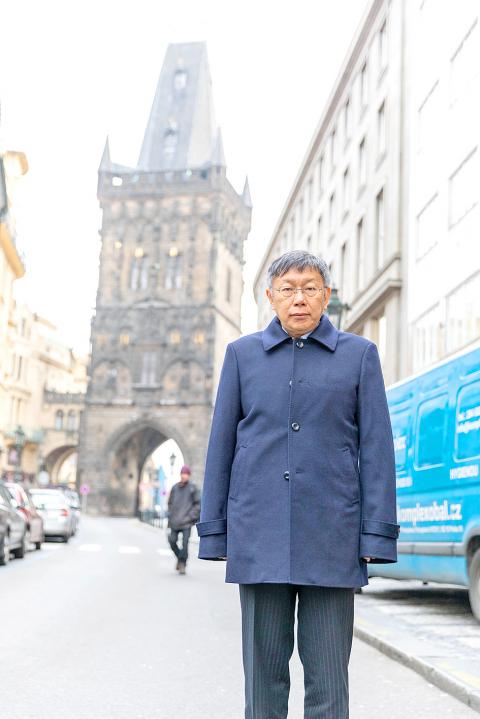
Photo courtesy of the Taipei City Government
KMT caucus whip William Tseng (曾銘宗) on Tuesday said that the KMT is open to the idea, but cooperation with the TPP would depend on whether the two parties agree on certain issues, adding that they could start from economic issues.
“Chickens and rabbits cannot share the same cage,” NPP Chairman Hsu Yung-ming (徐永明) said on Tuesday, adding that cooperation should be based on sharing similar ideals and values, but the NPP and the KMT do not share the same fundamental values, and the NPP does not know the TPP’s direction yet, so it is too soon to speak about the possibility of forming an alliance.
Independent Legislator Freddy Lim (林昶佐) said the TPP was formed last year and is about to enter the Legislative Yuan, but it does not have a clear stance regarding its main ideals as well as many issues, such as national security and foreign relations, adding that forming an alliance without shared ideals would amount to political manipulation.
Ko, speaking with Taiwanese reporters in Prague, said that the term “an alliance of opposition parties” is inaccurate, because the TPP wants to avoid conflict between ideologies and focus on solving people’s livelihood issues, so it should rather be called a “people’s alliance.”
Asked about speculation that the TPP is apparently a member of the pan-blue camp, Ko said the party does not want to be categorized by the blue-green divide, and that it would discuss issues that are beneficial to the public, adding that it can cooperate with the KMT, the DPP or any other party as long as the proposals are reasonable.
Tsai and TPP legislators would bring the experience they gained in the Taipei City Government, as well as their credo that the government should be open and transparent, to the Legislative Yuan, Ko said.

A total of 400 foreign “high- level” professionals have been naturalized as Republic of China (Taiwan) citizens over the past decade as the government has eased nationality rules to attract talent from a wider range of fields, the Ministry of the Interior said yesterday. The 400th high-level professional, who works in the electronics industry, was approved for ROC citizenship on Aug. 26, the MOI said. The MOI quoted the newly naturalized citizen as saying that Taiwan is a leader in fields such as semiconductors, electronics manufacturing, artificial intelligence development and energy technology. He also said
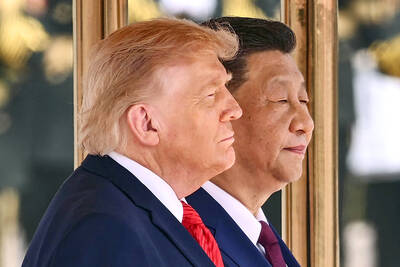
China has warned that it could cancel a planned US-China leaders’ summit if Washington approves new arms sales to Taiwan, a Japanese media outlet quoted sources as saying yesterday. US President Donald Trump, “apparently eager to showcase some diplomatic achievements ahead of November’s midterm congressional elections, places great importance on holding the summit with Chinese President Xi Jinping (習近平),” Japan’s Kyodo News reported. “While preparing for Xi’s upcoming trip, China has restated its position that the Taiwan issue is a ‘red line’ in bilateral relations,” the report said. The report said that when Xi met with Trump in Beijing in May, Xi said
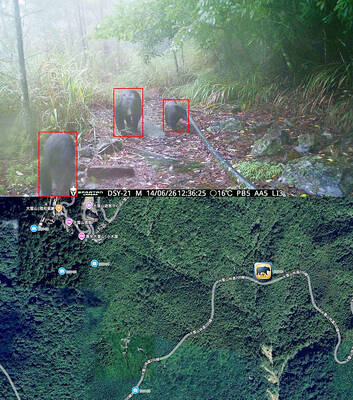
RARE PEEK: The footage released showed one of the bears staying in a cave for as long as 70 days, providing the first record of Formosan black bear’s overwintering The Forestry and Nature Conservation Agency yesterday released tracking records of released Formosan black bears for the first time, showing that they get much closer to human settlements than previously thought. The agency said it had captured two bears, Da Qu-ali (達古阿里) and Aziman (阿里曼), in indigenous villages in Hualien County and began to track them with a camera-mounted satellite collar after releasing them back into the wild. The results confirmed that the bears have moved from deep mountain areas into lowland hills closer to human communities, leading to an increase in human-bear conflicts, it said. The agency has introduced artificial intelligence-assisted early
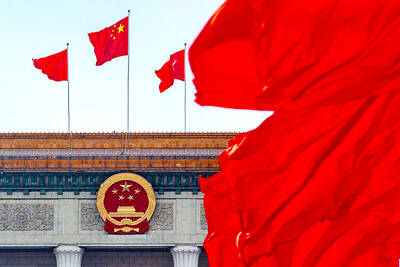
DIPLOMATIC TOUR: Chinese President Xi Jinping began a series of overseas visits last month to Kyrgyzstan, Egypt and India, aimed at securing leverage, an official said Recent Chinese diplomatic and military moves are aimed at creating pressure ahead of a planned meeting between Chinese President Xi Jinping (習近平) and US President Donald Trump, National Security Council adviser Huang Chung-yen (黃重諺) said. Trump when visiting China in May extended an invitation to Xi to visit Washington on Sept. 24. China is yet to officially announce plans for Xi’s visit to the US. In an interview with the Liberty Times (sister paper of the Taipei Times) on Thursday, Huang said Xi’s overseas visits, China’s “gray zone” activities along the First Island Chain and efforts to expand its trade surplus with the


 RSS
RSS