


Liberty Times (LT): What do you think is the most important factor influencing these elections?
William Lai (賴清德): There are a few things influencing these elections. First, Chinese President Xi Jinping (習近平) on Jan. 2 last year proposed a version of the “one country, two systems” framework intended for Taiwan. If there were people who in the past used the “1992 consensus” as a bridge for cross-strait communications, well, Xi personally tore that bridge down.
This made things all the more clear for Taiwanese — China simply wants to annex Taiwan. If it accomplishes this, the Republic of China would be annihilated. It shows that what the Chinese Nationalist Party (KMT) has been saying all these years is a lie.
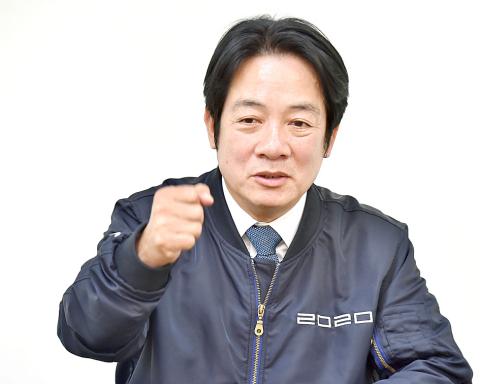
Photo: Tu Chien-jung, Taipei Times
Second, there are the protests in Hong Kong against a proposed extradition bill [that have now become broader pro-democracy demonstrations]. Before this, there were some people who might have wanted to create a sort of muddled cross-strait space.
However, the Hong Kong protests have made things very clear. More than 2 million Hong Kongers have taken to the streets.
Taiwanese have seen the brave actions of Hong Kongers and are reminded of the decades when Taiwan strove for democracy. Nobody wants to relive those days.
Third, President Tsai Ing-wen’s (蔡英文) administration has spoken about Taiwan’s sovereignty and its resolve to maintain it. These past three years, the government has made one achievement after another.
For example, pension reforms, without which the next generation would have been left facing a bankrupt pension system.
Similarly, had the government not enacted economic transformation and industrial upgrades, young people would have no opportunities and Taiwan would have no future.
When President Tsai first pushed these things, she faced challenges, but over time society will reflect on these policies and see them in a positive light.
Fourth, elections are about comparing the candidates. President Tsai’s main rival is Kaohsiung Mayor Han Kuo-yu (韓國瑜) of the KMT. Comparing the two, the discrepancy is quite significant. Han is not a very good strategist. On top of that, as mayor he has not demonstrated any ability to govern. Running for president is stretching it quite a bit for him.
LT: Aside from seeking re-election for Tsai, the DPP faces a tense battle in the legislative elections. What is the party’s plan of attack?
Lai: The overall objective of the DPP’s “Let’s Win” campaign is the re-election of President Tsai and a legislative majority. To achieve a legislative majority means winning not only district legislator seats, but also legislators-at-large — we cannot do without either.
President Tsai also tasked me with a mission — not only do I need to assist her re-election campaign, but also I need to assist the legislative candidates’ campaigns. Legislators have worked so hard, but without wins for the party’s legislator-at-large nominees we cannot achieve a legislative majority.
Another thing that worries me is that because so many new parties have been established, some of the pan-green camp’s votes might go to those other parties. I really need to watch the situation carefully.
LT: Given the concerns expressed by yourself and members of the public over [retired lieutenant general] Wu Sz-huai (吳斯懷) and other KMT legislator-at-large nominees, what more can be done to secure more votes for the DPP’s candidates?
Lai: If Wu makes it into the Legislative Yuan, then it is even more imperative that the DPP has a legislative majority. Therefore, we need to let voters know that to protect the nation’s sovereignty and democracy, the DPP needs a majority, President Tsai needs to be in office and the nation needs to rally together.
If President Tsai’s campaign promises are to become policy, they need to go through three readings at the legislature. This is the biggest significance behind seeking a legislative majority.
LT: You mentioned smaller parties putting a strain on the DPP when it comes to party ballots, but the DPP has also voiced support for some of those parties’ legislative candidates. Could you clarify what the DPP’s true appeal and strategy are?
Lai: Of course the DPP can partner up with smaller parties in regional legislative elections — but the DPP needs to win a legislative majority to gain more momentum.
The party has taken different missions during different stages of its development. In the first stage, the DPP fought for democracy and overthrew totalitarianism. In the second stage, it strengthened democracy and let every Taiwanese participate.
It is now in the third stage — to be the main force to fend off threats from China. A legislative majority is necessary to bolster the party’s capabilities — like a basketball player who plays center must be strong, otherwise they will not be able to fight for rebounds or block opponents.
LT: The pan-blue camp has said that some “external factors” in this election have helped Tsai’s approval rating surge. Do you agree with people who say that Tsai has simply been lucky?
Lai: Completely the opposite. When threats do not exist or cannot be felt, it is hard for people to notice the differences between parties and candidates. There have to be incidents that serve as a mirror to show people those differences.
People saw it with their own eyes when Xi last year declared that the so-called “1992 consensus” is the “one China” principle with no room for the KMT to interpret China as the Republic of China.
People have also seen the failure of Beijing’s “one county, two systems” formula in the pro-democracy movement in Hong Kong.
However, the KMT still upholds the “1992 consensus,” refusing to admit the impending doom of Taiwan’s annexation by China. How could a party that fails to realize the truth criticize the one that actually stands by the people?
I respect the cultural identity of Han, as well as some other KMT members, when they consider themselves to have inseparable connections with China.
However, cultural identity is one thing and national identity is another. We must unite to safeguard Taiwan.
Hopefully, this election will show people a clearer direction for the nation’s development — a democracy should be run by its people.
Taiwanese leaders have gone through one election after another, as if patiently forging a sword that rids society of the “one China” idea, making people’s resolve to uphold sovereignty and democracy firm as steel.
LT: Are there any tasks related to being vice president that Tsai has assigned to you if elected?
Lai: The Constitution does not mention the duty of a vice president. Simply put, I would shoulder whatever responsibilities the president gives me.
LT: The KMT has constantly cited the competition you had with Tsai in the DPP’s primary to cast doubt on the collaboration that the two of you would have leading the nation if elected. What is your view on it?
Lai: As a democratic party, the DPP has internal competitions, but always stands united when facing the outside world. The Constitution clearly states that the president is the nation’s leader, whereas the vice president is a role that assists the president.
As I said in the primary, Taiwan could not lose — my partnership with Tsai now is exactly my hope for Taiwan’s victory.
Interviewed by Yang Chun-hui, Chen Yu-fu and Su Yung-yao
Translated by William Hetherington and Dennis Xie

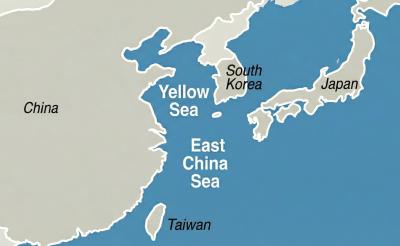
China has reserved offshore airspace in the Yellow Sea and East China Sea from March 27 to May 6, issuing alerts usually used to warn of military exercises, although no such exercises have been announced, the Wall Street Journal (WSJ) reported yesterday. Reserving such a large area for 40 days without explanation is an “unusual step,” as military exercises normally only last a few days, the paper said. These alerts, known as Notice to Air Missions (Notams), “are intended to inform pilots and aviation authorities of temporary airspace hazards or restrictions,” the article said. The airspace reserved in the alert is
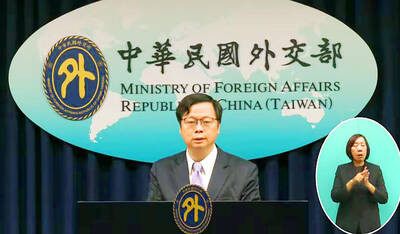
NAMING SPAT: The foreign ministry called on Denmark to propose an acceptable solution to the erroneous nationality used for Taiwanese on residence permits Taiwan has revoked some privileges for Danish diplomatic staff over a Danish permit that lists “Taiwan” as “China,” Eric Huang (黃鈞耀), head of the Ministry of Foreign Affairs’ Department of European Affairs, told a news conference in Taipei yesterday. Reporters asked Huang whether the Danish government had responded to the ministry’s request that it correct the nationality on Danish residence permits of Taiwanese, which has been listed as “China” since 2024. Taiwan’s representative office in Denmark continues to communicate with the Danish government, and the ministry has revoked some privileges previously granted to Danish representatives in Taiwan and would continue to review

More than 6,000 Taiwanese students have participated in exchange programs in China over the past two years, despite the Mainland Affairs Council’s (MAC) “orange light” travel advisory, government records showed. The MAC’s publicly available registry showed that Taiwanese college and university students who went on exchange programs across the Strait numbered 3,592 and 2,966 people respectively. The National Immigration Agency data revealed that 2,296 and 2,551 Chinese students visited Taiwan for study in the same two years. A review of the Web sites of publicly-run universities and colleges showed that Taiwanese higher education institutions continued to recruit students for Chinese educational programs without
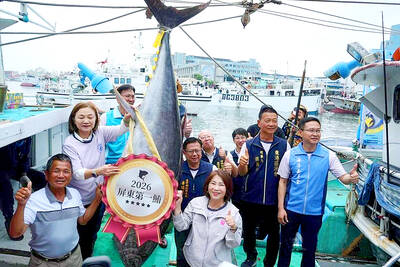
The first bluefin tuna of the season, brought to shore in Pingtung County and weighing 190kg, was yesterday auctioned for NT$10,600 (US$333.5) per kilogram, setting a record high for the local market. The auction was held at the fish market in Donggang Fishing Harbor, where the Siaoliouciou Island-registered fishing vessel Fu Yu Ching No. 2 delivered the “Pingtung First Tuna” it had caught for bidding. Bidding was intense, and the tuna was ultimately jointly purchased by a local restaurant and a local company for NT$10,600 per kilogram — NT$300 ,more than last year — for a total of NT$2.014 million. The 67-year-old skipper


 RSS
RSS