


The Taiwan Disaster Prevention Industry Association on Thursday declared a climate emergency in Taiwan, urging the government to devise medium to long-term measures to prepare for climate change.
If the atmospheric concentration of carbon dioxide continues to increase at its current pace, it would exceed 450 parts per million by 2036, causing a rise of 2°C in global temperatures, the group of disaster prevention experts from industry, government and academia said.
Calling it an emergency is not meant to invoke fear, but is intended to highlight the need for early preparation for global warming, otherwise Taiwan could be caught in severe problems it would be unable to fix, they said.
That is why leaders in Taiwan should propose strategies, one of which should be to integrate disaster prevention systems across all governmental levels, association director Peng Chi-ming (彭啟明) said.
Climate change would affect Taiwan’s industries, National Chiao Tung University civil engineering professor Shan Hsin-yu (單信瑜) said.
As the nation relies heavily on energy imports, the government should find ways to encourage reduced consumption of energy resources.
“Taiwan is no longer a frog sitting in tepid water, the water is already boiling,” Shan said.
The nation must admit that measures taken up to this point to combat global warming are no longer enough to limit its changes, and Taiwan lacks a climate vision, unlike its neighbors, Ming Chuan University architecture professor Wang Jieh-jiuh (王价巨) said.
Japan proposed a nationwide disaster prevention project in 2013, Wang said.
UN data show that Taiwan faces some of the highest risks of climate change consequences, said Yao Ta-chun (姚大鈞), chief executive of Eos Rhea Metis, a corporate and engineering risk management consulting firm.
The government should respond to the association’s statement and mobilize all parts of society to minimize losses, Yao said.
The group’s statement asked for four actions from the government: First, it should set clear carbon-reduction goals.
Second, the government should integrate its disaster prevention systems across all levels, and introduce a complete set of disaster prevention laws and plans, it said.
Third, it should open communication channels between it and the private sector to ensure better coordination and distribution of work, the statement said.
Last, more resources must be devoted to medium and long-term solutions, such as creating a green supply chain, mitigating the impact on global supply chains and turning the crisis into a new opportunity, it added.

Chinese spouse and influencer Guan Guan’s (關關) residency permit has been revoked for repeatedly posting pro-China videos that threaten national security, the National Immigration Agency confirmed today. Guan Guan has said many controversial statements in her videos posted to Douyin (抖音), including “the red flag will soon be painted all over Taiwan” and “Taiwan is an inseparable part of China,” and expressing hope for expedited reunification. The agency last year received multiple reports alleging that Guan Guan had advocated for armed reunification. After verifying the reports, the agency last month issued a notice requiring her to appear and explain her actions. Guan

GIVE AND TAKE: Blood demand continues to rise each year, while fewer young donors are available due to the nation’s falling birthrate, a doctor said Blood donors can redeem points earned from donations to obtain limited edition Formosan black bear travel mugs, the Kaohsiung Blood Center said yesterday, as it announced a goal of stocking 20,000 units of blood prior to the Lunar New Year. The last month of the lunar year is National Blood Donation Month, when local centers seek to stockpile blood for use during the Lunar New Year holiday. The blood demand in southern Taiwan — including Tainan and Kaohsiung, as well as Chiayi, Pingtung, Penghu and Taitung counties — is about 2,000 units per day, the center said. The donation campaign aims to boost

The Kaohsiung Tourism Bureau audited six hotels in an effort to prevent price gouging ahead of Korean band BTS’ concert tour in the city scheduled for Nov. 19, 21 and 22 this year. The bureau on Friday said that the audits — conducted in response to allegations of unfair pricing posted on social media — found no wrongdoing. These establishments included the local branches of Chateau de Chine, Hotel Nikko, My Humble House, and Grand Hai Lai, it said, adding that the Consumer Protection Commission would have penalized price gougers had the accusations been substantiated. The bureau said the Tourism Development Act
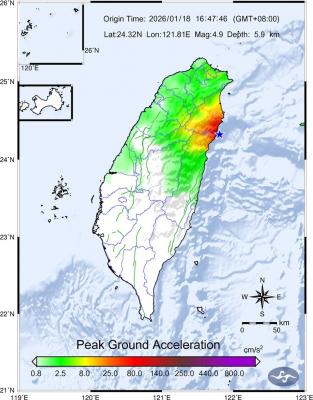
The Central Weather Administration (CWA) said a magnitude 4.9 earthquake that struck off the coast of eastern Taiwan yesterday was an independent event and part of a stress-adjustment process. The earthquake occurred at 4:47pm, with its epicenter at sea about 45.4km south of Yilan County Hall at a depth of 5.9km, the CWA said. The quake's intensity, which gauges the actual effects of a temblor, was highest in several townships in Yilan and neighboring Hualien County, where it measured 4 on Taiwan's seven-tier intensity scale, the CWA said. Lin Po-yu (林柏佑), a division chief at the CWA's Seismological Center, told a news conference


 RSS
RSS