


It is important that young people participate in politics so that the nation’s democracy and freedoms can be passed to future generations, former premier William Lai (賴清德), the Democratic Progressive Party’s (DPP) vice presidential candidate, said yesterday as he campaigned for the party’s legislative candidates in Keelung, Hsinchu County and other regions.
In Keelung in the morning to stump for Tsai Shih-ying (蔡適應), Lai met with the public while visiting the city’s temples, traditional markets and commercial areas.
He was accompanied by Keelung Mayor Lin Yu-chang (林右昌), another rising star that the DPP is depending on going into the presidential and legislative elections on Saturday next week.
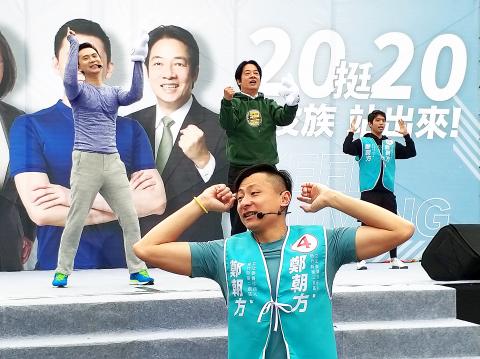
Photo: Liao Hsueh-ju, Taipei Times
One campaign stop was a Wu family eatery that has been in business for more than 100 years — being passed down three generations, from grandfather to grandson — where the DPP politicians sampled several dishes with other customers.
“It has not been easy for the Wu family to pass on the business — the skills needed to prepare and cook the dishes — for three generations,” Lai said. “It is the same for Taiwan’s democracy. We must pass on the torch to young people so that they take up the responsibility of protecting our freedoms and democratic values.”
Lai cited the pioneers of Taiwan’s democracy movement, the early founders of the DPP, who defied the authoritarian regime and the Marital Law era of the Chinese Nationalist Party (KMT) one-party state, saying that human rights, freedoms and the right to set up political parties must be protected.
Asked about the presidential race, Lai said: “President Tsai Ing-wen (蔡英文) is the only candidate who presented a policy platform to the public. She explained her administration’s performance to voters and talked about how she has provided leadership and direction to our nation.”
“It is rather disappointing,” Lai said, referring to the race. “Taiwanese wanted to see a race for the presidency that had a high level of style, in which all candidates presented their policy platforms, with a positive approach and clear direction.”
Lai said he hopes that in the final stretch of the campaigns, the candidates of opposition parties will show how their policies could provide for people’s needs.
Asked about the passage of the Anti-infiltration Act (反滲透法), DPP legislative candidate Tsai Shih-ying said: “Taiwan needs this law right now. Even countries very far away from China have needed to pass similar laws against foreign states using money and political influence to meddle in their countries’ affairs.”
“About half of the KMT legislators chose not to show up at the Legislative Yuan on Tuesday, because they knew that the anti-infiltration legislation and its aims have a lot of support among Taiwanese,” Tsai said.
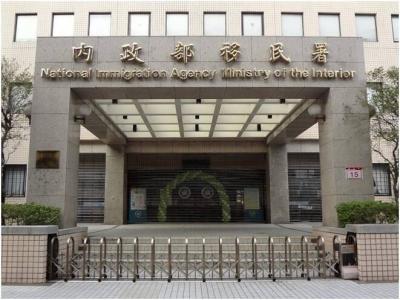
A small number of Taiwanese this year lost their citizenship rights after traveling in China and obtaining a one-time Chinese passport to cross the border into Russia, a source said today. The people signed up through Chinese travel agencies for tours of neighboring Russia with companies claiming they could obtain Russian visas and fast-track border clearance, the source said on condition of anonymity. The travelers were actually issued one-time-use Chinese passports, they said. Taiwanese are prohibited from holding a Chinese passport or household registration. If found to have a Chinese ID, they may lose their resident status under Article 9-1

Taiwanese were praised for their composure after a video filmed by Taiwanese tourists capturing the moment a magnitude 7.5 earthquake struck Japan’s Aomori Prefecture went viral on social media. The video shows a hotel room shaking violently amid Monday’s quake, with objects falling to the ground. Two Taiwanese began filming with their mobile phones, while two others held the sides of a TV to prevent it from falling. When the shaking stopped, the pair calmly took down the TV and laid it flat on a tatami mat, the video shows. The video also captured the group talking about the safety of their companions bathing

PROBLEMATIC APP: Citing more than 1,000 fraud cases, the government is taking the app down for a year, but opposition voices are calling it censorship Chinese Nationalist Party (KMT) Chairwoman Cheng Li-wun (鄭麗文) yesterday decried a government plan to suspend access to Chinese social media platform Xiaohongshu (小紅書) for one year as censorship, while the Presidential Office backed the plan. The Ministry of the Interior on Thursday cited security risks and accusations that the Instagram-like app, known as Rednote in English, had figured in more than 1,700 fraud cases since last year. The company, which has about 3 million users in Taiwan, has not yet responded to requests for comment. “Many people online are already asking ‘How to climb over the firewall to access Xiaohongshu,’” Cheng posted on

A classified Pentagon-produced, multiyear assessment — the Overmatch brief — highlighted unreported Chinese capabilities to destroy US military assets and identified US supply chain choke points, painting a disturbing picture of waning US military might, a New York Times editorial published on Monday said. US Secretary of Defense Pete Hegseth’s comments in November last year that “we lose every time” in Pentagon-conducted war games pitting the US against China further highlighted the uncertainty about the US’ capability to intervene in the event of a Chinese invasion of Taiwan. “It shows the Pentagon’s overreliance on expensive, vulnerable weapons as adversaries field cheap, technologically


 RSS
RSS