


Passengers traveling on the South Link Line (南迴鐵路) can look forward to uninterrupted mobile phone service while passing through some of its tunnels after two base stations along the route are activated today, the National Communications Commission (NCC) said yesterday.
Two signal stations at Puan (菩安) and Gujhuang (古莊), about 8km apart, would serve about 550,000 passengers on the railway line annually, the commission said, adding that travelers could experience preliminary results of improved mobile phone reception along the South Link.
About 40km of the South Link Line is inside 35 tunnels along the 98.2km route, and prior to the activation of the base stations, mobile service was unavailable for about one-and-a-half hours of the travel time, it said.

Photo courtesy of Lai Chien-yi
The NCC started coordinating with the Taiwan Railways Administration (TRA), telecoms and other agencies to improve reception and expand coverage along the line, it said.
The telecoms had to work at night after service ended and coordinate with the railway agency on improvements made inside the tunnels, which are mostly located in the forests and canyons, making it more of a challenge, it added.
All five major telecoms also agreed to jointly provide about NT$60 million (US$1.99 million) to fund the mobile signal improvement project, which was completed within 50 days after the railway agency mobilized 750 workers for the project, the NCC said.
Of the total funds spent on the project, NT$19 million came from the budget allocated for the Forward-Looking Infrastructure Development Program, telecoms said.
Asked why they chose to improve the reception between Puan and Gujhuang first, representatives from the telecoms said that they were following TRA’s progress on the electrification of the South Link Line, the only railway in the nation that has not yet been completely electrified.
“We recognize the efforts made by telecoms and government agencies to jointly improve the mobile phone signal receptions along the South Link Line and thank all the unsung heroes at the front line for their hard work,” the commission said. “We are aiming to improve reception along the entire route by the end of next year.”
In other news, Chunghwa Telecom said that it is working with Thunder Tiger to test if they can use small cell base stations mounted on unmanned aerial vehicles (UAVs) to improve reception and coverage in disaster-struck areas.
Should the tests prove successful, Chunghwa said it would to four UAVs on standby in the north, south, east and west regions for potential disasters, when the base stations are most likely to be damaged.

Chinese spouse and influencer Guan Guan’s (關關) residency permit has been revoked for repeatedly posting pro-China videos that threaten national security, the National Immigration Agency confirmed today. Guan Guan has said many controversial statements in her videos posted to Douyin (抖音), including “the red flag will soon be painted all over Taiwan” and “Taiwan is an inseparable part of China,” and expressing hope for expedited reunification. The agency last year received multiple reports alleging that Guan Guan had advocated for armed reunification. After verifying the reports, the agency last month issued a notice requiring her to appear and explain her actions. Guan

GIVE AND TAKE: Blood demand continues to rise each year, while fewer young donors are available due to the nation’s falling birthrate, a doctor said Blood donors can redeem points earned from donations to obtain limited edition Formosan black bear travel mugs, the Kaohsiung Blood Center said yesterday, as it announced a goal of stocking 20,000 units of blood prior to the Lunar New Year. The last month of the lunar year is National Blood Donation Month, when local centers seek to stockpile blood for use during the Lunar New Year holiday. The blood demand in southern Taiwan — including Tainan and Kaohsiung, as well as Chiayi, Pingtung, Penghu and Taitung counties — is about 2,000 units per day, the center said. The donation campaign aims to boost

The Kaohsiung Tourism Bureau audited six hotels in an effort to prevent price gouging ahead of Korean band BTS’ concert tour in the city scheduled for Nov. 19, 21 and 22 this year. The bureau on Friday said that the audits — conducted in response to allegations of unfair pricing posted on social media — found no wrongdoing. These establishments included the local branches of Chateau de Chine, Hotel Nikko, My Humble House, and Grand Hai Lai, it said, adding that the Consumer Protection Commission would have penalized price gougers had the accusations been substantiated. The bureau said the Tourism Development Act
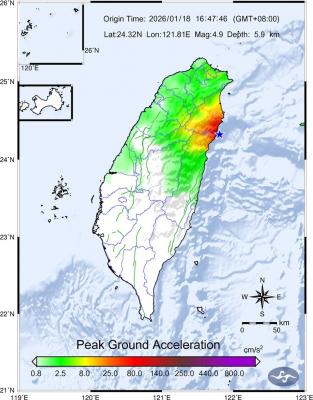
The Central Weather Administration (CWA) said a magnitude 4.9 earthquake that struck off the coast of eastern Taiwan yesterday was an independent event and part of a stress-adjustment process. The earthquake occurred at 4:47pm, with its epicenter at sea about 45.4km south of Yilan County Hall at a depth of 5.9km, the CWA said. The quake's intensity, which gauges the actual effects of a temblor, was highest in several townships in Yilan and neighboring Hualien County, where it measured 4 on Taiwan's seven-tier intensity scale, the CWA said. Lin Po-yu (林柏佑), a division chief at the CWA's Seismological Center, told a news conference


 RSS
RSS