


The Taiwan High-Speed Rail Corp (THSRC) yesterday officially launched a new theme train from Taipei, with the train’s exterior featuring two popular cartoon characters created by Japanese illustrator Kanahei.
The company said that the train, featuring Piske (P助) and Usagi (粉紅兔兔), is to operate until September next year, adding that all high-speed rail passengers would have a chance to ride the new train in the next 10 months.
The company and Kanehei also released 14 co-branded items related to the new train, including pull-back trains, belt bags, stuffed animals, ticket holders and key chains.
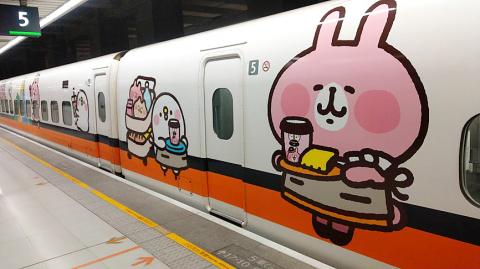
Photo: Cheng Wei-chi, Taipei Times
Piske and Usagi are also appear on the uniforms of train conductors, on-board service personnel and station crew, THSRC Spokesperson Johnson Sun (孫鴻文) said yesterday.
As Piske and Usagi are good friends, the company hoped that the characters would convey the image that the high-speed rail is a good friend to every passenger, he said.
Sun also said that the company started selling Kanahei’s products before the launch of the train and that the sale of some items has exceeded the company’s expectations.
THSRC has also displayed the merchandise at its station in Taichung, where people can purchase the products from two vending machines.
A Taipei resident surnamed Ni (倪), an avid fan of Piske and Usagi, boarded the theme train yesterday to go to Taichung when she heard that THSRC was selling merchandise featuring her favorite cartoon characters.
Wearing a pink dress and carrying a Piske-shaped bag, Ni said that she thought the color of her outfit would go well with the cartoon characters.
Having spent about two to three years collecting merchandise, Ni said that her bedroom is filled with Kanahei’s products.
She bought a set of pull-back trains and a ticket card holder to add to her collection.
In related news, the THSRC said it aims to have 30 percent of its maintenance parts and materials produced by Taiwanese manufacturers by 2022.
THSRC executive vice president John Chen (陳強) said that since last year the company has been working to build up its own ability to maintain the system.
This year it has started to train personnel to repair and maintain power lines, the power supply system and railway tracks in classroom settings, he said.
This move is aimed at ensuring that trainees would learn to strictly follow standardized operating procedures.
Currently, 90 percent of train maintenance can be conducted by local staff, except for parts of the system involving patented techniques from Japan.
The company this year also began to use Taiwanese paint instead of Japanese paint to furbish the bodies of five trains, he said.
The paint’s quality is higher than that of Japanese paint, and testing in the past five months has shown that the paint is durable and resists erosion.
“We aim to have all the train sets furbished using Taiwanese paints by September next year,” he said, adding that the move would cut the original costs in half.

The Centers for Disease Control (CDC) yesterday reported the first case of a new COVID-19 subvariant — BA.3.2 — in a 10-year-old Singaporean girl who had a fever upon arrival in Taiwan and tested positive for the disease. The girl left Taiwan on March 20 and the case did not have a direct impact on the local community, it said. The WHO added the BA.3.2 strain to its list of Variants Under Monitoring in December last year, but this was the first imported case of the COVID-19 variant in Taiwan, CDC Deputy Director-General Lin Ming-cheng (林明誠) said. The girl arrived in Taiwan on

South Korea is planning to revise its controversial electronic arrival card, a step Taiwanese officials said prompted them to hold off on planned retaliatory measures, a South Korean media report said yesterday. A Yonhap News Agency report said that the South Korean Ministry of Foreign Affairs is planning to remove the “previous departure place” and “next destination” fields from its e-arrival card system. The plan, reached after interagency consultations, is under review and aims to simplify entry procedures and align the electronic form with the paper version, a South Korean ministry official said. The fields — which appeared only on the electronic form

The Ministry of Foreign Affairs (MOFA) is suspending retaliation measures against South Korea that were set to take effect tomorrow, after Seoul said it is updating its e-arrival system, MOFA said today. The measures were to be a new round of retaliation after Taiwan on March 1 changed South Korea's designation on government-issued alien resident certificates held by South Korean nationals to "South Korea” from the "Republic of Korea," the country’s official name. The move came after months of protests to Seoul over its listing of Taiwan as "China (Taiwan)" in dropdown menus on its new online immigration entry system. MOFA last week

A bipartisan group of US senators has introduced a bill to enhance cooperation with Taiwan on drone development and to reduce reliance on supply chains linked to China. The proposed Blue Skies for Taiwan Act of 2026 was introduced by Republican US senators Ted Cruz and John Curtis, and Democratic US senators Jeff Merkley and Andy Kim. The legislation seeks to ease constraints on Taiwan-US cooperation in uncrewed aerial systems (UAS), including dependence on China-sourced components, limited access to capital and regulatory barriers under US export controls, a news release issued by Cruz on Wednesday said. The bill would establish a "Blue UAS


 RSS
RSS