

The National Museum of Prehistory’s (NMP) Tainan branch officially opened yesterday after a nine-month soft opening, with hundreds of artifacts, including some dating back 5,000 years, on display.
Named the Museum of Archaeology, the branch is built on 2.44 hectares of land in the city’s Southern Taiwan Science Park (南部科學工業園區). Artifacts unearthed in the Tainan area are being showcased, some of which have never been exhibited to the public before.
Among the artifacts being showcased in the opening exhibition are carbonized rice pellets, which date back 4,300 to 5,000 years, NMP director Wang Chang-hua (王長華) said.
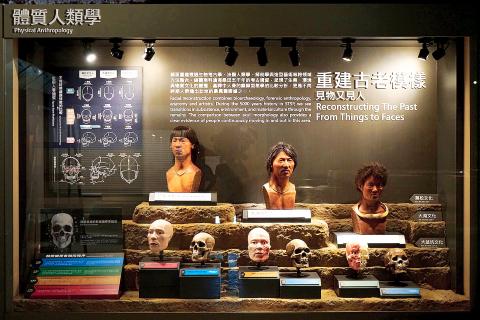
Photo: CNA
“The rice pellets show us that people lived in the area 5,000 years ago,” she said.
Another exhibition highlight is a jade necklace, determined to be 2,100 to 2,800 years old, which is made from 188 pieces.
“The diameter of each jade piece is about 0.2cm to 0.6cm. These pieces are originally from Hualien, which is very interesting because it shows that 2,800 years ago, people could find products from Hualien in Tainan,” Museum of Archaeology research assistant Sung Yu-chieh (宋昱潔) said.
Another discovery on display is the “three superimposed burials” — the skeletal remains of three adult males buried on top of each other 800 to 1,300 years ago.
The body at the bottom was buried the earliest, while the other two were buried closer together, Sung said, adding that back then, people who lived in the Southern Taiwan Science Park area often used to bury bodies on top of one another.
Ancient burial sites in the area have often been found near the remain of homes, according to the museum’s information guide.
People began digging for artifacts in the area 24 years ago, and so far more than 8 million artifacts have been found, Wang said.
Eighty-two historical cultural sites have been discovered in the Southern Taiwan Science Park area, encompassing more 3,000 hectares, Wang said.
“The museum aims to show the public how people lived thousands of years ago and hopes to promote the understanding of history and culture,” Wang said. “The museum’s collection reflects the pride of Taiwan.”
The Museum of Archaeology is one of the world’s only archaeology museums within a science park, Minister of Culture Cheng Li-chiun (鄭麗君) said.
Museum of Archaeology research assistant Huang Yu-lin (黃于琳) said that 540 items consisting primarily of artifacts unearthed in the Tainan area were displayed on the opening day.
They are among about 8 million artifacts collected in parts of the science park and Tainan’s Tree Valley Park, many of which date back 300 to 5,500 years, she added.
To celebrate the official opening, visitors can enter free of charge this weekend.
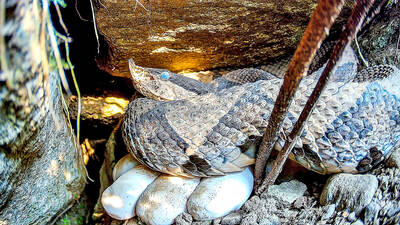
NATURE TAKES ITS COURSE: The agency’s head said he felt a sense of loss watching red-banded snakes eat the babies, as they had decided on non-intervention The Forestry and Nature Conservation Agency yesterday released a documentary on a hundred-pace viper that had incubated 16 eggs, all of which hatched, but only a baby viper escaped after they were attacked by red-banded snakes. The agency’s Taichung branch last year launched the viper reproduction monitoring project soon after forest rangers Lin Chun-yu (林俊佑) and Chou Chia-cheng (周家成) spotted a pregnant hundred-pace viper in a grass-covered burrow near a parking lot in Tbulan Village (松鶴部落). The Atayal village, in Taichung’s Heping District (和平), is headed by Ecyang Yapu, who was positive about the project and assisted in access control and power

The Coast Guard Administration (CGA) yesterday said that it had deployed vessels to “monitor” Chinese ships operating in waters off the east coast. The CGA said it dispatched vessels in response to a China Coast Guard announcement that it had carried out another “routine law-enforcement patrol” in waters off the east coast. “The CGA firmly rejects China’s cognitive warfare campaign of ‘law enforcement in name, jurisdictional expansion in practice,’” it said on X. As of 11am yesterday, two China Coast Guard ships were “loitering and drifting” about 105 nautical miles (195km) and 74 nautical miles east of Green Island (綠島) respectively, it said. It
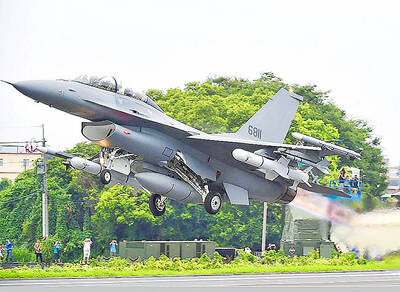
A sharp rise in compensation to be paid by air force officers who leave before completing their required service could indicate an increase in pilots leaving the military early, an analyst said on Friday, warning that the trend could worsen a shortage of experienced personnel. Chieh Chung (揭仲), a researcher at the Association for Strategic Foresight, issued the warning even though the number of volunteer military personnel is expected to increase next year. The planned headcount for volunteer military personnel, covering officers, noncommissioned officers (NCO) and enlisted soldiers, is 158,223 for next year, up 4,258 from 153,965 this year, Chieh said. The increase
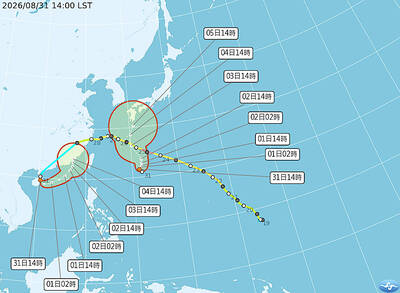
A tropical depression near Hainan that was once Typhoon Saudel may once again strengthen into a tropical storm, the Central Weather Administration (CWA) said yesterday, but a sea warning for waters around Taiwan is unlikely. CWA forecaster Huang En-hung (黃恩鴻) said that Saudel would return to being a weak tropical storm by late yesterday or early this morning. However, as the storm is to gradually weaken again and would head toward China’s Guangdong Province away from Taiwan, the chances that it would affect Taiwan enough for the CWA to issue a sea warning are relatively low,


 RSS
RSS