

Former president Ma Ying-jeou (馬英九) yesterday slammed President Tsai Ing-wen (蔡英文) for refusing to acknowledge the so-called “1992 consensus” and plunging cross-strait relations into a state of “cold confrontation,” while placing all of her hope on the US.
“Tsai’s administration has adopted a lopsided foreign policy that is slanted toward the US, but have Taiwan-US relations really improved?” Ma asked in a speech at a Taipei seminar on national security.
Despite US President Donald Trump having signed off on the Taiwan Travel Act, no ministerial visits have been made by either side, Ma told the seminar, which was hosted by his foundation.
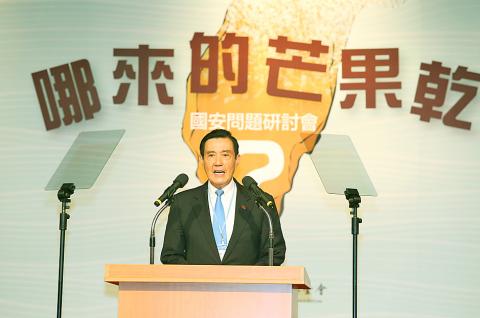
Photo: CNA
In 2014, during Ma’s time in office, then-US Environmental Protection Agency administrator Gina McCarthy visited Taiwan, and some of his Cabinet members visited the US, he added.
Before the Solomon Islands broke off ties with Taiwan last month, Washington vainly voiced its concern over the potential switch in diplomatic ties, Ma said.
Due to Tsai’s “backsliding cross-strait ties,” the nation has lost seven diplomatic allies, whereas the nation only lost one during Ma’s eight years in office thanks to the “diplomatic truce” his administration had with Beijing, he said.
Tsai — nicknamed “the spice Taiwanese girl” by her fans — claims she is protecting the nation’s sovereignty when she has only degraded it, Ma said, adding that if Tsai does not right her wrongs, she is doomed to go down in history as the “cut-ties president” who humiliated Taiwan.
Talks between Taiwan and the US under the bilateral Trade and Investment Framework Agreement (TIFA) have not been held since 2016, he added.
The Tsai administration has tried to use “hipster-esque language” to talk up its achievements in furthering Taiwan-US relations, but bilateral ties under Tsai have been quite “FBI” (friendly but inconsequential), Ma said.
His and Tsai’s administrations have both purchased weapons from the US, but his administration used arms procurement as a third layer of defense, following a secure Taiwan Strait and a diplomatic truce, Ma said.
Tsai’s administration first provokes China, then buys weapons from the US, which not only fails to promote peace in the Taiwan Strait, but also draws the criticism that her administration is paying the US tribute (protection fees), he added.
When the Trump administration unveiled the Indo-Pacific strategy aimed at stemming Chinese influence, the Tsai administration quickly opted in, but China has become the second-largest economy in the world, and Japan, India and ASEAN no longer capitulate to the US on every issue, he said.
Tsai is adamant about working with the US to confront China, which could cause Taiwan to lose its strategic advantage and turn the nation into a bargaining chip in a power struggle between the US and China, Ma said.
Tsai has instilled fear in Taiwanese by evoking “dried mango strips” (芒果乾) — a word play on “a sense of the nation’s impending doom” (亡國感) — banking on increased anti-China sentiment to bring her votes in next January’s presidential election, he said.
Ma said he remembered Tsai saying on Facebook shortly before taking office that people should “discard a government that escalates competition in an election by creating social division and terrorizing the public like they discard tainted food products manufactured by unscrupulous means.”
The post seems a fitting portrayal of Tsai’s performance in office, he said, adding that people should oust the Tsai administration in next year’s elections to help bring Taiwan back to the right path.
Separately yesterday, Tsai said that Ma’s awareness of what is happening around him seems not to have been updated for a long time.
If the so-called “dried mango strips” are true, Ma likely planted the mangoes in the first place, she said.
The so-called “1992 consensus,” a term former Mainland Affairs Council chairman Su Chi (蘇起) in 2006 admitted making up in 2000, refers to a tacit understanding between the Chinese Nationalist Party (KMT) and the Chinese government that both sides of the Strait acknowledge there is “one China,” with each side having its own interpretation of what “China” means.
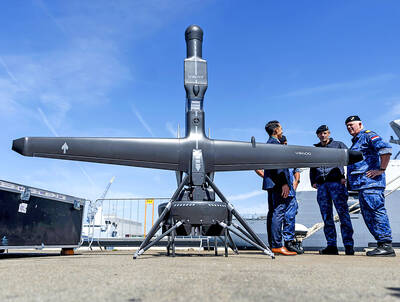
DEFENSE PROCUREMENT: Taiwan could become the largest operator of V-BAT drones outside the US once they are delivered, the Ministry of National Defense said The navy and the coast guard are acquiring 292 units of MQ-35A V-BAT vertical takeoff and landing (VTOL) surveillance drones manufactured by US-based defense technology company Shield AI, making Taiwan one of the largest buyers of the drone. The Coast Guard Administration budgeted NT$1.2 billion (US$37.1 million) to buy 12 drones, which have been delivered, Shield AI said in a report on Oct 13. The navy is planning to spend NT$36 billion under a four-year program code-named Project Yuan Xiao (遠鴞) to acquire 280 V-BAT drones, the Ministry of National Defense’s fiscal 2027 report showed. The combined procurement is expected
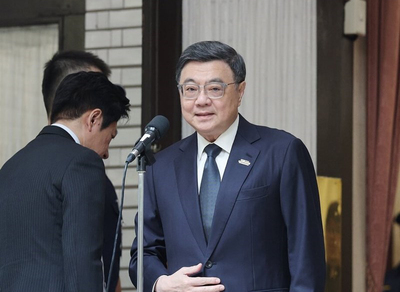
The government would continue monitoring online rumors that a pneumonic plague outbreak has spread from Russia into China and could enhance existing quarantine measures, Premier Cho Jung-tai (卓榮泰) said today. During a legislative meeting, Democratic Progressive Party Legislator Wang Ting-yu (王定宇) said rumors were circulating that the disease had spread across several Chinese provinces. He asked Cho whether the government was prepared to prevent the disease from spreading to Taiwan, given the frequent exchanges between Taiwan and China, and how concerned the government was about the alleged outbreak. The Ministry of Health and Welfare implemented border quarantine measures after briefing the Executive Yuan
A Chinese People's Liberation Army (PLA) Navy aircraft carrier group was being monitored after entering the western Pacific, the Ministry of National Defense said today, after Beijing yesterday criticized Taiwan for using a water cannon against a Chinese fishing boat near the Pratas Islands (Dongsha Islands, 東沙群島). A Chinese naval task group led by the aircraft carrier Liaoning (遼寧) yesterday sailed to the western Pacific for training, Chinese state-run Xinhua news agency quoted the PLA Navy as saying. “The drill is part of the annual routine training plan aimed at testing and improving the troops’ combat readiness and enhancing their ability to

MAYORAL RACE: Su Chiao-hui made gains by persuading undecided voters and winning over voters in KMT-leaning districts, a pollster said Legislator Su Chiao-hui (蘇巧慧), the Democratic Progressive Party’s (DPP) candidate for New Taipei City mayor, has a 13.1 percentage point lead over her Chinese Nationalist Party (KMT) rival Lee Shu-chuan (李四川), a poll released yesterday showed. The poll, commissioned by the Taipei Trust in Democracy Association, showed that 43.1 percent of respondents said they would vote for Su, up 7.9 percentage points from a poll conducted in late August, while support for Lee was at 30 percent, down 4.7 percentage points. It showed that 48.6 percent of respondents thought Su would make a suitable mayor, compared with 35.9 percent for Lee. Independent candidate


 RSS
RSS