


Taiwan could face the same problem as Hong Kong if it does not solve the issue of high rent and housing prices, Taipei Mayor Ko Wen-je (柯文哲) said yesterday, as he unveiled a new housing policy called “Housing Justice 2.0.”
The housing price-to-income ratio has worsened to 15 from 8.6 about 30 years, Ko told a news conference in Taipei.
“High rent and housing prices are a big problem in Hong Kong, causing class struggle, a widening wealth disparity and accumulating resentment among young people,” he said.
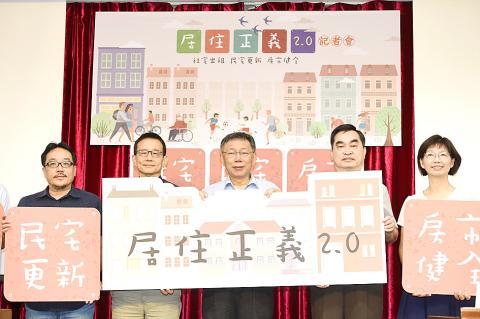
Photo: George Tsorng, Taipei Times
“Hong Kong’s problem today could become Taiwan’s tomorrow if we do not solve the problem of high rent and housing prices now,” he said.
Citing an example, he said that passenger traffic at the MRT Ximen Station (西門站) during the annual Lantern Festival increased by about 16 percent, but many young store owners told him that they did not make more money, because commercial rent jumped by about 2.5 times in a short period.
The three main problems that the Housing Justice 2.0 policy aims to solve are high rent and housing prices, a surplus of vacant houses and the overly low cost of owning vacant houses, Taipei Deputy Mayor Teng Chia-chi (鄧家基) said.
“Housing justice for the younger generation is a serious problem that needs to be addressed,” Organization of Urban REs secretary-
general Peng Yang-kai (彭揚凱) said.
If housing costs continue to increase, especially in Taipei, young people would be forced to move out of the city, the birthrate would drop and Taipei might become “a city filled with elderly people,” which would seriously affect its human resources development and competitiveness, he said.
To ease the problem, non-governmental organizations have called on the government to establish a healthy residential housing market, develop a healthy rental market and provide more public housing instead of rent subsidies.
Teng said the Housing Justice 2.0 policy aims to build more public housing, amend the house tax rate to ease the burden on people who own only one house that they are living in, raise the tax on owning vacant houses, provide rental subsidies and increase housing price transparency.
Establishing an actual house selling price registration system is difficult as it would require amending national regulations, Taipei Department of Land Administration Commissioner Chang Chih-hsiang (張治祥) said.
The department launched the nation’s first community house transaction traceability database in July, which allows the public to search for transaction records of apartments in the same community or building over the past few years, she said.
Taipei was the first local government to reduce the house tax rate from 1.2 percent to 1 percent in July 2017 for people who own only one household-registered unit, and plans to further reduce it to 0.6 percent, Taipei Department of Finance Commissioner Chen Jia-jen (陳家蓁) said.
The department is also planning to allow multiple homeowners who rent out their empty houses through a subletting and management program to pay a property tax of only 0.6 percent as an incentive to revitalize the city’s vacant houses, she said.
The policy’s ultimate goal is to create at least 50,000 public housing units, increase the rental subsidy from 14,000 to 20,000 households, modify house tax rates, encourage owners to rent out vacant houses and enhance the transparency of house transaction price register, Ko said.
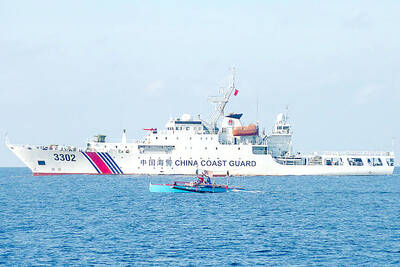
EXPANSIONIST: China deploys an average of 40 to 50 warships and coast guard vessels daily in the South China Sea, despite pledges not to militarize the region, an official said China is attempting to expand its influence across the First Island Chain and increase pressure on Japan by sending coast guard vessels into waters off of Taiwan under the pretext of maritime negotiations with Japan and the Philippines, a national security official said yesterday. China’s recent actions in the waters east of Taiwan and Japan and the Philippines’ exclusive economic zones (EEZ) are attempts to establish dominance in First Island Chain waters, said the official who declined to be named, adding that this is “expansion disguised as law enforcement.” Framing China’s actions solely as a cross-strait issue is a serious misjudgment that
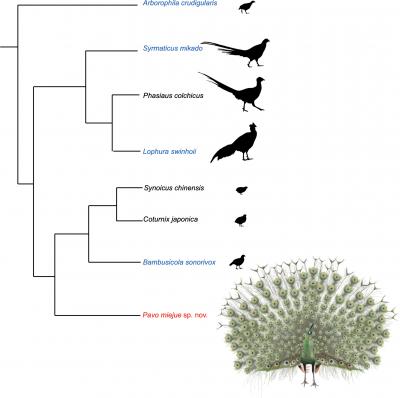
Through analyzing fossil evidence, a research team at National Taiwan University (NTU) discovered the largest endemic bird to have lived in Taiwan, naming it Pavo miejue, or extinct peafowl (滅絕孔雀). The Mikado pheasant, which is printed on the back of the NT$1,000 bank note, was previously believed to be the biggest endemic bird to Taiwan. The research team’s findings suggest that Pavo miejue lived during the Pleistocene epoch tens of thousands of years ago. It is the first endemic extinct bird species discovered and formally named in Taiwan. The study was coauthored by NTU Institute of Ecology and Evolutionary Biology professor Tsai Cheng-hsiu (蔡政修),
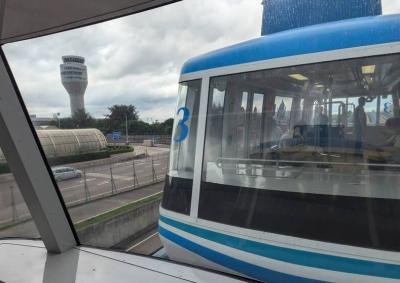
Taiwan Taoyuan International Airport is to suspend its automated Skytrain service connecting Terminal 1 and Terminal 2 starting on July 1 to facilitate connection works for the upcoming Terminal 3, the airport operator said today. Passengers and staff who need to travel between the two terminals after the suspension can instead use the Taoyuan MRT or the airport's 24-hour shuttle bus service, Taoyuan International Airport Corp said. The Taoyuan MRT Airport Line directly links the two terminals, while the shuttle buses are to operate around the clock, the company added. The Skytrain provides free transportation between the airport’s two terminals for travelers and
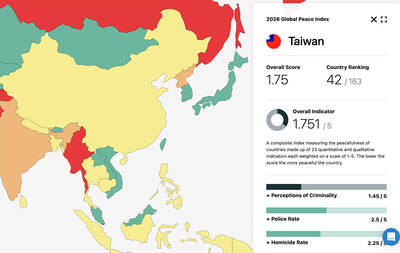
Taiwan ranked 42nd in terms of peacefulness among 163 countries, down five places from last year, according to this year’s Global Peace Index. With an overall score of 1.751, Taiwan dropped from 37th last year, the report published by the global Institute for Economics and Peace showed. The overall score measures a country’s level of peacefulness using 23 quantitative and qualitative indicators across three domains — ongoing domestic and international conflict, societal safety and security, and militarization. While Taiwan ranked 42nd worldwide, it was listed in ninth place among the 19 Asian-Pacific countries in the report, after New Zealand, Singapore, Japan, Malaysia,


 RSS
RSS