


The Taiwan Computing Cloud platform, which is backed by domestically developed supercomputer Taiwania 2, is to be opened to commercial use next month, featuring lower application fees and better security than foreign suppliers, the National Applied Research Laboratories (NARL) said.
The platform was built by the NARL’s National Center for High-performance Computing and local firms Asustek Computer Inc, Quanta Computer Inc and Taiwan Mobile Co, with a goal of accelerating the nation’s artificial intelligence (AI) development, the Ministry of Science and Technology said.
The platform is run on the center’s Taiwania 2, which has 2,016 of Nvidia’s Tesla V100 graphic processing units (GPUs) and a computing capacity of 9 quadrillion floating-point operations per second, the ministry said.
The program has been running trials since May, center deputy director-general Lin Hsi-ching (林錫慶) told the Taipei Times on Tuesday.
Companies at least 30 percent owned by Chinese investors would be barred from using the platform, in line with Ministry of Economic Affairs regulations, Lin said.
The center has drafted three tiers of fees for ordinary businesses, start-ups and government agencies, with the proposal awaiting ministry approval, he said.
Businesses would pay less than NT$100 for an hour of GPU use, which is a better deal than offered by major cloud suppliers such as Google, Microsoft and Amazon, he said.
Start-ups and government agencies would pay even less, he added.
The ministry is to complete its review of the fees in about a week, Department of Foresight and Innovation Policies Director-General Yang Hsiu-ya (楊琇雅) said.
Data processing and local storage are other advantages of the platform, Lin said.
Previously, those needing cloud computing had to purchase services from foreign suppliers, which risked exposing valuable data — such as those collected by healthcare providers, manufacturers and semiconductor developers — to security risks and time costs, Lin said.
To protect data, the center would limit access to the platform, he said.
Taiwania 2 was named the world’s 20th-fastest computer in the Top500 Supercomputer List released in November last year, but dropped to 23rd on the list released in June.
The drop shows how nations are vying to build more efficient supercomputers, Lin said.
“Computing power is a nation’s power,” he added.

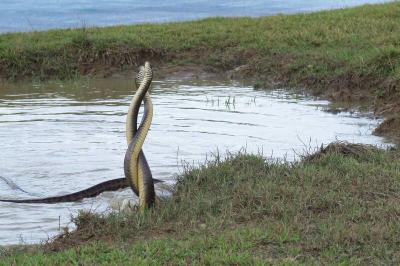
Kenting National Park service technician Yang Jien-fon (楊政峰) won a silver award in World Grand Prix Photography Awards Spring Season for his photograph of two male rat snakes intertwined in combat. Yang’s colleagues at Kenting National Park said he is a master of nature photography who has been held back by his job in civil service. The awards accept entries in all four seasons across six categories: architectural and urban photography, black-and-white and fine art photography, commercial and fashion photography, documentary and people photography, nature and experimental photography, and mobile photography. Awards are ranked according to scores and divided into platinum, gold and
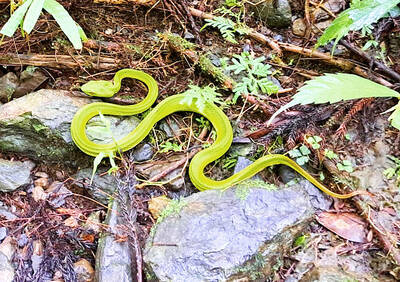
More than half of the bamboo vipers captured in Tainan in the past few years were found in the city’s Sinhua District (新化), while other districts had smaller catches or none at all. Every year, Tainan captures about 6,000 snakes which have made their way into people’s homes. Of the six major venomous snakes in Taiwan, the cobra, the many-banded krait, the brown-spotted pit viper and the bamboo viper are the most frequently captured. The high concentration of bamboo vipers captured in Sinhua District is puzzling. Tainan Agriculture Bureau Forestry and Nature Conservation Division head Chu Chien-ming (朱健明) earlier this week said that the
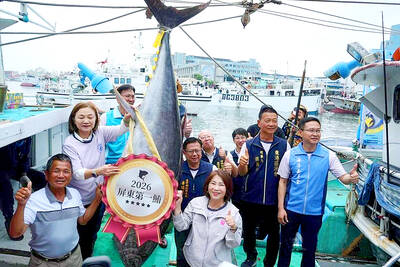
The first bluefin tuna of the season, brought to shore in Pingtung County and weighing 190kg, was yesterday auctioned for NT$10,600 (US$333.5) per kilogram, setting a record high for the local market. The auction was held at the fish market in Donggang Fishing Harbor, where the Siaoliouciou Island-registered fishing vessel Fu Yu Ching No. 2 delivered the “Pingtung First Tuna” it had caught for bidding. Bidding was intense, and the tuna was ultimately jointly purchased by a local restaurant and a local company for NT$10,600 per kilogram — NT$300 ,more than last year — for a total of NT$2.014 million. The 67-year-old skipper
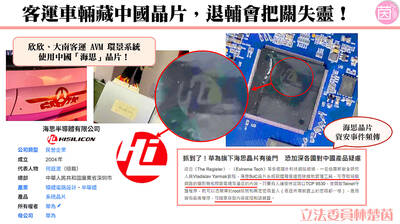
BREACH OF CONTRACT: The bus operators would seek compensation and have demanded that the manufacturer replace the chips with ones that meet regulations Two bus operators found to be using buses with China-made chips are to demand that the original manufacturers replace the systems and provide compensation for breach of contract, the Veterans Affairs Council said yesterday. Democratic Progressive Party Legislator Michelle Lin (林楚茵) yesterday said that Da Nan Bus Co and Shin-Shin Bus Co Ltd have fielded a total of 82 buses that are using Chinese chips. The bus models were made by Tron-E, while the systems provider was CYE Electronics, Lin said. Lin alleged that the buses were using chips manufactured by Huawei subsidiary HiSilicon Co, which presents a national security risk if the


 RSS
RSS