


Hikers who plan on ascending to high altitudes should consult a doctor about altitude sickness medication before their departure, a family doctor in Taichung said after a 24-year-old college student narrowly escaped death on Hehuanshan (合歡山).
A man surnamed Tsai (蔡) and his friends had planned on summiting their first baiyue (百岳, a mountain higher than 3km above sea level) before graduation, said Wu Han-ming (巫翰明), a physician at Asia University Hospital’s department of family medicine.
Although he exercised regularly, he had not prepared for the altitude change, Wu said.
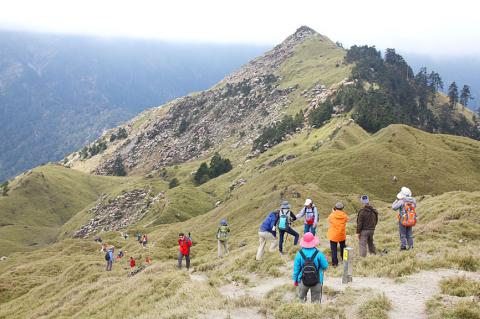
Photo: Tung Chen-kuo, Taipei Times
Midway through the trek, which they were trying to complete quickly, he began experiencing symptoms of altitude sickness, including shortness of breath, headaches, dizziness and malaise, he said.
His friend had luckily gotten a prescription for altitude sickness meditation before the trip and it alleviated his symptoms, saving his life, he said.
Altitude sickness has more to do with personal predisposition than fitness and can be prevented by taking medication one day before hiking, he said.
Travelers should consult a doctor and get a prescription prior to departure, Wu added.
The thin air at higher altitudes is the primary cause of altitude sickness, in addition to the body’s inability to adapt to the rise in elevation, resulting in hypoxemia and then deterioration in the functions of the heart, brain or other parts of the body, the physician said.
The oxygen level at 3km is only about 70 percent of that near sea level, Wu said, adding that the risk is present at 2.1km above sea level or higher.
Many hikers have to be rescued from baiyue due to severe cases of altitude sickness each year, with more than one-quarter of hikers on Jade Mountain (玉山) showing signs of acute mountain sickness (AMS), he said.
Altitude sickness is the third leading cause of non-accidental injury while traveling, behind only the common cold and stomach flu, Wu said, citing a foreign study.
Altitude sickness includes AMS, high-altitude cerebral edema and high-altitude pulmonary edema (HAPE), he said.
The main symptoms of AMS include headaches, dizziness, fatigue, lack of strength, nausea, vomiting, loss of appetite and insomnia, he said.
These symptoms typically emerge six to 12 hours after reaching high altitudes and go away on their own after two to three days as the body adapts to the environment, he said.
In a small number of cases, AMS could worsen into HAPE, with the primary symptom being an unsteady gait, he said, adding that if HAPE is not treated within 24 hours or if the person does not move to a lower altitude immediately, they could die.
Sometimes altitude sickness also causes severe headaches, hallucinations or loss of consciousness, he said.
The earliest signs of HAPE include poor physical performance, shortness of breath, faster heartbeat and dry coughs, he said, adding that resting does not make it easier to breathe, and people with HAPE could also cough up saliva with blood.

Considering that most countries issue more than five denominations of banknotes, the central bank has decided to redesign all five denominations, the bank said as it prepares for the first major overhaul of the banknotes in more than 24 years. Central bank Governor Yang Chin-lung (楊金龍) is expected to report to the Legislative Yuan today on the bank’s operations and the redesign’s progress. The bank in a report sent to the legislature ahead of today’s meeting said it had commissioned a survey on the public’s preferences. Survey results showed that NT$100 and NT$1,000 banknotes are the most commonly used, while NT$200 and NT$2,000

The Centers for Disease Control (CDC) yesterday reported the first case of a new COVID-19 subvariant — BA.3.2 — in a 10-year-old Singaporean girl who had a fever upon arrival in Taiwan and tested positive for the disease. The girl left Taiwan on March 20 and the case did not have a direct impact on the local community, it said. The WHO added the BA.3.2 strain to its list of Variants Under Monitoring in December last year, but this was the first imported case of the COVID-19 variant in Taiwan, CDC Deputy Director-General Lin Ming-cheng (林明誠) said. The girl arrived in Taiwan on

ANNUAL EVENT: Two massive Pokemon balloons are to be set up in Daan Park, with an event zone operating from 10am to 6pm This year’s Taipei Floral Picnic is to be held at Daan Park today and tomorrow, featuring an exclusive Pokemon Go event, a themed food market, a coffee rave picnic area and stage performances, the Taipei Department of Information and Tourism said yesterday. Two massive Pokemon balloons are to be set up in the park as attractions, with an exclusive event zone operating from 10am to 6pm, it said. Participants who complete designated tasks on-site would have a chance to receive limited-edition souvenirs, it added. People could also try the newly launched game Pokemon Pokopia in the trial area, the department said. Three PokeStops are

South Korea is planning to revise its controversial electronic arrival card, a step Taiwanese officials said prompted them to hold off on planned retaliatory measures, a South Korean media report said yesterday. A Yonhap News Agency report said that the South Korean Ministry of Foreign Affairs is planning to remove the “previous departure place” and “next destination” fields from its e-arrival card system. The plan, reached after interagency consultations, is under review and aims to simplify entry procedures and align the electronic form with the paper version, a South Korean ministry official said. The fields — which appeared only on the electronic form


 RSS
RSS