


There have been 303 imported cases of dengue fever this year, the highest number in a decade, the Centers for Disease Control (CDC) said yesterday.
Seventeen imported cases were confirmed last week, bringing the total since last month to 107 as of Monday, Epidemic Intelligence Center Director Liu Ting-ping (劉定萍) said.
People who were confirmed to have dengue in the past month were mostly infected in Vietnam, Cambodia and the Philippines, and more than 90 percent of the cases confirmed this year came from infections picked up in Southeast Asian countries, she said.
This is peak transmission season for dengue fever in the Philippines, Sri Lanka, Laos, Maldives, Vietnam, Malaysia, Thailand, Cambodia, Singapore and Indonesia, and the CDC has issued a level 1 travel advisory for these nations, as well as Myanmar and India, she said.
The Philippines last week declared a national dengue epidemic, after at least 622 people died of the mosquito-borne disease since January. It has recorded 146,062 cases this year as of July 20.
The El Nino effect last month intensified extreme weather and high temperatures, so the dengue situation in Southeast Asia is more serious than in the past few years, CDC Deputy Director-General Chuang Jen-hsiang (莊人祥) said.
As summer is high season for travel, a significant increase in the number of cases has been seen since last month, Chuang said.
There have also been 30 imported cases of Chikungunya fever this year, the highest for the same period since 2007, he said, adding that most of the patients were also infected in Southeast Asia.
Chuang urged people who are traveling to countries where the two mosquito-borne diseases are spreading to wear brightly colored long-sleeve clothing, apply insect repellent, stay in places with air conditioning or window and door screens or mosquito nets to avoid mosquito bites.
In other health news, the CDC said that a serious case of enterovirus complication was confirmed last week in a two-year-old boy living in central Taiwan.
The boy has since recovered and been discharged from hospital, the agency said.
The boy late last month developed a fever and oral ulcers, prompting his family to seek treatment, CDC physician Lin Yung-ching (林詠青) said.
He later developed weakness in the limbs and low vitality, and was diagnosed with coxsackievirus A10 infection and acute flaccid paralysis, Lin said.
Among the 26 cases of serious enterovirus complications confirmed this year, 19 were in children under five, he said.
Adults and children should wash their hands frequently with soap, maintain good personal hygiene and indoor air ventilation to reduce the risk of enterovirus infection, Lin said.


Kenting National Park service technician Yang Jien-fon (楊政峰) won a silver award in World Grand Prix Photography Awards Spring Season for his photograph of two male rat snakes intertwined in combat. Yang’s colleagues at Kenting National Park said he is a master of nature photography who has been held back by his job in civil service. The awards accept entries in all four seasons across six categories: architectural and urban photography, black-and-white and fine art photography, commercial and fashion photography, documentary and people photography, nature and experimental photography, and mobile photography. Awards are ranked according to scores and divided into platinum, gold and

More than half of the bamboo vipers captured in Tainan in the past few years were found in the city’s Sinhua District (新化), while other districts had smaller catches or none at all. Every year, Tainan captures about 6,000 snakes which have made their way into people’s homes. Of the six major venomous snakes in Taiwan, the cobra, the many-banded krait, the brown-spotted pit viper and the bamboo viper are the most frequently captured. The high concentration of bamboo vipers captured in Sinhua District is puzzling. Tainan Agriculture Bureau Forestry and Nature Conservation Division head Chu Chien-ming (朱健明) earlier this week said that the
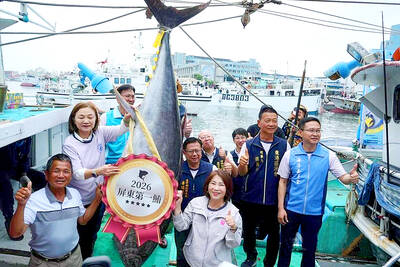
The first bluefin tuna of the season, brought to shore in Pingtung County and weighing 190kg, was yesterday auctioned for NT$10,600 (US$333.5) per kilogram, setting a record high for the local market. The auction was held at the fish market in Donggang Fishing Harbor, where the Siaoliouciou Island-registered fishing vessel Fu Yu Ching No. 2 delivered the “Pingtung First Tuna” it had caught for bidding. Bidding was intense, and the tuna was ultimately jointly purchased by a local restaurant and a local company for NT$10,600 per kilogram — NT$300 ,more than last year — for a total of NT$2.014 million. The 67-year-old skipper
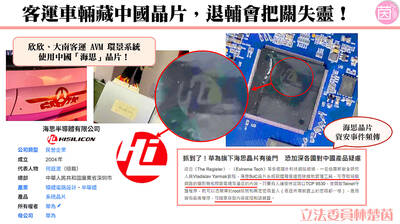
BREACH OF CONTRACT: The bus operators would seek compensation and have demanded that the manufacturer replace the chips with ones that meet regulations Two bus operators found to be using buses with China-made chips are to demand that the original manufacturers replace the systems and provide compensation for breach of contract, the Veterans Affairs Council said yesterday. Democratic Progressive Party Legislator Michelle Lin (林楚茵) yesterday said that Da Nan Bus Co and Shin-Shin Bus Co Ltd have fielded a total of 82 buses that are using Chinese chips. The bus models were made by Tron-E, while the systems provider was CYE Electronics, Lin said. Lin alleged that the buses were using chips manufactured by Huawei subsidiary HiSilicon Co, which presents a national security risk if the


 RSS
RSS