


A petition to block Taipei Mayor Ko Wen-je (柯文哲) from registering his political party under the name Taiwan People’s Party (台灣民眾黨) passed its initial legal review, the online public policy platform showed yesterday.
From its launch on Friday last week to press time last night, the petition had gathered 1,115 signatures. It must collect 5,000 signatures by Oct. 5 to require the government to issue an official response, according to join.gov.tw.
The petition’s sponsor, former Tainan deputy mayor Tseng Hsu-cheng (曾旭正), has said that Ko should not be allowed to “muddle history” by reusing the name of the party that Taiwanese democracy pioneer Chiang Wei-shui (蔣渭水) founded in 1927.
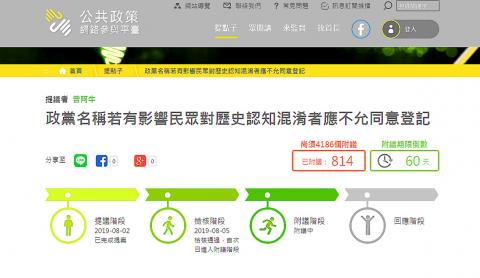
Photo: Hung Jui-ching, Taipei Times
Following yesterday’s announcement, Tseng on Facebook called on the public to sign the petition, saying that the news was a “gift” for Ko after his convention to found the party was officially formed earlier yesterday.
“A politician has proposed registering a new political party under the name Taiwan People’s Party, while bearing no resemblance in purpose, spirit or character to the Taiwan People’s Party of the past century or its founder, Chiang,” the petition reads. “It is deeply inappropriate to allow the machinations of politicians to mislead innocent members of the public in their understanding of history.”
The Ministry of Culture should explain the historical relevance of Chiang’s movement, while the Ministry of the Interior should amend the Political Parties Act (政黨法) to close the loophole that would allow Ko to use the name, it says.
The petition would “protect a historical and cultural heritage from pollution” and “ensure that the farcical plagiarism of history by political parties will not repeat itself,” the organizers said.
Under the act, the name or abbreviation of a political party should not be similar or identical to a political party that has already been established, have potential for confusion with a governmental or nonprofit organization, or incite discrimination or hatred.
It also stipulates that the responsible agency should establish a body to arbitrate “doubts or concerns ... regarding a political party’s disciplinary actions, name, abbreviation or emblem, or other related matters.”
The Ministry of the Interior would convene a committee to review Ko’s application if the petition obtains the necessary number of signatures, a source said on condition of anonymity.

NATIONAL SECURITY: Authorities are working to confirm the identities of the military personnel involved and investigating possible illegal conduct and regulatory violations Authorities are probing possible national security implications after Kinmen police and immigration officers on Sunday found a Chinese woman allegedly posing as a tourist while engaging in prostitution involving more than 10 military personnel. The woman, surnamed Chen (陳), has since been deported, authorities said, adding that investigators are still working to confirm the identities of those implicated, as the records only listed code names and aliases. The case stemmed from a report received by the Kinmen District Prosecutors’ Office on Friday last week from the Jinhu Precinct of the Kinmen County Police Bureau. On Sunday, police, along with the National Immigration

REASONS FOR TRAVEL: An assistant professor said that proposed amendments to penalize drivers if they used drugs overseas would not deter people from traveling People who operate a motor vehicle under the influence of marijuana would have their driver’s license revoked, even if they used the substance while overseas, the Ministry of Transportation and Communications said yesterday, citing proposed amendments to the Road Traffic Management and Penalty Act (道路交通管理處罰條例). The amendments would also authorize the government to revoke the licenses of people determined to have used Category 1 or Category 2 narcotics, even if they were not operating a vehicle while under the influence of drugs, as well as ban them from taking the license test for three years, the ministry said. People aged 18 or

GLOBALGIVING: ‘ Caving to external pressure is not acceptable for an organization that has cultivated justice reform and human rights for 30 years,’ one NGO said A slew of non-government organizations (NGOs) have withdrawn from the GlobalGiving fundraising platform after it announced it would use “Chinese Taipei” instead of “Taiwan” from next month. The Taiwan Good Rice Association wrote on Facebook on Friday that it was informed on April 28 via a teleconference call of the change, which was made because the platform wanted to operate in China. Taiwan Good Rice is to terminate all cooperative relationships with GlobalGiving in response to the platform’s “unilateral and non-negotiable” decision to remove references to Taiwan, the NGO said. “Taiwan is in the official name of Taiwan Good Rice Association and the

HEAVY WEATHER: Typhoon Jangmi is due to crash straight into the Ryukyus as airlines look to shift flights to larger aircraft or cancel flights to Okinawa entirely Taiwan’s international air carriers announced flight adjustments over the weekend as Typhoon Jangmi is forecast to hit the Ryukyu Islands today and tomorrow. The Central Weather Administration (CWA) upgraded Jangmi from a tropical storm to a typhoon at 8am yesterday, with the eye located 580km south of Naha city. It was moving north at 19kph. Today, China Airlines’ CI-120, CI-121, CI-122 and CI-123 flights between Taoyuan and Naha, Okinawa, have been canceled as well as CI-132 and CI-133 between Kaohsiung and Naha. EVA Air’s BR-112, BR-113, BR-186 and BR-185 flights between Taoyuan and Naha are also canceled. Low-cost carrier Tigerair Taiwan canceled IT-230,


 RSS
RSS