


Democratic Progressive Party Secretary-General Luo Wen-chia (羅文嘉) and Hong Kong bookseller Lam Wing-kei (林榮基) yesterday discussed the right to political protest at a public event, at which Lam also announced his plan to open a bookstore in Taipei.
Billed as “A Dialogue Between Two Bookstore Bosses,” Luo and Lam discussed politics, democracy, repression by China and promoting reading among the youth under the theme: “Today Hong Kong, Tomorrow Taiwan?”
Operating a bookstore under an oppressive regime is very dangerous, said Luo, who also owns Buffalo Bookstore, the venue for the dialogue.
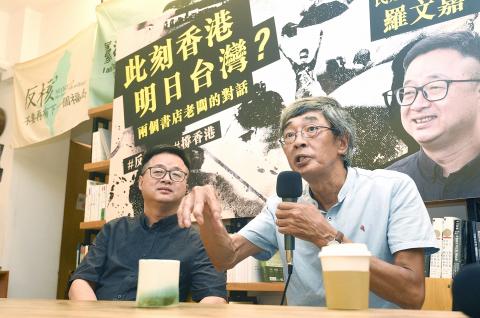
Photo: George Tsorng, Taipei Times
As the founder of Causeway Bay Books in Hong Kong, Lam stocked political books, Luo said, adding that Lam was arrested in 2015 when crossing the border into Shenzhen, and was detained and tortured by Chinese authorities for eight months.
“This is why [Hong Kong] protesters are fighting against the extradition bill, because China kidnapped Lam illegally... From this case, people there realized that China’s promise of ‘one country, two systems’ was impossible, and they see the bill as a way for Chinese authorities to legitimize such illegal kidnappings,” Luo said.
“Many Hong Kongers said they are now under darkness, but are hoping to return to the sunshine. We must wonder why there are Taiwanese who are living in the sunshine, but want to live in darkness,” Luo said.
Lam said he plans to open a bookstore in Taipei’s Ximending (西門町), because it is a popular area for young people.
“Taiwan’s youth are looking at their mobile phones all the time. If they do not read books, they will not have a good understanding of the outside world, which ... poses a grave danger for Taiwan’s future,” Lam said.
His vision is to open a bookstore where people can connect.
“It could become a place for academics, youths and students to communicate and interact with each other, so it would not just be for selling books,” Lam said.
Lam said that his Taiwanese visa expires next month, “but I know I cannot go back to Hong Kong.”
He said he hopes the government would let him stay and open a bookstore.
“Bookstores are small, and difficult to manage and keep going, but ruling regimes are fearful of them, because a bookstore has its own soul and its own thoughts,” Luo said. “It would be Taiwan’s good fortune if Lam opened his store in Taipei.”

The military has spotted two Chinese warships operating in waters near Penghu County in the Taiwan Strait and sent its own naval and air forces to monitor the vessels, the Ministry of National Defense (MND) said. Beijing sends warships and warplanes into the waters and skies around Taiwan on an almost daily basis, drawing condemnation from Taipei. While the ministry offers daily updates on the locations of Chinese military aircraft, it only rarely gives details of where Chinese warships are operating, generally only when it detects aircraft carriers, as happened last week. A Chinese destroyer and a frigate entered waters to the southwest
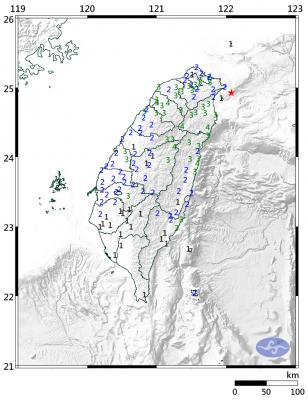
A magnitude 6.1 earthquake struck off the coast of Yilan County at 8:39pm tonight, the Central Weather Administration (CWA) said, with no immediate reports of damage or injuries. The epicenter was 38.7km east-northeast of Yilan County Hall at a focal depth of 98.3km, the CWA’s Seismological Center said. The quake’s maximum intensity, which gauges the actual physical effect of a seismic event, was a level 4 on Taiwan’s 7-tier intensity scale, the center said. That intensity level was recorded in Yilan County’s Nanao Township (南澳), Hsinchu County’s Guansi Township (關西), Nantou County’s Hehuanshan (合歡山) and Hualien County’s Yanliao (鹽寮). An intensity of 3 was

Japanese Prime Minister Sanae Takaichi’s comment last year on Tokyo’s potential reaction to a Taiwan-China conflict has forced Beijing to rewrite its invasion plans, a retired Japanese general said. Takaichi told the Diet on Nov. 7 last year that a Chinese naval blockade or military attack on Taiwan could constitute a “survival-threatening situation” for Japan, potentially allowing Tokyo to exercise its right to collective self-defense. Former Japan Ground Self-Defense Force general Kiyofumi Ogawa said in a recent speech that the remark has been interpreted as meaning Japan could intervene in the early stages of a Taiwan Strait conflict, undermining China’s previous assumptions
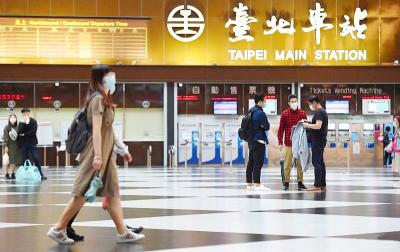
Taiwan Railways Corp (TRC) today announced that Shin Kong Mitsukoshi has been selected as the preferred bidder to operate the Taipei Railway Station shopping mall, replacing the current operator, Breeze Development Co Ltd. Among eight qualified firms that delivered presentations and were evaluated by a review committee, Shin Kong Mitsukoshi was ranked first, while Breeze was named the runner-up, the rail company said in a statement. Contract negotiations are to proceed in accordance with regulations, it said, adding that if negotiations with the top bidder fail, it could invite the second-ranked applicant to enter talks. Breeze in a statement today expressed doubts over


 RSS
RSS