


Yilan County prosecutors yesterday charged a train driver and two Taiwan Railways Administration (TRA) supervisors with criminal negligence in connection with a fatal derailment last year that killed 18 people and injured more than 200.
The driver, Yu Chen-chung (尤振仲), should be held responsible for the derailment of Puyuma Express No. 6432, because he had switched off the automatic train protection (ATP) signaling system while the train was traveling over the speed limit before it derailed near Yilan County’s Suao Township (蘇澳) at 4:50pm on Oct. 21 last year, the Yilan District Prosecutors’ Office said.
An investigation found that the train was traveling at 141kph when approaching a bend near Suao’s Sinma Station (新馬), where the speed limit for the express train was set at 75kph.

Photo: Taipei Times [no photographer credit provided]
“Prior to the incident, at 4:17pm, Yu breached TRA operation rules by switching off the ATP system, after which the train lost the system’s protective function, and Yu failed to report this condition,” the indictment said.
“Yu did not switch the ATP back on at Toucheng Station (頭城), and through subsequent tracks, he missed several other opportunities to switch it back on, causing the speeding train to derail when approaching the Sinma Station,” the indictment said.
“Although Yu later on did tell the dispatcher via radio communication that the ‘ATP system is now switched off,’ it was only 85 seconds before the crash. As the train was going over the speed limit, the dispatcher had no time to give Yu proper instructions,” the indictment said.
“What Yu could have done was to switch the ATP back on or manually reduce the speed before the train approached the bend. However, he neglected to do so, thereby causing the train to derail,” it said.
Yu also said the train’s air compressor system was operating “abnormally,” resulting in reduced air pressure to operate the pneumatic brakes and valves, but investigators found that he could have restarted the air compressor by pressing an instrument button just behind the driver’s cab, prosecutor Lin Yu-hung (林禹宏) said.
“We ran numerous tests of this scenario, in which when the air compressor system ceased functioning, the train would gradually lose speed to slow down and eventually stop. It would not result in the train picking up speed and causing it to derail,” Lin said.
Liu Tsan-huang (柳燦煌), former deputy head of the Locomotive Department, and Wu Jung-chin (吳榮欽), former head of its central dispatch center, were also indicted.
Prosecutors said that Liu had failed to note the absence of a remote monitoring system linking the ATP system with the central dispatch center when conducting an inspection before taking delivery of the trains from the Japanese manufacturer Nippon Sharyo.
The absence of the link meant that central dispatching had not been aware that the ATP had been disabled, the report said.
Wu was charged for failing to report records of numerous problems with the ATP system since 2014.
Prosecutors decided not to indict three former TRA directors-general — Jason Lu (鹿潔身), Chou Yung-hui (周永暉) and Frank Fan (范植谷) — and 13 other TRA officials, saying there was not sufficient evidence of responsibility on their part.
The derailment led to the resignation of then-minister of transportation and communications Wu Hong-mo (吳宏謀) in December last year, as well as administrative penalties being meted out to 20 people, including Yu and the three former directors-general.
Additional reporting by CNA

Actor Darren Wang (王大陸) was sentenced to six months in prison, commutable to a fine, by the New Taipei District Court today for contravening the Personal Data Protection Act (個人資料保護法) in a case linked to an alleged draft-dodging scheme. Wang allegedly paid NT$3.6 million (US$114,380) to an illegal group to help him evade mandatory military service through falsified medical documents, prosecutors said. He transferred the funds to Chen Chih-ming (陳志明), the alleged mastermind of a draft-evasion ring, although he lost contact with him as he was already in detention on fraud charges, they said. Chen is accused of helping a

SECURITY: Starlink owner Elon Musk has taken pro-Beijing positions, and allowing pro-China companies to control Taiwan’s critical infrastructure is risky, a legislator said Starlink was reluctant to offer services in Taiwan because of the nation’s extremely high penetration rates in 4G and 5G services, the Ministry of Digital Affairs said yesterday. The ministry made the comments at a meeting of the legislature’s Transportation Committee, which reviewed amendments to Article 36 of the Telecommunications Management Act (電信管理法). Article 36 bans foreigners from holding more than 49 percent of shares in public telecommunications networks, while shares foreigners directly and indirectly hold are also capped at 60 percent of the total, unless specified otherwise by law. The amendments, sponsored by Chinese Nationalist Party (KMT) Legislator Ko
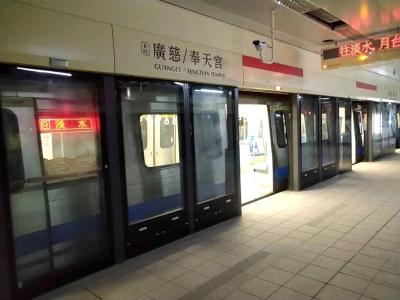
The eastern extension of the Taipei MRT Red Line could begin operations as early as late June, the Taipei Department of Rapid Transit Systems said yesterday. Taipei Rapid Transit Corp said it is considering offering one month of free rides on the new section to mark its opening. Construction progress on the 1.4km extension, which is to run from the current terminal Xiangshan Station to a new eastern terminal, Guangci/Fengtian Temple Station, was 90.6 percent complete by the end of last month, the department said in a report to the Taipei City Council's Transportation Committee. While construction began in October 2016 with an
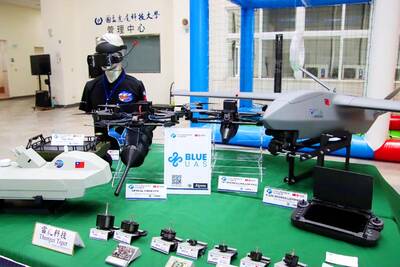
NON-RED SUPPLY: Boosting the nation’s drone industry is becoming increasingly urgent as China’s UAV dominance could become an issue in a crisis, an analyst said Taiwan’s drone exports to Europe grew 41.7-fold from 2024 to last year, with demand from Ukraine’s fight against Russian aggression the most likely driver of growth, a study showed. The Institute for Democracy, Society and Emerging Technology (DSET) in a statement on Wednesday said it found that many of Taiwan’s uncrewed aerial vehicle (UAV) sales were from Poland and the Czech Republic. These countries likely transferred the drones to Ukraine to aid it in its fight against the Russian invasion that started in 2022, it said. Despite the gains, Taiwan is not the dominant drone exporter to these markets, ranking second and fourth


 RSS
RSS