

A series of new measures, including regulations preventing landlords from overcharging their tenants and a raised minimum fee for driving schools, are set to take effect tomorrow.
Based on the new standardized lease contract, which was approved by the Consumer Protection Committee in February, a tenant should pay a deposit of no more than two months’ rent.
To prevent landlords from overcharging for electricity, the contract stipulates that the electricity charge be calculated based on the meter readings for each room, and the price of per kilowatt hour must not exceed NT$6.41, which is the price charged to high electricity users in summer.
Damage to houses or facilities should be fixed by landlords, unless caused by the tenant, the contract says.
Tenants should give landlords at least one month’s notice before terminating their lease, and vice versa. Should any party fail to do so, the other party should be given compensation equivalent to one month’s rent, it says.
Meanwhile, the Ministry of Transportation and Communications would allow driving schools to raise the fee for courses from NT$8,000 to NT$10,000 due to increasing costs.
The cap for the fee remains NT$13,500, the ministry said, adding that driving schools have not adjusted their fees in 12 years.
From tomorrow, Aborigines aged 40 to 60 would qualify for one free hepatitis B and hepatitis C screening.
Previously, those who qualified had to be aged 45 to 53.
New Taipei City residents aged 65 and older will be able to use the points stored in their Elderly Card to board public buses and Taipei’s MRT metropolitan railway system.
Each month, senior residents in New Taipei City receive 480 points their Elderly Cards.
Taoyuan is also launching a trial using technology to reduce the noise created by modified motor vehicles.
Any of noise-producing vehicles would be videotaped if they exceed a certain sound level, the Taoyuan City Government said, adding that the owners of those vehicles would be notified that they must go for an inspection at the motor vehicle office.
Those who do not appear or fail the inspection would be fined NT$1,800 to NT$3,600, it said.
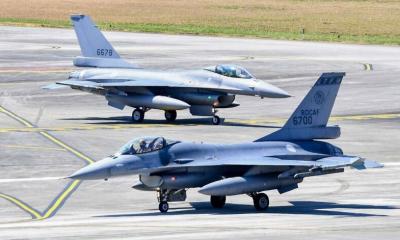
The first two F-16V Block 70 jets Taiwan purchased from the US were spotted unexpectedly turning back after departing from Hawaii yesterday, potentially further delaying delivery of the aircraft. Taiwan has purchased 66 of the F-16 C/D Block 70 jets to be deployed at Chihhang Air Base (志航基地) in Taitung County and operated by the air force's 7th Tactical Fighter Wing to defend Taiwan’s eastern region. Two single-seat jets, bearing serial No. 6727 and 6728, were spotted taking off from Hickam Field in Hawaii yesterday, observers said. Based on the precedent set during the delivery of Taiwan's older F-16 Block 20s, the new

Taiwan’s growing defense preparations might be sending a stronger signal to the US than to Beijing, highlighting the need for Taipei to tailor its deterrence efforts to different audiences, a US security academic said yesterday. Stanford University Freeman Spogli Institute for International Studies fellow Oriana Skylar Mastro made the comment during a Taipei Security Dialogue panel examining lessons Taiwan could draw from the wars in Ukraine and the Middle East. Mastro said she was impressed by Taiwan’s increased defense spending, emphasis on asymmetric capabilities and efforts to prepare society for conflict, but questioned whom those initiatives were influencing. She said when she asked
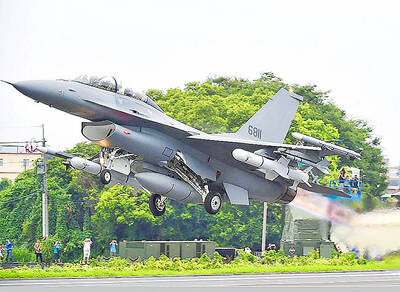
A sharp rise in compensation to be paid by air force officers who leave before completing their required service could indicate an increase in pilots leaving the military early, an analyst said on Friday, warning that the trend could worsen a shortage of experienced personnel. Chieh Chung (揭仲), a researcher at the Association for Strategic Foresight, issued the warning even though the number of volunteer military personnel is expected to increase next year. The planned headcount for volunteer military personnel, covering officers, noncommissioned officers (NCO) and enlisted soldiers, is 158,223 for next year, up 4,258 from 153,965 this year, Chieh said. The increase
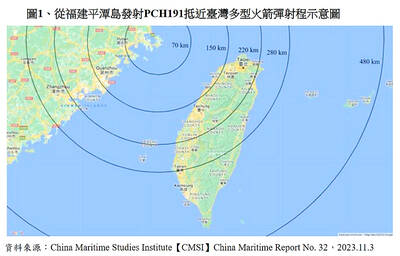
Potential improvements to munitions used by China’s long-range rocket-artillery units could extend their range to cover the entire Miyako Strait, which might give the Chinese People’s Liberation Army (PLA) the ability to secure the strategic waterway, the Mainland Affairs Council (MAC) said in a report. The PLA’s long-range rocket-artillery units deployed along the Taiwan Strait are concentrated along the coast of Fujian Province, including Changle, Pingtan and Shishi, the quarterly report on China said. The artillery brigades of the PLA’s 71st, 72nd and 73rd group armies have been deployed, with preparations for potential battlefield operations under way since August 2022, the report


 RSS
RSS