

About 172,000 Taiwanese are plagued by migraines, with the condition more prevalent among women than men, statistics released by the National Health Insurance Administration has shown.
The condition is most prevalent among people aged 30 to 59, the statistics showed. Migraine is recognized by the WHO as a disabling disorder.
Migraines are the condition most commonly diagnosed by neurologists, said Lin Kao-chang (林高章), a neurologist at Tainan’s Chi Mei Medical Center and president of the Taiwan Headache Society.
Migraines are caused by an excessive release of calcitonin gene-related peptides (CGRPs) and can cause symptoms such as a throbbing pain in the head, nausea, vomiting, or sensitivity to light or noise, he said.
Symptoms can last from a few hours to three days, he added.
People with a persistent headache severe enough to disrupt daily activities and cause nausea or sensitivity to light should consult a doctor, Lin said.
Delayed diagnosis or excessive use of painkillers could turn episodic migraines into chronic migraines, which are more difficult to treat, he added.
Certain medications designed to prevent migraines need to be taken daily or twice a day and could produce side effects such as drowsiness and dizziness, Taipei Veterans General Hospital Neurological Institute director Wang Shuu-jiun (王署君) said.
However, there have been breakthroughs in migraine medication over the past few years, he said.
US and European regulators last year approved a new medication that requires lower dosages, with milder side effects, Wang said.
Studies have found that CGRP levels spike during migraine attacks, suggesting that drugs that block CGRPs have a better chance of preventing or reducing the intensity of migraine attacks, he said.
One such drug last year completed clinical trials in Taiwan, and trials for another have entered the final stage, Wang added.
Results of the former were similar to studies conducted abroad, in that most patients’ symptoms improved with no obvious side effects, he said.
Migraine patients in Taiwan would have access to the new drugs once the Food and Drug Administration approves applications from pharmaceutical companies, Wang added.
A study on migraines conducted by Taipei Veterans General Hospital in collaboration with National Chiao Tung University is expected to be published in an international journal soon, he said.
The study involved 40 people with migraines and 40 without, and found that changes in brain wave patterns could be used to predict migraine attacks with 78 percent accuracy, Wang said.
If migraine attacks could be predicted, people could take medication ahead of time and reduce the possibility of experiencing an attack, he said.
However, researchers need to make the brain wave detection devices more portable and practical before that can happen, Wang said.
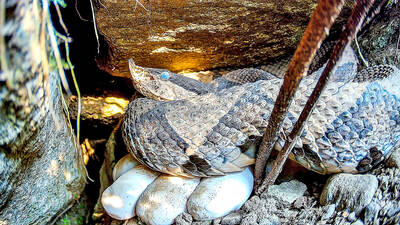
NATURE TAKES ITS COURSE: The agency’s head said he felt a sense of loss watching red-banded snakes eat the babies, as they had decided on non-intervention The Forestry and Nature Conservation Agency yesterday released a documentary on a hundred-pace viper that had incubated 16 eggs, all of which hatched, but only a baby viper escaped after they were attacked by red-banded snakes. The agency’s Taichung branch last year launched the viper reproduction monitoring project soon after forest rangers Lin Chun-yu (林俊佑) and Chou Chia-cheng (周家成) spotted a pregnant hundred-pace viper in a grass-covered burrow near a parking lot in Tbulan Village (松鶴部落). The Atayal village, in Taichung’s Heping District (和平), is headed by Ecyang Yapu, who was positive about the project and assisted in access control and power
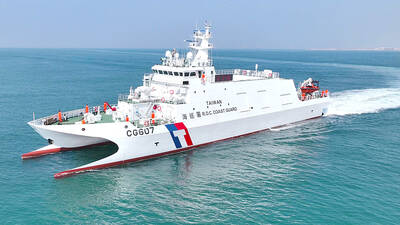
The Coast Guard Administration (CGA) yesterday said that it had deployed vessels to “monitor” Chinese ships operating in waters off the east coast. The CGA said it dispatched vessels in response to a China Coast Guard announcement that it had carried out another “routine law-enforcement patrol” in waters off the east coast. “The CGA firmly rejects China’s cognitive warfare campaign of ‘law enforcement in name, jurisdictional expansion in practice,’” it said on X. As of 11am yesterday, two China Coast Guard ships were “loitering and drifting” about 105 nautical miles (195km) and 74 nautical miles east of Green Island (綠島) respectively, it said. It
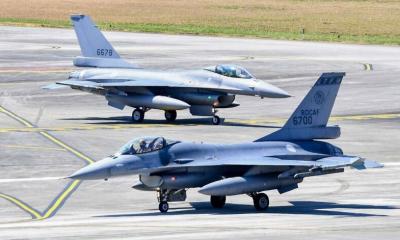
The first two F-16V Block 70 jets Taiwan purchased from the US were spotted unexpectedly turning back after departing from Hawaii yesterday, potentially further delaying delivery of the aircraft. Taiwan has purchased 66 of the F-16 C/D Block 70 jets to be deployed at Chihhang Air Base (志航基地) in Taitung County and operated by the air force's 7th Tactical Fighter Wing to defend Taiwan’s eastern region. Two single-seat jets, bearing serial No. 6727 and 6728, were spotted taking off from Hickam Field in Hawaii yesterday, observers said. Based on the precedent set during the delivery of Taiwan's older F-16 Block 20s, the new
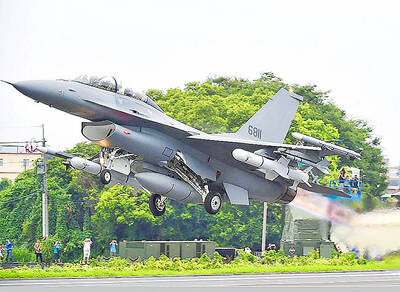
A sharp rise in compensation to be paid by air force officers who leave before completing their required service could indicate an increase in pilots leaving the military early, an analyst said on Friday, warning that the trend could worsen a shortage of experienced personnel. Chieh Chung (揭仲), a researcher at the Association for Strategic Foresight, issued the warning even though the number of volunteer military personnel is expected to increase next year. The planned headcount for volunteer military personnel, covering officers, noncommissioned officers (NCO) and enlisted soldiers, is 158,223 for next year, up 4,258 from 153,965 this year, Chieh said. The increase


 RSS
RSS