


Minister of Education Pan Wen-chung (潘文忠) yesterday said that he is willing to buy 1,000 cups of pearl milk tea as a treat to match a legislator’s pledge to buy 1,000 fried chicken cutlets if the nation wins at least four gold medals at the Summer Olympics in Tokyo next year.
Pan made the remarks at a meeting of the Legislative Yuan’s Education and Culture Committee to brief lawmakers about the nation’s preparations for the Olympics.
Democratic Progressive Party (DPP) Legislator Huang Kuo-shu said that the national team’s morale is at an all-time high as lawmakers passed an amendment to the National Sports Act (國民體育法) in 2017 and the national team achieved its best performance at the Asian Games last year.
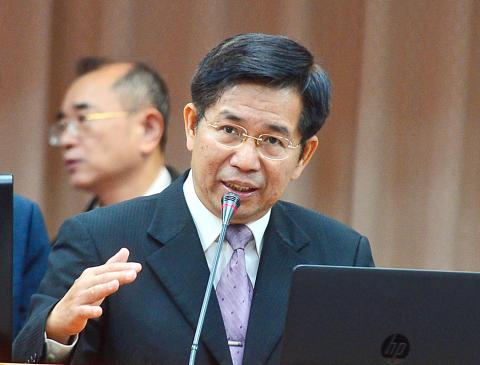
Photo: Wang Yi-sung, Taipei Times
Asking Pan if the Sports Administration has set a target for the number of gold medals that the team could win at the Olympics, Huang said that he thinks the nation has a very high chance of winning gold in women’s badminton, men’s gymnastics, women’s weightlifting and men’s javelin throw.
Taiwan has the world’s No. 1 badminton player Tai Tzu-ying (戴資穎), “pummel horse prince” Lee Chi-kai (李智凱), three-time world champion weightlifter Kuo Hsing-chun (郭婞淳) and Universiade javelin champion Cheng Chao-tsun (鄭兆村), Huang said.
Cheng would win another gold medal in Tokyo if he throws the javelin as far as he did at the 2017 Summer Universiade in Taipei, he said.
Huang then vowed to buy 1,000 fried chicken cutlets if the nation secures at least four gold medals and asked Pan if he would like to double down on that pledge by buying 1,000 cups of pearl milk tea.
Pan said that he is willing to do what Huang asked, adding that the nation has stipulated a “Golden Plan” to intensify training for potential winners.
Sports Administration officials told lawmakers that the plan covers 27 athletes, who are divided into three groups.
Level I athletes refer to those who are either in the world’s top three rankings or whose accumulative points for the Olympics are within the world’s top three.
Level II athletes are those who have won gold medals in a recently held World Championship in different sports categories or in the Asian Games last year.
Level III athletes are those who are likely to make it to the quarter-finals in the Olympics.
All these athletes receive customized training, the agency said.
The agency estimated that the nation would send 50 to 70 athletes to next year’s Olympics, not including members of the women’s softball team, women’s soccer team and baseball team.
There are currently 433 athletes and 145 coaches in the National Sports Training Center in Zuoying (左營), Kaohsiung, the agency said, adding that they are competing in 23 sports categories.
There are also athletes training in facilities in other cities or counties, including basketball, beach volleyball, soccer and shooting, it said.
As Taichung is to hold the World Baseball Softball Confederation Premier 12 baseball tournament in November, DPP legislators Su Chiao-hui (蘇巧慧) and Chang Liao Wan-chien (張廖萬堅) asked Sports Administration Director-General Kao Chun-hsiung (高俊雄) when the manager of the national baseball team is to be selected, as the Chinese Professional Baseball League had previously said that a manager would be chosen by the middle of last month.
Kao said the decision has been delayed because the league was busy handling the entry of a fifth team.
He added that they are to discuss issues relating to the selection of a team manager on Monday.

Yangmingshan National Park authorities yesterday urged visitors to respect public spaces and obey the law after a couple was caught on a camera livestream having sex at the park’s Qingtiangang (擎天崗) earlier in the day. The Shilin Police Precinct in Taipei said it has identified a suspect and his vehicle registration number, and would summon him for questioning. The case would be handled in accordance with public indecency charges, it added. The couple entered the park at about 11pm on Thursday and began fooling around by 1am yesterday, the police said, adding that the two were unaware of the park’s all-day live

A former soldier and an active-duty army officer were yesterday indicted for allegedly selling classified military training materials to a Chinese intelligence operative for a total of NT$79,440. The Taipei District Prosecutors’ Office indicted Chen Tai-yin (陳泰尹) and Lee Chun-ta (李俊達) for contravening the National Security Act (國家安全法) and the Anti-Corruption Act (貪污治罪條例). Chen left the military in September 2013 after serving alongside then-staff sergeant Lee, now an army lieutenant, at the 21st Artillery Command of the army’s Sixth Corps from 2011 to 2013, according to the indictment. Chen met a Chinese intelligence operative identified as “Wang” (王) through a friend in November

Minister of Digital Affairs Lin Yi-ching (林宜敬) yesterday cited regulatory issues and national security concerns as an expert said that Taiwan is among the few Asian regions without Starlink. Lin made the remarks on Facebook after funP Innovation Group chief executive officer Nathan Chiu (邱繼弘) on Friday said Taiwan and four other countries in Asia — China, North Korea, Afghanistan and Syria — have no access to Starlink. Starlink has become available in 166 countries worldwide, including Ukraine, Malaysia, the Philippines and Vietnam, in the six years since it became commercial, he said. While China and North Korea block Starlink, Syria is not
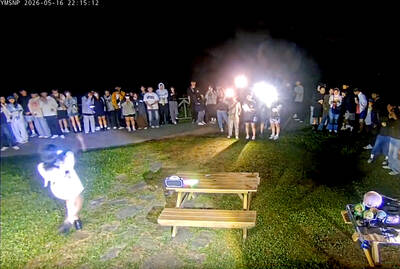
Yangmingshan National Park’s Qingtiangang (擎天崗) nature area has gone viral after a park livestream camera observed a couple in the throes of intimate congress, which was broadcast live on YouTube, drawing large late-night crowds and sparking a backlash over noise, bright lights and disruption to wildlife habitat. The area’s livestream footage appeared to show a couple engaging in sexual activity on a picnic table in the park on Friday last week, with the uncensored footage streamed publicly online. The footage quickly spread across social media, prompting a tide of visitors to travel to the site to “check in” and recreate the


 RSS
RSS