


The Taiwan Jury Association yesterday opposed a plan by the Judicial Yuan to combine the jury system and the lay judge system, saying that introducing an unprecedented fusion of the two systems could be dangerous.
The government should implement a jury system instead of creating a “collage of inherently different systems using pure imagination,” the association said in a statement.
Local Chinese-language media on Sunday reported that the Judicial Yuan had decided to replace its proposal to introduce a lay judge system at the nation’s criminal courts with the combined system.
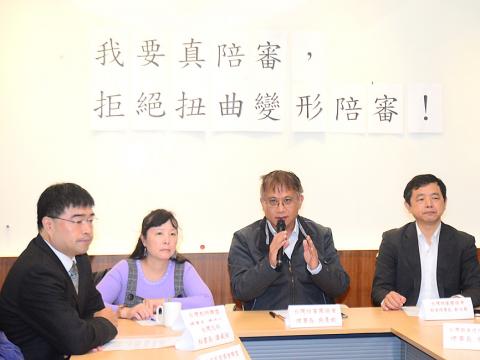
Photo: Wang Yi-sung, Taipei Times
In the original proposal, which is similar to the lay judge system in Japan, each case would be tried by three professional judges and six lay judges, reports said.
For a defendant to be found guilty, two-thirds, or six judges, including at least one professional judge, must vote in favor of the guilty verdict, they said.
The Judicial Yuan is leaning toward the combined system, which is close to a jury system, to appease jury system advocates, the reports said.
The new proposal divides criminal proceedings into two phases.
The first phase would be presided over by eight lay judges. For a defendant to be found guilty, all eight must unanimously agree on the verdict.
The second phase would be presided over by three professional judges, who would decide whether to second the guilty verdict.
If at least one of them agrees with the verdict, the three would then decide the penalties to be meted out.
If no professional judges agree, the defendant would not be found guilty. In death penalty cases, all 11 judges would have to agree to the verdict.
At a news conference at the Legislative Yuan, association president Wu Ching-chin (吳景欽), an associate professor of law at Aletheia University, said that the combined system is likely “an unprecedented invention.”
It is neither a lay judge system nor a jury system, put together by copying bits and pieces of the criminal justice system in Japan, the US and Germany, he said.
“That is very dangerous, because in a way you are treating defendants as guinea pigs,” he said.
He likened the system to driving a self-assembled car, adding: “We cannot even imagine the consequences.”
The Judicial Yuan on Monday said it has from the beginning planned to introduce a criminal justice system combining the strengths of the lay judge and jury systems.
It is open to advice and hopes to build a criminal justice system that best suits the nation, the Judicial Yuan added.

Taiwanese paleontologists have discovered fossil evidence that pythons up to 4m long inhabited Taiwan during the Pleistocene epoch, reporting their findings in the international scientific journal Historical Biology. National Taiwan University (NTU) Institute of Ecology and Evolutionary Biology associate professor Tsai Cheng-hsiu (蔡政修) led the team that discovered the largest snake fossil ever found in Taiwan. The single trunk vertebra was discovered in Tainan at the Chiting Formation, dated to between 400,000 and 800,000 years ago in the Middle Pleistocene, the paper said. The area also produced Taiwan’s first avian fossil, as well as crocodile, mammoth, saber-toothed cat and rhinoceros fossils, it said. Discoveries

Taiwanese paleontologists have discovered fossil evidence that pythons up to 4m long inhabited Taiwan during the Pleistocene epoch, reporting their findings in the international scientific journal Historical Biology. National Taiwan University (NTU) Institute of Ecology and Evolutionary Biology associate professor Tsai Cheng-hsiu (蔡政修) led the team that discovered the largest snake fossil ever found in Taiwan. A single trunk vertebra was discovered in Tainan at the Chiting Formation, dated to between 800,000 to 400,000 years ago in the Middle Pleistocene, the paper said. The area also produced Taiwan’s first avian fossil, as well as crocodile, mammoth, sabre-toothed cat and rhinoceros fossils, it said. Discoveries
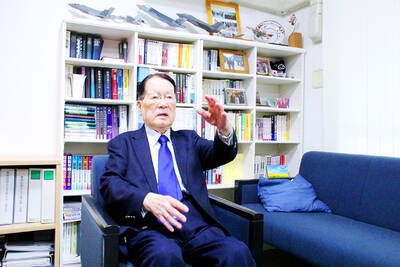
Whether Japan would help defend Taiwan in case of a cross-strait conflict would depend on the US and the extent to which Japan would be allowed to act under the US-Japan Security Treaty, former Japanese minister of defense Satoshi Morimoto said. As China has not given up on the idea of invading Taiwan by force, to what extent Japan could support US military action would hinge on Washington’s intention and its negotiation with Tokyo, Morimoto said in an interview with the Liberty Times (sister paper of the Taipei Times) yesterday. There has to be sufficient mutual recognition of how Japan could provide
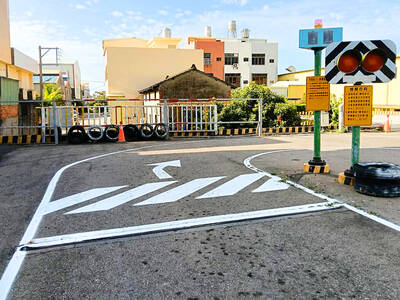
UPDATED TEST: The new rules aim to assess drivers’ awareness of risky behaviors and how they respond under certain circumstances, the Highway Bureau said Driver’s license applicants who fail to yield to pedestrians at intersections or to check blind spots, or omit pointing-and-calling procedures would fail the driving test, the Highway Bureau said yesterday. The change is set to be implemented at the end of the month, and is part of the bureau’s reform of the driving portion of the test, which has been criticized for failing to assess whether drivers can operate vehicles safely. Sedan drivers would be tested regarding yielding to pedestrians and turning their heads to check blind spots, while drivers of large vehicles would be tested on their familiarity with pointing-and-calling


 RSS
RSS