


China should return the goodwill Taiwan has shown it instead of considering to annex it, which is against the nation’s interests and runs counter to prevailing public opinion, Premier Su Tseng-chang (蘇貞昌) told the legislature yesterday.
Su made the remark during his first question-and-answer session since he last month assumed the role of premier for the second time.
He was responding to People First Party Legislator Chou Chen Hsiu-hsia’s (周陳秀霞) call for a “new discourse” that could serve as the basis for cross-strait exchanges, seeing as President Tsai Ing-wen (蔡英文) has said that she would not accept the so-called “1992 consensus” or a Taiwanese version of the “one country, two systems” framework proposed last month by Chinese President Xi Jinping (習近平) on the 40th anniversary of the “Message to Compatriots in Taiwan.”
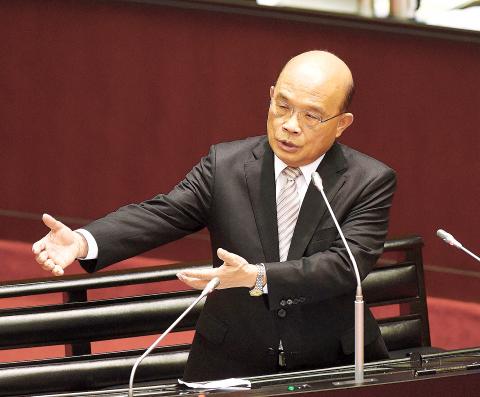
Photo: Huang Yao-cheng, Taipei Times
The so-called “1992 consensus,” a term former Mainland Affairs Council chairman Su Chi (蘇起) in 2006 admitted making up in 2000, refers to a tacit understanding between the Chinese Nationalist Party (KMT) and the Chinese Communist Party that both sides of the Strait acknowledge there is “one China,” with each side having its own interpretation of what “China” means.
“We and China have been like this for decades, and any discussion has proved to be useless,” Su said. “If we told them that we agreed with ‘one China,’ it would eliminate the need for debate and they would be most pleased.”
However, the nation would definitely not allow this, especially when Beijing has advocated a “one country, two systems” approach and is attempting to enter into “peace agreements” with various groups in Taiwan, which is a “united front” tactic, he said.
The premier has a responsibility delegated to him by 23 million Taiwanese to safeguard their democratic way of life and maintain their security, so he could not allow Taiwan to be annexed by China, Su said.
Public figures, especially politicians, should make remarks that are in the nation’s interests, as no matter how strong China’s economy might be or how prosperous its society is, “the most prominent of businesspeople [in China] could disappear in a day and the prettiest of movie stars could be detained on a whim, without even telling the public where they are kept,” he said.
Nevertheless, both sides of the Taiwan Strait should engage in mutually beneficial interactions, Su said, calling on China not to “fear democracy.”
“China today is like the Chinese Nationalist Party [KMT] when I first entered politics, when it tried to control Taiwan through martial law. Today, society is entirely liberal and we have managed to come this far,” Su said.
Referencing the “different interpretations” component of the “1992 consensus,” Chou Chen had proposed that Su acknowledge the “1992 consensus,” saying that it could prevent cross-strait ties from worsening and ensure peace in the Strait.
There is really no room for one-sided interpretation of what “China” means, Su said.
“No KMT official who has visited China has dared to say a word while there, regardless of their rank,” he said.
Proponents of the “consensus” should openly tell Beijing what their interpretation of “China” is, especially when Xi has now asserted that “one country, two systems” is part of the “consensus,” he said.
“As we endeavor to defend our sovereignty and extend our goodwill, China, as a large nation, should be confident in itself and not exclusively fix its attention on tiny Taiwan,” Su said.
“Rather than coveting this land all day long, it should think about the 23 million people who are used to a democratic and free way of life,” he said.

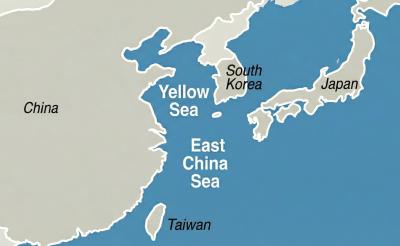
China has reserved offshore airspace in the Yellow Sea and East China Sea from March 27 to May 6, issuing alerts usually used to warn of military exercises, although no such exercises have been announced, the Wall Street Journal (WSJ) reported yesterday. Reserving such a large area for 40 days without explanation is an “unusual step,” as military exercises normally only last a few days, the paper said. These alerts, known as Notice to Air Missions (Notams), “are intended to inform pilots and aviation authorities of temporary airspace hazards or restrictions,” the article said. The airspace reserved in the alert is

South Korea is planning to revise its controversial electronic arrival card, a step Taiwanese officials said prompted them to hold off on planned retaliatory measures, a South Korean media report said yesterday. A Yonhap News Agency report said that the South Korean Ministry of Foreign Affairs is planning to remove the “previous departure place” and “next destination” fields from its e-arrival card system. The plan, reached after interagency consultations, is under review and aims to simplify entry procedures and align the electronic form with the paper version, a South Korean ministry official said. The fields — which appeared only on the electronic form
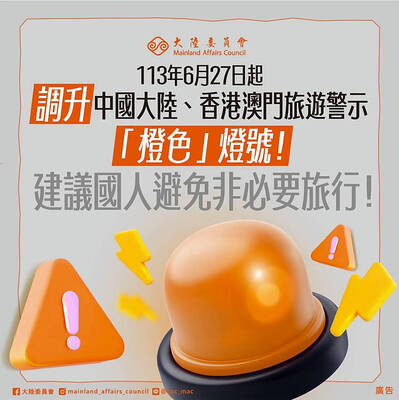
More than 6,000 Taiwanese students have participated in exchange programs in China over the past two years, despite the Mainland Affairs Council’s (MAC) “orange light” travel advisory, government records showed. The MAC’s publicly available registry showed that Taiwanese college and university students who went on exchange programs across the Strait numbered 3,592 and 2,966 people respectively. The National Immigration Agency data revealed that 2,296 and 2,551 Chinese students visited Taiwan for study in the same two years. A review of the Web sites of publicly-run universities and colleges showed that Taiwanese higher education institutions continued to recruit students for Chinese educational programs without
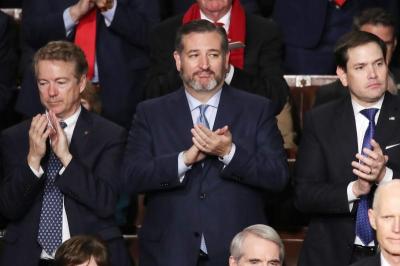
A bipartisan group of US senators has introduced a bill to enhance cooperation with Taiwan on drone development and to reduce reliance on supply chains linked to China. The proposed Blue Skies for Taiwan Act of 2026 was introduced by Republican US senators Ted Cruz and John Curtis, and Democratic US senators Jeff Merkley and Andy Kim. The legislation seeks to ease constraints on Taiwan-US cooperation in uncrewed aerial systems (UAS), including dependence on China-sourced components, limited access to capital and regulatory barriers under US export controls, a news release issued by Cruz on Wednesday said. The bill would establish a "Blue UAS


 RSS
RSS