


The Democratic Progressive Party (DPP) yesterday announced new appointments intended to boost party morale following the DPP’s defeats in the nine-in-one elections in November last year.
At a news conference at the party’s headquarters in Taipei, the DPP referred to the new appointees as the “slash group.”
Each member has various abilities and interests that would “bring creativity” to the party, DPP Secretary-General Luo Wen-jia (羅文嘉) said.
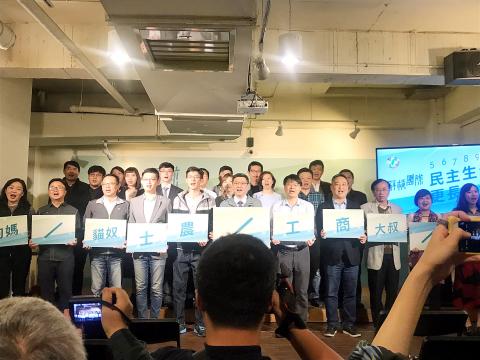
Photo: Su Fun-her, Taipei Times
Lee Ming-li (李明俐), who is one of the party’s new spokespeople, has a background in cultural policy studies, but no experience with politics, which has caused many to look at her appointment with great interest, he said.
Veteran party worker Kao Hsing-hsueh (高幸雪), Taiwan Normal Country Promotion Association member Kuo Kun-wen (郭昆文) and Hsu Chia-ching (徐佳青) of the DPP’s former New Tide faction are to be the party’s new deputy secretaries-general.
Lee Ching-feng (李慶峰) — a former DPP Taipei City councilor — is to head the party’s organizational development department, while Wang Po-chun (王柏鈞), who previously headed the Taiwan Youth Citizen Association, is to lead the communications department.
Johnny Lin (林琮盛), who was a reporter in China, is to head the campaign intelligence department. Veteran party worker Lin Hsiu-ling (林秀玲) is to be secretariat director, while the online communications department is to be lead by Ho Meng-hua (何孟樺), who had been directing the party’s youth department.
Chen Chang-wei (陳長偉), who is to head the social movement department, has worked in Yilan County’s Business and Tourism Department.
Veteran party worker Chiu Shih-yuan (邱世元) is to head the religion department, while the agriculture and fisheries department is to be run by Huang Te-cheng (黃德成), who has a background in agricultural studies.
Chen Yi-ting (陳奕廷), who previously worked in online media, is to head the social issues department.
DPP Hakka affairs department head Chou Chiang-chieh (周江杰) is also to act as a party spokesperson, while the new youth department director, Yan Juo-fang (顏若芳), was previously a Taipei City councilor.
The international affairs department is to be headed by DPP Legislator Lin Ching-yi (林靜儀). Deputy director of the office of the DPP secretary-general Sun Mei-hui (孫美惠) was formerly a member of a well-known dance troupe.
The public relations department is to be headed by businessman Hsieh Yu-li (謝雨利).
The public research center is to be headed by Lee Kuan-yi (李冠毅), who used to be a director at the legislators’ office, as well as the Thinking Taiwan Foundation.
Veteran party worker Lin Ping-chung (林秉忠) is to head the labor department, while former Executive Yuan deputy spokesman Ting Yun-kong (丁允恭) is to be the news department director.
“All of these people have different roles ... but at this moment we all share a single role, which is to fight to protect our democratic way of life,” Luo said.
At the end of the news conference, Luo spoke further about Lee Ming-li, praising her background in foreign languages, translation and the teaching of Taiwanese history.
Lee Ming-li has worked hard to preserve historical Taiwanese sites, he added.
Part of her interest in culture comes from her diverse background, as her grandfather was Mongolian and her grandmother was a Rukai Aborigine, he said.

Taiwan has received more than US$70 million in royalties as of the end of last year from developing the F-16V jet as countries worldwide purchase or upgrade to this popular model, government and military officials said on Saturday. Taiwan funded the development of the F-16V jet and ended up the sole investor as other countries withdrew from the program. Now the F-16V is increasingly popular and countries must pay Taiwan a percentage in royalties when they purchase new F-16V aircraft or upgrade older F-16 models. The next five years are expected to be the peak for these royalties, with Taiwan potentially earning
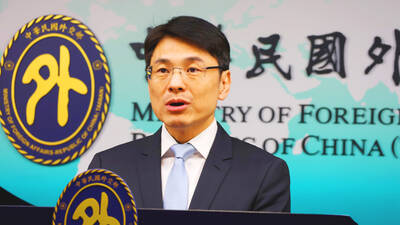
STAY IN YOUR LANE: As the US and Israel attack Iran, the ministry has warned China not to overstep by including Taiwanese citizens in its evacuation orders The Ministry of Foreign Affairs (MOFA) yesterday rebuked a statement by China’s embassy in Israel that it would evacuate Taiwanese holders of Chinese travel documents from Israel amid the latter’s escalating conflict with Iran. Tensions have risen across the Middle East in the wake of US and Israeli airstrikes on Iran beginning Saturday. China subsequently issued an evacuation notice for its citizens. In a news release, the Chinese embassy in Israel said holders of “Taiwan compatriot permits (台胞證)” issued to Taiwanese nationals by Chinese authorities for travel to China — could register for evacuation to Egypt. In Taipei, the ministry yesterday said Taiwan
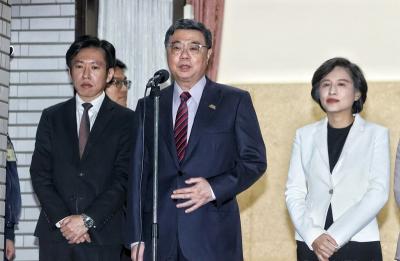
Taiwan is awaiting official notification from the US regarding the status of the Agreement on Reciprocal Trade (ART) after the US Supreme Court ruled US President Donald Trump's global tariffs unconstitutional. Speaking to reporters before a legislative hearing today, Premier Cho Jung-tai (卓榮泰) said that Taiwan's negotiation team remains focused on ensuring that the bilateral trade deal remains intact despite the legal challenge to Trump's tariff policy. "The US has pledged to notify its trade partners once the subsequent administrative and legal processes are finalized, and that certainly includes Taiwan," Cho said when asked about opposition parties’ doubts that the ART was
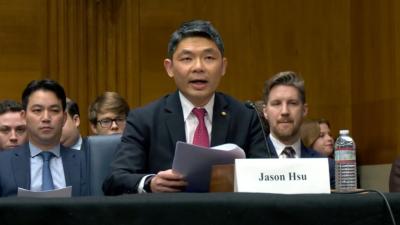
If China chose to invade Taiwan tomorrow, it would only have to sever three undersea fiber-optic cable clusters to cause a data blackout, Jason Hsu (許毓仁), a senior fellow at the Hudson Institute and former Chinese Nationalist Party (KMT) legislator, told a US security panel yesterday. In a Taiwan contingency, cable disruption would be one of the earliest preinvasion actions and the signal that escalation had begun, he said, adding that Taiwan’s current cable repair capabilities are insufficient. The US-China Economic and Security Review Commission (USCC) yesterday held a hearing on US-China Competition Under the Sea, with Hsu speaking on


 RSS
RSS