


China’s poor handling of the African swine fever crisis is evidence of the dangers of close cross-strait ties, National Taiwan University professor of veterinary studies Lai Shiow-suey (賴秀穗) said.
Taiwan has stepped up customs inspections at ports of entry in light of an outbreak that has been reported in 23 areas in China, which international media reports say has seen about 600,000 pigs culled since August.
Lai, 77, has been widely praised for his work to prevent the spread of foot-and-mouth disease and the avian flu in Taiwan.
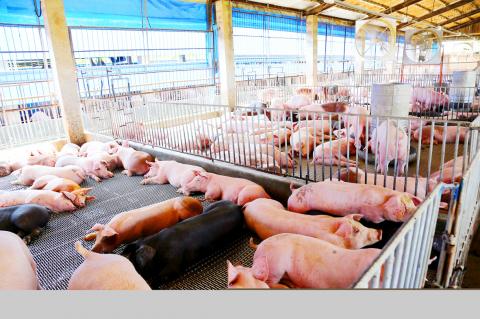
Photo: Ashley Chiu, Taipei Times
In an interview with the Liberty Times (sister paper of the Taipei Times), Lai said that China failed to isolate and slaughter pigs infected with the disease, instead using them to make processed pork products.
The result was that African swine fever, which had not been a problem in Asia for 97 years, is spreading in epidemic proportions, he said.
If Taiwan and China were to grow too close politically, it might be impossible to stop diseases like this from spreading throughout the nation, he said.
In Europe, when the disease occurs, it spreads 100km in a year, but in China it has already spread over a 1,000km radius in just five months, he said.
In China, veterinarians are powerless to combat infectious diseases, whereas in Taiwan the government listens to the advice of veterinarians to enact policy, he said.
While the Chinese government has reported the eradication of several hundred infected pigs that were being raised on private property, there have so far been no reports of infections at commercial farms, Lai said.
However, as China lost control of the disease’s early spread, it is inevitable that commercial farms would have been affected, he said.
“Commercial farms in China each raise several hundred thousand pigs — maybe up to 1 million. Do you think they would slaughter that many pigs in one go? Impossible,” he said.
China likely only reported a small number of infections, but it is highly likely that 100 million of China’s roughly 430 million pigs are infected by now, he said.
The economic impact on China is likely to reach several trillion yua, he said, adding that it will be difficult to raise pigs in China from now on.
By sending infected pigs to butchers to be processed, Chinese farmers contributed to the spread in two ways: first by transporting infected pigs, thereby exposing more animals to infection, and second by allowing infected pork to enter the food chain.
“What is most scary is that Europe has been unable to eradicate the disease after 61 years, and each country there has at most several million pigs. China will not get rid of the infection even in 100 years,” he said.
Due to the US-China trade dispute, China stopped importing US pork and instead imported several million tonnes of pork from Russia, which has African swine fever, he said.
Lab tests on the virus from pigs in Shenyang, Liaoning Province, showed that it was the same strain as found in Russia and Poland, he said.
Taiwan must be cautious, as the virus is likely to spread throughout Southeast Asia over the next year or two, he said.
Farmers especially must report the disease if they find it and must not send infected pigs to be slaughtered, he said.

Taiwan has received more than US$70 million in royalties as of the end of last year from developing the F-16V jet as countries worldwide purchase or upgrade to this popular model, government and military officials said on Saturday. Taiwan funded the development of the F-16V jet and ended up the sole investor as other countries withdrew from the program. Now the F-16V is increasingly popular and countries must pay Taiwan a percentage in royalties when they purchase new F-16V aircraft or upgrade older F-16 models. The next five years are expected to be the peak for these royalties, with Taiwan potentially earning

STAY IN YOUR LANE: As the US and Israel attack Iran, the ministry has warned China not to overstep by including Taiwanese citizens in its evacuation orders The Ministry of Foreign Affairs (MOFA) yesterday rebuked a statement by China’s embassy in Israel that it would evacuate Taiwanese holders of Chinese travel documents from Israel amid the latter’s escalating conflict with Iran. Tensions have risen across the Middle East in the wake of US and Israeli airstrikes on Iran beginning Saturday. China subsequently issued an evacuation notice for its citizens. In a news release, the Chinese embassy in Israel said holders of “Taiwan compatriot permits (台胞證)” issued to Taiwanese nationals by Chinese authorities for travel to China — could register for evacuation to Egypt. In Taipei, the ministry yesterday said Taiwan

Taiwan is awaiting official notification from the US regarding the status of the Agreement on Reciprocal Trade (ART) after the US Supreme Court ruled US President Donald Trump's global tariffs unconstitutional. Speaking to reporters before a legislative hearing today, Premier Cho Jung-tai (卓榮泰) said that Taiwan's negotiation team remains focused on ensuring that the bilateral trade deal remains intact despite the legal challenge to Trump's tariff policy. "The US has pledged to notify its trade partners once the subsequent administrative and legal processes are finalized, and that certainly includes Taiwan," Cho said when asked about opposition parties’ doubts that the ART was
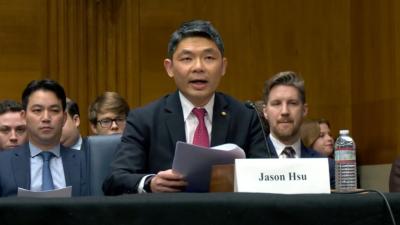
If China chose to invade Taiwan tomorrow, it would only have to sever three undersea fiber-optic cable clusters to cause a data blackout, Jason Hsu (許毓仁), a senior fellow at the Hudson Institute and former Chinese Nationalist Party (KMT) legislator, told a US security panel yesterday. In a Taiwan contingency, cable disruption would be one of the earliest preinvasion actions and the signal that escalation had begun, he said, adding that Taiwan’s current cable repair capabilities are insufficient. The US-China Economic and Security Review Commission (USCC) yesterday held a hearing on US-China Competition Under the Sea, with Hsu speaking on


 RSS
RSS