


Thousands of people wearing yellow vests yesterday rallied in front of the Presidential Office in Taipei to demand that the government reform tax laws and return what they say were unfairly levied taxes.
The tax system is “unfair and lacks transparency,” said the Tax and Legal Reform League, which organized the rally.
To improve the system, the government should convene a national congress to discuss tax reform and establish a committee to help people who have been erroneously taxed, it said in a statement.
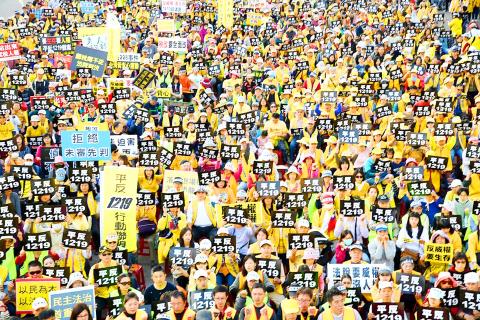
Photo courtesy of the Tax and Legal Reform League
The system makes it extremely difficult for victims of erroneous or illegal taxation to recover their money, said Wu Ching-chin (吳景欽), an associate professor in Aletheia University’s Department of Law and one of the league’s founding members.
When someone files an administrative appeal over illegal or erroneous taxation, they still have to pay half of the taxes levied while the case is ongoing, he said.
“This means that if you have been illegally asked to pay NT$10 million [US$324,538], you would have to pay NT$5 million first,” Wu said.
Moreover, the appeal process usually takes 10 years and the chance of winning such a case is only 6 percent, he added.
“Even if you win, the court ruling is useless,” Wu said, adding that the National Taxation Bureau could continue to levy the tax deemed illegal by the court due to a legislative flaw that grants it the authority to “recheck” its own tax decisions.
Tax bureaus continue to levy illegal and erroneous taxes, because admitting mistakes would prevent officials from receiving performance-based bonuses, he said, adding that tax bureaus have more performance-based bonuses than any other government agency.
“To lessen people’s pain, the bureau should stop requiring the same tax to be paid once an administrative court has ruled it to be illegal,” Wu said.
The unfair tax system not only causes unnecessary suffering, but pushes foreign investors away, he said.
The rally is “people’s protest against this undemocratic system and demand for a better life,” he added.
League members began protesting unfair taxes in yellow vests on Dec. 18, 2016, well before the “yellow vest” protests began in France, said another founding member of the league, Chen Chih-lung (陳志龍), a retired National Taiwan University law professor.
“As with the French ‘yellow vest’ protesters, we are against government bullying. We are opposed to the government doing whatever it wants, believing it is the boss,” he said.
“This is a human rights movement,” Chen said, adding that similar protests are happening in Belgium and Hungary.
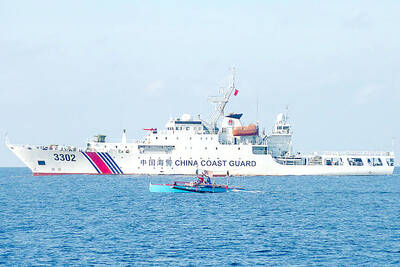
EXPANSIONIST: China deploys an average of 40 to 50 warships and coast guard vessels daily in the South China Sea, despite pledges not to militarize the region, an official said China is attempting to expand its influence across the First Island Chain and increase pressure on Japan by sending coast guard vessels into waters off of Taiwan under the pretext of maritime negotiations with Japan and the Philippines, a national security official said yesterday. China’s recent actions in the waters east of Taiwan and Japan and the Philippines’ exclusive economic zones (EEZ) are attempts to establish dominance in First Island Chain waters, said the official who declined to be named, adding that this is “expansion disguised as law enforcement.” Framing China’s actions solely as a cross-strait issue is a serious misjudgment that
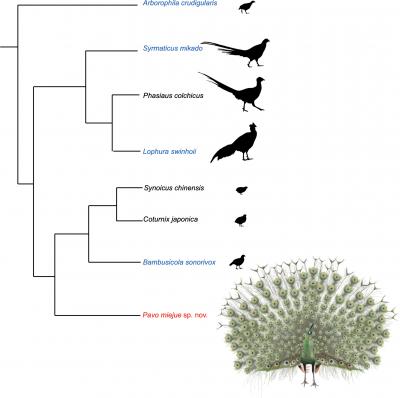
Through analyzing fossil evidence, a research team at National Taiwan University (NTU) discovered the largest endemic bird to have lived in Taiwan, naming it Pavo miejue, or extinct peafowl (滅絕孔雀). The Mikado pheasant, which is printed on the back of the NT$1,000 bank note, was previously believed to be the biggest endemic bird to Taiwan. The research team’s findings suggest that Pavo miejue lived during the Pleistocene epoch tens of thousands of years ago. It is the first endemic extinct bird species discovered and formally named in Taiwan. The study was coauthored by NTU Institute of Ecology and Evolutionary Biology professor Tsai Cheng-hsiu (蔡政修),
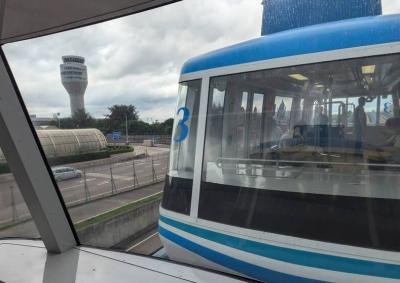
Taiwan Taoyuan International Airport is to suspend its automated Skytrain service connecting Terminal 1 and Terminal 2 starting on July 1 to facilitate connection works for the upcoming Terminal 3, the airport operator said today. Passengers and staff who need to travel between the two terminals after the suspension can instead use the Taoyuan MRT or the airport's 24-hour shuttle bus service, Taoyuan International Airport Corp said. The Taoyuan MRT Airport Line directly links the two terminals, while the shuttle buses are to operate around the clock, the company added. The Skytrain provides free transportation between the airport’s two terminals for travelers and
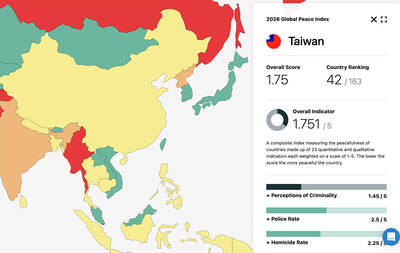
Taiwan ranked 42nd in terms of peacefulness among 163 countries, down five places from last year, according to this year’s Global Peace Index. With an overall score of 1.751, Taiwan dropped from 37th last year, the report published by the global Institute for Economics and Peace showed. The overall score measures a country’s level of peacefulness using 23 quantitative and qualitative indicators across three domains — ongoing domestic and international conflict, societal safety and security, and militarization. While Taiwan ranked 42nd worldwide, it was listed in ninth place among the 19 Asian-Pacific countries in the report, after New Zealand, Singapore, Japan, Malaysia,


 RSS
RSS