


The Ministry of Education has established a task force to investigate whether vocational schools across the nation have contravened laws after it found that foreign students at University of Kang Ning international were engaged in work and not study, Deputy Ministry of Education Yao Leeh-der (姚立德) said yesterday.
Yao said that at the start of last school year, the university admitted 69 Sri Lankan students, who were asked to work at meat and food processing plants and told that their labor was paying for their tuition.
The university later informed the students that it had not received money for their work and that they still owed the school tuition, Yao said.

Photo: CNA
The university has admitted to oversight on the matter and said it would comply with all Ministry of Education and Ministry of Labor inquiries into the issue.
It issued a statement saying it plans to sue a person who posed as an intermediary agency and school representative.
Chu Chi-ping (朱啟屏), using the alias Chu Yun-sheng (朱雲生), claimed to work for the Taoyuan Dual-school Education Training Association and brokered the deal with the university last year, the statement said.
The school learned that the students were working off-campus illegally — arranged by the intermediary agency — during the process of applying for their residency and work permits.
Unable to contact Chu or his organization, the school realized that Chu had provided false information, the university said.
The school denied that it had arranged for the Sri Lankan students to work off-campus, adding that it had considered such action as simply part-time jobs performed by college students.
The university said it is waiving the students’ tuition for the last school year, but hoped that the remaining 41 students — 28 had returned to Sri Lanka — would start paying tuition this year.
The ministry said it was cutting the university’s subsidies, lowering its school admission cap and banning it from admitting foreign students this year as punishment.
Yao said that Kang Ning’s case is an isolated incident and should not detract from the contributions that many other schools are making to promote the education sector in line with the government’s New Southbound Policy.
Commenting on the case, a student told the Chinese-language United Daily News that he had come to Taiwan hoping for a better education than that offered by his home country, and has instead been sent to work at food processing factories or butchering plants.
“We were promised NT$220,000 per month, but received only NT$6,000 to NT$8,000, with the rest deducted for ‘tuition fees’ that the school said it never received,” the student said.
The student said he would never trust another Taiwanese, nor recommend Taiwan to other Sri Lankans.

Kenting National Park service technician Yang Jien-fon (楊政峰) won a silver award in World Grand Prix Photography Awards Spring Season for his photograph of two male rat snakes intertwined in combat. Yang’s colleagues at Kenting National Park said he is a master of nature photography who has been held back by his job in civil service. The awards accept entries in all four seasons across six categories: architectural and urban photography, black-and-white and fine art photography, commercial and fashion photography, documentary and people photography, nature and experimental photography, and mobile photography. Awards are ranked according to scores and divided into platinum, gold and

More than half of the bamboo vipers captured in Tainan in the past few years were found in the city’s Sinhua District (新化), while other districts had smaller catches or none at all. Every year, Tainan captures about 6,000 snakes which have made their way into people’s homes. Of the six major venomous snakes in Taiwan, the cobra, the many-banded krait, the brown-spotted pit viper and the bamboo viper are the most frequently captured. The high concentration of bamboo vipers captured in Sinhua District is puzzling. Tainan Agriculture Bureau Forestry and Nature Conservation Division head Chu Chien-ming (朱健明) earlier this week said that the
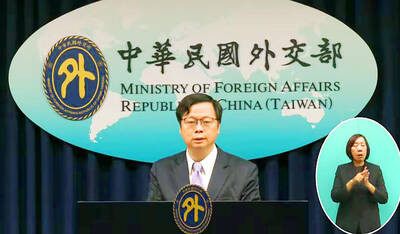
NAMING SPAT: The foreign ministry called on Denmark to propose an acceptable solution to the erroneous nationality used for Taiwanese on residence permits Taiwan has revoked some privileges for Danish diplomatic staff over a Danish permit that lists “Taiwan” as “China,” Eric Huang (黃鈞耀), head of the Ministry of Foreign Affairs’ Department of European Affairs, told a news conference in Taipei yesterday. Reporters asked Huang whether the Danish government had responded to the ministry’s request that it correct the nationality on Danish residence permits of Taiwanese, which has been listed as “China” since 2024. Taiwan’s representative office in Denmark continues to communicate with the Danish government, and the ministry has revoked some privileges previously granted to Danish representatives in Taiwan and would continue to review
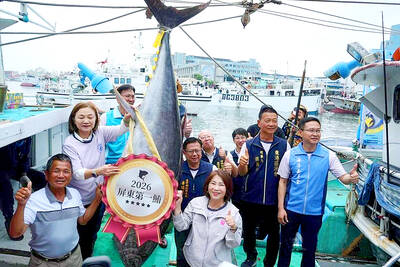
The first bluefin tuna of the season, brought to shore in Pingtung County and weighing 190kg, was yesterday auctioned for NT$10,600 (US$333.5) per kilogram, setting a record high for the local market. The auction was held at the fish market in Donggang Fishing Harbor, where the Siaoliouciou Island-registered fishing vessel Fu Yu Ching No. 2 delivered the “Pingtung First Tuna” it had caught for bidding. Bidding was intense, and the tuna was ultimately jointly purchased by a local restaurant and a local company for NT$10,600 per kilogram — NT$300 ,more than last year — for a total of NT$2.014 million. The 67-year-old skipper


 RSS
RSS