


The Council of Grand Justices on Friday dismissed a request by the Control Yuan for a constitutional interpretation of the legality of the Act Governing the Handling of Ill-gotten Properties by Political Parties and Their Affiliate Organizations (政黨及其附隨組織不當取得財產處理條例).
The council said it was not within the remit of the Control Yuan to request a constitutional interpretation.
The Control Yuan in 2016 received a petition asking it to investigate the legality of the act — through which the Ill-gotten Party Assets Settlement Committee was created — and it found that the act and the committee were unconstitutional, with the latter contravening the Basic Code Governing Central Administrative Agencies Organizations (中央行政機關組織基準法).
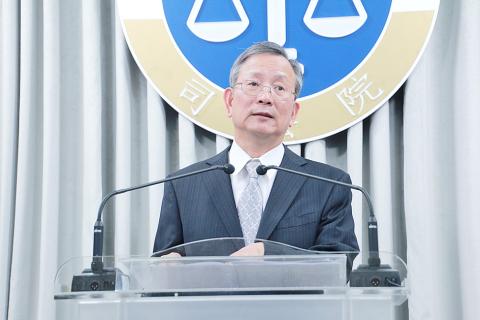
Photo: Wu Cheng-fong, Taipei Times
The Control Yuan last year filed the request for a constitutional interpretation.
The council gave four reasons for its dismissal of the request.
First, the right to request constitutional interpretations resides with the Judicial Yuan; the Control Yuan does not have the right to do so.
Second, the request was based on the premise that it was normal for the council to process constitutional interpretations filed by the Control Yuan, but this practice was abolished in 1992 after the elections for the second Legislative Yuan, which normalized the constitutional system, so the council no longer has to comply with Control Yuan requests.
Third, the Control Yuan launched its investigation before determining whether the act was unconstitutional, but it is only delegated to impeach, censure and audit.
Fourth, the Control Yuan may request a constitutional interpretation on the condition that laws are potentially unconstitutional; it cannot request interpretations based on its own investigations.
If the procedure the Control Yuan went through to file the request were constitutional, that would mean it had the power to second-guess laws passed by the Legislative Yuan, which would unbalance the five branches of government, the council said.
However, the resolution was not a consensus, with grand justices Tang Te-tsung (湯德宗), Huang Hsi-chun (黃璽君), Lin Chun-yi (林俊益), Chang Chiung-wen (張瓊文) and Wu Chen-huan (吳陳鐶) saying that the request should have been processed, while Huang Horng-hsya (黃虹霞) expressed partial agreement.
Nine justices said that the request should be dismissed.
It was the first time the council has made public the individual stances of the grand justices.
Control Yuan members Chang Kuei-mei (仉桂美) and Liu Te-shun (劉德勳), who filed the request, criticized the dismissal, saying the Judicial Yuan has trampled on the constitutional system and the five branches of government.
“The Control Yuan might as well be abolished,” they said, adding that the council had imposed on itself a “historical burden” and that there would be a heavy price to pay for its decision.
Chinese Nationalist Party (KMT) caucus secretary-general William Tseng (曾銘宗) called the council’s decision “regrettable,” while he questioned the need for the council.
Democratic Progressive Party caucus director-general Lee Chun-yi (李俊俋) said the Legislative Yuan stands by the laws that are passed based on prevalent public opinion.
“If members of the Control Yuan can request constitutional interpretations whenever they are not happy [with a law], the checks and balances of the constitutional system would be thrown into turmoil,” Lee said.
Ill-gotten Party Assets Settlement Committee spokeswoman Shih Chin-gang (施錦芳) said the committee respects the council’s decision.
Additional reporting by Chen Yu-fu and Su Fun-her
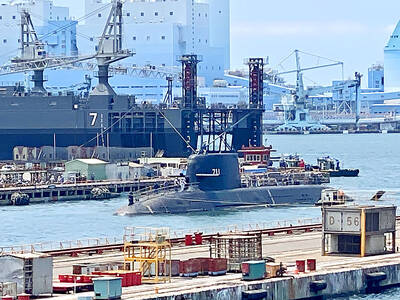
AGING: While Japan has 22 submarines, Taiwan only operates four, two of which were commissioned by the US in 1945 and 1946, and transferred to Taiwan in 1973 Taiwan would need at least 12 submarines to reach modern fleet capabilities, CSBC Corp, Taiwan chairman Chen Cheng-hung (陳政宏) said in an interview broadcast on Friday, citing a US assessment. CSBC is testing the nation’s first indigenous defense submarine, the Hai Kun (海鯤, Narwhal), which is scheduled to be delivered to the navy next month or in July. The Hai Kun has completed torpedo-firing tests and is scheduled to undergo overnight sea trials, Chen said on an SET TV military affairs program. Taiwan would require at least 12 submarines to establish a modern submarine force after assessing the nation’s operational environment and defense

A white king snake that frightened passengers and caused a stir on a Taipei MRT train on Friday evening has been claimed by its owner, who would be fined, Taipei Rapid Transit Corp (TRTC) said yesterday. A person on Threads posted that he thought he was lucky to find an empty row of seats on Friday after boarding a train on the Bannan (Blue) Line, only to spot a white snake with black stripes after sitting down. Startled, he jumped up, he wrote, describing the encounter as “terrifying.” “Taipei’s rat control plan: Release snakes on the metro,” one person wrote in reply, referring
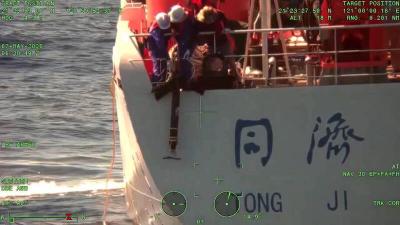
The coast guard today said that it had disrupted "illegal" operations by a Chinese research ship in waters close to the nation and driven it away, part of what Taipei sees a provocative pattern of China's stepped up maritime activities. The coast guard said that it on Thursday last week detected the Chinese ship Tongji (同濟號), which was commissioned only last year, 29 nautical miles (54km) southeast of the southern tip of Taiwan, although just outside restricted waters. The ship was observed lowering ropes into the water, suspected to be the deployment of scientific instruments for "illegal" survey operations, and the coast
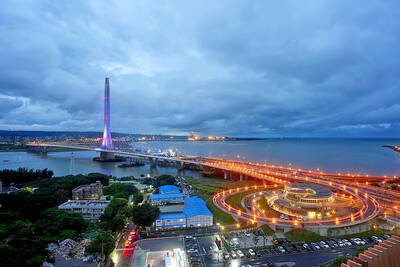
An inauguration ceremony was held yesterday for the Danjiang Bridge, the world’s longest single-mast asymmetric cable-stayed bridge, ahead of its official opening to traffic on Tuesday, marking a major milestone after nearly three decades of planning and construction. At the ceremony in New Taipei City attended by President William Lai (賴清德), Premier Cho Jung-tai (卓榮泰), Minister of Transportation and Communications Chen Shih-kai (陳世凱) and New Taipei City Mayor Hou Yu-ih (侯友宜), the bridge was hailed as both an engineering landmark and a long-awaited regional transport link connecting Tamsui (淡水) and Bali (八里)


 RSS
RSS