


The Central Election Commission (CEC) yesterday confirmed that a referendum to phase out thermal power plants proposed by Chinese Nationalist Party (KMT) Legislator Lu Shiow-yen (盧秀燕) is to be held on Nov. 24 alongside the nine-in-one elections, but added that all forged signatures found in the petitions would be reported to prosecutors so that criminal charges could be brought.
It was “with a heavy heart” that the commission decided to pass the proposal and report the forgeries to prosecutors, commission Vice Chairman Chen Chao-chien (陳朝建) told a news conference in Taipei after a meeting to discuss how to handle the forged signatures.
Lu on Aug. 27 submitted to the commission 497,243 signatures backing the proposed referendum.

Photo: Liu Hsin-de, Taipei Times
Local household registration offices found 314,395 to be valid, after removing 182,848 signatures that failed to meet the legal requirements, the commission said, adding that the valid total still passed the legal threshold of 281,745.
The invalid signatures contained many forgeries, which accounted for 2.38 percent of all the signatures submitted, Chen said, adding that it is “not a small number.”
“It is 100 percent sure that they were forged because the signatures belong to people who had passed away before the proposal was launched,” he said.
Other examples of invalid signatures found included having an incorrect age, address, name, incomplete information or repetition of identity, he said.
“Forging signatures of people who have passed away must be condemned,” he said. “Referendums are an essential part of democracy and must be cherished. Attempts to undermine democracy and the referendum system cannot be tolerated.”
The commission is to activate procedures for pressing criminal charges by reporting all forged signatures to prosecutors, he said.
It would apply the same standards and procedures to every proposed referendum, and inform the public if similar cases have been found, he added.
He also said that the KMT’s claim that the commission had colluded with local household registration offices to add forged signatures to its referendum proposals was a “false accusation.”
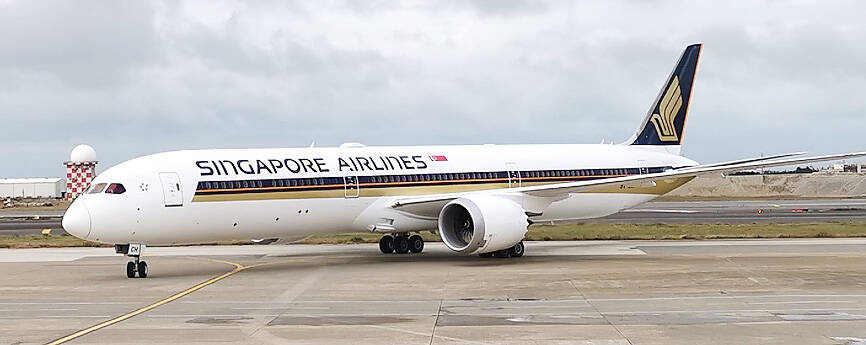
INCREASED CAPACITY: The flights on Mondays, Wednesdays, Fridays and Sundays would leave Singapore in the morning and Taipei in the afternoon Singapore Airlines is adding four supplementary flights to Taipei per week until May to meet increased tourist and business travel demand, the carrier said on Friday. The addition would raise the number of weekly flights it operates to Taipei to 18, Singapore Airlines Taiwan general manager Timothy Ouyang (歐陽漢源) said. The airline has recorded a steady rise in tourist and business travel to and from Taipei, and aims to provide more flexible travel arrangements for passengers, said Ouyang, who assumed the post in July last year. From now until Saturday next week, four additional flights would depart from Singapore on Monday, Wednesday, Friday
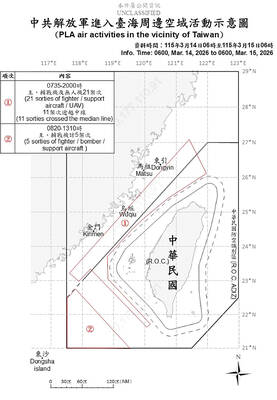
The Ministry of National Defense yesterday reported the return of large-scale Chinese air force activities after their unexplained absence for more than two weeks, which had prompted speculation regarding Beijing’s motives. China usually sends fighter jets, drones and other military aircraft around the nation on a daily basis. Interruptions to such routine are generally caused by bad weather. The Ministry of National Defense said it had detected 26 Chinese military aircraft in the Taiwan Strait over the previous 24 hours. It last reported that many aircraft on Feb. 25, when it spotted 30 aircraft, saying Beijing was carrying out another “joint combat

Taiwan successfully defended its women’s 540 kilogram title and won its first-ever men’s 640 kg title at the 2026 World Indoor Tug of War Championships in Taipei yesterday. In the women’s event, Taiwan’s eight-person squad reached the final following a round-robin preliminary round and semifinals featuring teams from Ukraine, Japan, Thailand, Vietnam, the Basque Country and South Korea. In the finals, they swept the Basque team 2-0, giving the team composed mainly of National Taiwan Normal University students and graduates its second championship in a row, and its fourth in five years. Team captain

Taiwan’s three major international carriers are increasing booking fees, with EVA Airways having already increased the charge to US$28 per flight segment from US$25, while China Airlines (CAL) and Starlux Airlines are set to follow suit. Booking fees are charged by airlines through a global distribution system (GDS) and passed on to passengers. Carriers that apply the fees include CAL, EVA, Starlux and Tigerair Taiwan. A GDS is a computerized network operated by a company that connects airlines with travel agents and ticketing platforms, allowing reservations to be made and processed in real time. Major players include Amadeus, Sabre and Travelport. EVA Air began


 RSS
RSS