


A book by former Military Intelligence Bureau deputy chief Lieutenant General Wong Yen-ching (翁衍慶) describes how China infiltrated the nation’s military and society.
State-run China Central Television (CCTV) on Sept. 15 accused Taiwanese intelligence of using “honey traps” to build ties with Chinese students studying in Taiwan and obtain information on Chinese state secrets.
The Ministry of National Defense has called the allegations “baseless,” and lawmakers and academics have accused China of being the one attempting to infiltrate another nation’s society.
However, the Chinese accusations have sparked public discussion of Taiwan’s and China’s spying activities against each other.
In The Communist Party of China — Intelligence Organization and Spy, Wong writes that Chinese Ministry of State Security agents favor honey-trap methods, citing as example the case of former Republic of China Army general Lo Hsien-che (羅賢哲) and the Chinese ministry’s Taiwan Special Division director Li Peiqi (李佩琪).
Lo, who was the military attache to the Taipei Economic and Cultural Office to Thailand from 2002 to 2005, was recruited by Li and other Chinese agents in 2004.
On Jan. 1, 2008, he was promoted to the rank of general, but came under suspicion of involvement in espionage in October 2010.
Lo was sentenced to life in prison in 2011 on espionage charges.
In his book, Wong offers detailed descriptions of the Chinese intelligence units tasked with spying on and infiltration of Taiwan.
The People’s Liberation Army’s “Sixth Bureau” cyberspace unit in Wuhan in Hubei Province is specifically tasked with gathering and researching all technical information and intelligence gathered on Taiwan, Wong wrote.
The unit attempts to tap into Taiwan’s telecommunications networks, preconfiguring a group of keywords that if spoken would instantly alert surveillance crews, Wong wrote.
The unit also gathers information from satellite images, aerial photographs, intercepted or tapped telephone calls and Internet data analysis, he wrote.
Select “Sixth Bureau” divisions are embedded at Wuhan University as research centers and labs, Wong said, adding that three large listening stations are positioned in China’s Fujian Province.
The bureau is part of the Chinese Central Military Commission Political Work Department’s Communications Bureau and is the primary unit gathering intelligence for political warfare against Taiwan and other military powers, Wong said.
The Shanghai office of the bureau is focused primarily on the Taiwanese military, Wong wrote.
He said that the unit keeps digital files on all Taiwanese military personnel ranked colonel or higher that include place of residence, educational background and some personal information.

UPGRADE: The Kang Ding-class frigate is replacing its Chaparall missiles with Tien Chien II and Hua Yang VLS, which would provide it with long-range, 360° air defense Taiwan plans to produce 1,200 to 1,376 Hai Chien II missiles (海劍二, Sea Sword II) — also known as TC-2N — to serve as the standard air defense system of the navy’s surface combatant fleet, a source said yesterday. Last week, the Hai Chien II, the naval version of the Tien Kung II missile (天劍二, Sky Sword II), completed a live-fire test in waters off the National Chungshan Institute of Science and Technology’s Jiupeng facility (九鵬) in Pingtung County’s Manjhou Township (滿州). The MIM72 Chaparral and other dated air defense missiles that currently arm Taiwanese ships have inadequate range to combat Chinese

REASONS FOR TRAVEL: An assistant professor said that proposed amendments to penalize drivers if they used drugs overseas would not deter people from traveling People who operate a motor vehicle under the influence of marijuana would have their driver’s license revoked, even if they used the substance while overseas, the Ministry of Transportation and Communications said yesterday, citing proposed amendments to the Road Traffic Management and Penalty Act (道路交通管理處罰條例). The amendments would also authorize the government to revoke the licenses of people determined to have used Category 1 or Category 2 narcotics, even if they were not operating a vehicle while under the influence of drugs, as well as ban them from taking the license test for three years, the ministry said. People aged 18 or
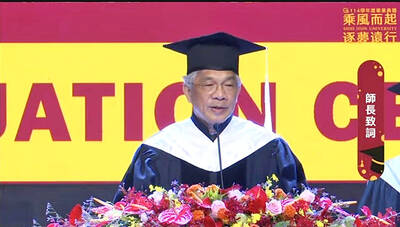
Shih Hsin University President Chen Ching-he (陳清河) yesterday issued a public apology for comments made in his commencement speech last week, stating that he has asked the school to suspend his duties and halt his wages for two months as a show of contrition. At the commencement ceremony on May 30, Chen said, “If you don’t manage your time well, or your own emotions, or your health, then I am telling every one of you — put a quick end to ‘you,’ because the world has no need for ‘you.’” The comments have sparked significant controversy online, and Chen through an open
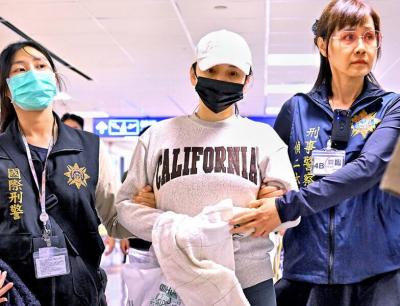
Johanne Liou (劉喬安), a Taiwanese woman who shot to unwanted fame during the Sunflower movement protests in 2014, returned to Taiwan last night after being deported from the US. She is to stand trial in Taiwan for charges involving embezzlement, fraud and drug crimes. The Criminal Investigation Bureau (CIB) said it took her into custody at Taiwan Taoyuan International Airport and would first question her before transferring her to the New Taipei District Prosecutors’ Office. She was arrested upon disembarking a flight from San Francisco that landed shortly before 7pm. Liou absconded to the US in 2019 after jumping bail


 RSS
RSS