


An exhibition of memorabilia and photographs from the Hayashi Department Store in Tainan can be viewed inside the historic building until the end of November.
Opened in 1932, it was the first department store in southern Taiwan to have elevators.
Stacy Tseng (曾芃茵), deputy manager of the store’s planning department, has been collecting store memorabilia since it reopened in 2013, after a 68-year hiatus.
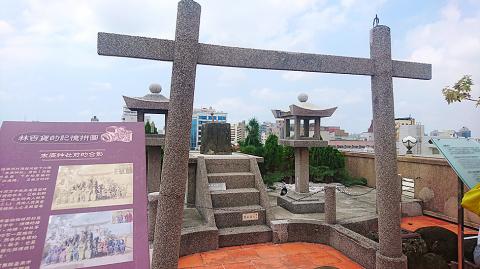
Photo: Liu Wan-chun, Taipei Times
Among the keepsakes on display are a lunchbox kept in the family of oil painter Cheng Pai-chen (鄭百真) for three generations, a notebook sold at the store during the Japanese colonial era on loan from designer Cheng Pei-che (鄭培哲), a garment cover for storing kimonos on loan from Lin Li-hua (林麗華) and a kimono on loan from National Tainan Girls’ Senior High School alumna Sumiko Akiyama — the only kimono she took when she left and went to Japan, Tseng said.
The exhibition includes a wedding photograph of then-employees Lee Hsi-chuan (李錫全) and Lee Chen Ching (李陳錦), who held the ceremony at a Tainan shrine with the department store manager serving as a witness; a photograph taken of employees at work in the store; and a photograph of employees on an outing.
A photograph dated 1934 shows employees at a farewell party for two colleagues, posing with an arch made of inflatable lifebuoys in front of the department store’s elevator.
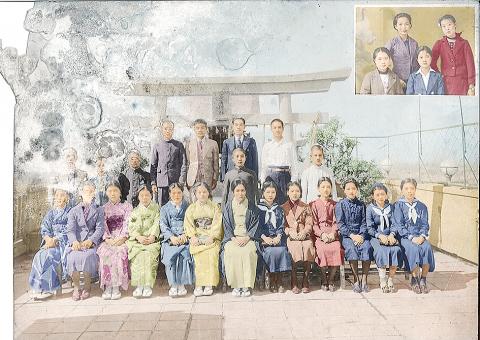
Photo: reproduced by Liu Wan-chun, Taipei Times
A group photograph shows department store founder Houichi Hayashi’s wife, Toshi Hayashi, with employees in front of a shrine and another photograph shows a Tainan cityscape, which was taken from the roof of the department store and loaned by Huang Chien-lung (黃建龍).
The artifacts and photographs are on display on all six floors of the department store.
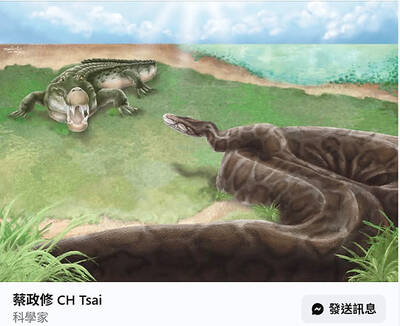
Taiwanese paleontologists have discovered fossil evidence that pythons up to 4m long inhabited Taiwan during the Pleistocene epoch, reporting their findings in the international scientific journal Historical Biology. National Taiwan University (NTU) Institute of Ecology and Evolutionary Biology associate professor Tsai Cheng-hsiu (蔡政修) led the team that discovered the largest snake fossil ever found in Taiwan. The single trunk vertebra was discovered in Tainan at the Chiting Formation, dated to between 400,000 and 800,000 years ago in the Middle Pleistocene, the paper said. The area also produced Taiwan’s first avian fossil, as well as crocodile, mammoth, saber-toothed cat and rhinoceros fossils, it said. Discoveries

Taiwanese paleontologists have discovered fossil evidence that pythons up to 4m long inhabited Taiwan during the Pleistocene epoch, reporting their findings in the international scientific journal Historical Biology. National Taiwan University (NTU) Institute of Ecology and Evolutionary Biology associate professor Tsai Cheng-hsiu (蔡政修) led the team that discovered the largest snake fossil ever found in Taiwan. A single trunk vertebra was discovered in Tainan at the Chiting Formation, dated to between 800,000 to 400,000 years ago in the Middle Pleistocene, the paper said. The area also produced Taiwan’s first avian fossil, as well as crocodile, mammoth, sabre-toothed cat and rhinoceros fossils, it said. Discoveries
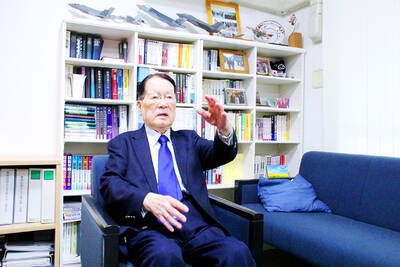
Whether Japan would help defend Taiwan in case of a cross-strait conflict would depend on the US and the extent to which Japan would be allowed to act under the US-Japan Security Treaty, former Japanese minister of defense Satoshi Morimoto said. As China has not given up on the idea of invading Taiwan by force, to what extent Japan could support US military action would hinge on Washington’s intention and its negotiation with Tokyo, Morimoto said in an interview with the Liberty Times (sister paper of the Taipei Times) yesterday. There has to be sufficient mutual recognition of how Japan could provide
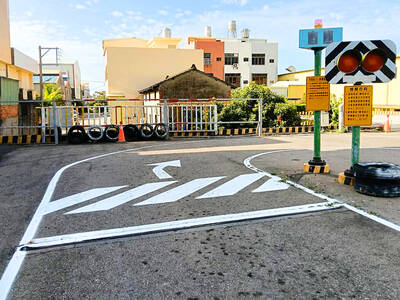
UPDATED TEST: The new rules aim to assess drivers’ awareness of risky behaviors and how they respond under certain circumstances, the Highway Bureau said Driver’s license applicants who fail to yield to pedestrians at intersections or to check blind spots, or omit pointing-and-calling procedures would fail the driving test, the Highway Bureau said yesterday. The change is set to be implemented at the end of the month, and is part of the bureau’s reform of the driving portion of the test, which has been criticized for failing to assess whether drivers can operate vehicles safely. Sedan drivers would be tested regarding yielding to pedestrians and turning their heads to check blind spots, while drivers of large vehicles would be tested on their familiarity with pointing-and-calling


 RSS
RSS