


China’s interference in an East Asian Olympic Committee meeting to revoke Taichung’s right to host the East Asian Youth Games is not a smart move and shows that it does not understand Taiwanese society, Taipei Mayor Ko Wen-je (柯文哲) said yesterday.
The committee announced its decision after a provisional meeting in Beijing on Tuesday, citing “political factors.”
China was reportedly unhappy about a referendum proposal in Taiwan to change the national team’s name to “Taiwan” from “Chinese Taipei” for the 2020 Tokyo Olympics and pressured committee members into revoking Taichung’s right to host the Youth Games.
When asked for comment, Ko said he hopes that cross-strait tensions do not intensify, adding that the two sides should demonstrate mutual respect and understanding.
Taiwan is a democratic and free nation where everyone has the right to express their opinions, Ko said, adding that the referendum proposal is the manifestation of people expressing their political ideas and should be respected.
It is not known whether the proposal will be accepted, and Beijing must understand that Taiwanese society cherishes the values of democracy, freedom, diversity and openness, and domestic issues cannot be dealt with according to its thinking, he said.
Separately, New Power Party (NPP) Legislator Hsu Yung-ming (徐永明) yesterday said China’s interference was clearly an attempt to meddle in November’s nine-in-one local elections.
“Is Beijing worried that things would get out of control if Taichung Mayor Lin Chia-lung (林佳龍) is re-elected?” he asked.
While a public opinion poll released on Tuesday showed that Chinese Nationalist Party (KMT) legislator and Taichung mayoral candidate Lu Shiow-yen (盧秀燕) is more likely to win the election, Hsu said he expects Lu’s support rating to fall following the incident.
Hsu also questioned KMT caucus whip Johnny Chiang’s (江啟臣) role in the incident.
Chiang and former vice president Lien Chan (連戰) met with Chinese President Xi Jinping (習近平) in Beijing on July 13.
If Chiang knew about Beijing’s plan and remained silent, his integrity would be questioned, and if he did not know, it would be unreasonable for him to endorse Beijing’s “one China” principle, Hsu said.
The KMT and the Democratic Progressive Party should take concrete measures to protect Taiwan, he said, adding that the NPP would continue to promote the referendum proposal.
“Only by holding the referendum can we send a powerful message to China, making it clear that Taiwanese will not succumb [to its pressure],” he said.
Political parties must work together to find a way to reverse the committee’s decision, instead of focusing on mud-slinging and making verbal attacks, Chiang wrote on Facebook yesterday.
“Now is not the time for discriminating between the pan-blue and pan-green camps, or the ruling and opposition parties,” he added.
Meanwhile, civil groups are continuing to promote the referendum proposal, despite pressure from China.
“Everyday on the streets we hear words of encouragement from people who believe in the cause. What I see is that people really want to see our athletes wearing uniforms that bear the name ‘Taiwan’ and represent us in the [Olympic] Games,” said Tunghai University student Chao Che-ju (趙哲儒), who volunteered to collect signatures for the referendum proposal.
They would be on the streets every day during summer vacation collecting signatures, he said, adding that they collected more than 500 signatures in three hours on Saturday.
For the referendum to be held concurrently with the nine-in-one elections on Nov. 24, it must gather 281,745 signatures by Tuesday.
The proposal has collected more than 100,000 signatures so far, Taiwan-UN Alliance president Michael Tsai (蔡明憲) said.
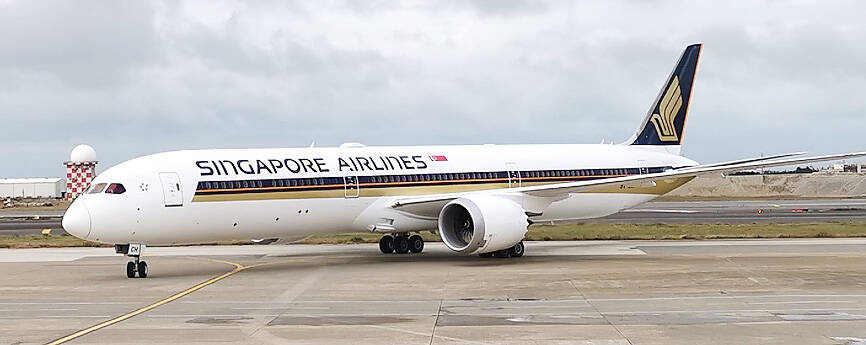
INCREASED CAPACITY: The flights on Mondays, Wednesdays, Fridays and Sundays would leave Singapore in the morning and Taipei in the afternoon Singapore Airlines is adding four supplementary flights to Taipei per week until May to meet increased tourist and business travel demand, the carrier said on Friday. The addition would raise the number of weekly flights it operates to Taipei to 18, Singapore Airlines Taiwan general manager Timothy Ouyang (歐陽漢源) said. The airline has recorded a steady rise in tourist and business travel to and from Taipei, and aims to provide more flexible travel arrangements for passengers, said Ouyang, who assumed the post in July last year. From now until Saturday next week, four additional flights would depart from Singapore on Monday, Wednesday, Friday
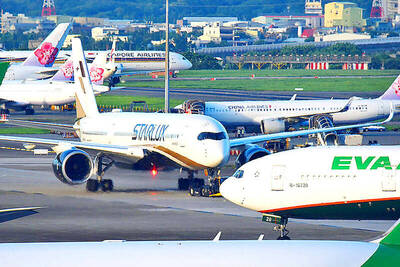
Taiwan’s three major international carriers are increasing booking fees, with EVA Airways having already increased the charge to US$28 per flight segment from US$25, while China Airlines (CAL) and Starlux Airlines are set to follow suit. Booking fees are charged by airlines through a global distribution system (GDS) and passed on to passengers. Carriers that apply the fees include CAL, EVA, Starlux and Tigerair Taiwan. A GDS is a computerized network operated by a company that connects airlines with travel agents and ticketing platforms, allowing reservations to be made and processed in real time. Major players include Amadeus, Sabre and Travelport. EVA Air began
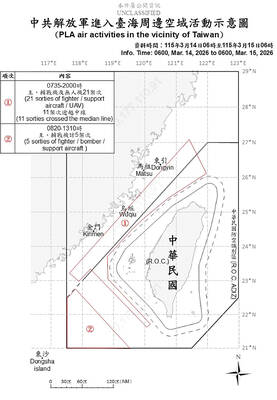
The Ministry of National Defense yesterday reported the return of large-scale Chinese air force activities after their unexplained absence for more than two weeks, which had prompted speculation regarding Beijing’s motives. China usually sends fighter jets, drones and other military aircraft around the nation on a daily basis. Interruptions to such routine are generally caused by bad weather. The Ministry of National Defense said it had detected 26 Chinese military aircraft in the Taiwan Strait over the previous 24 hours. It last reported that many aircraft on Feb. 25, when it spotted 30 aircraft, saying Beijing was carrying out another “joint combat
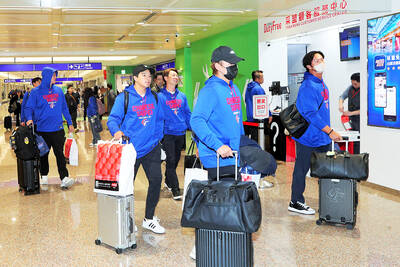
WATCH FOR HITCHHIKERS: The CDC warned those returning home from Japan to be alert for any contagious diseases that might have come back with them People who have returned from Japan following the World Baseball Classic (WBC) games during the weekend are recommended to watch for symptoms of infectious gastroenteritis, flu and measles for two weeks, the Centers for Disease Control (CDC) said. Flu viruses remain the most common respiratory pathogen in Taiwan in the past four weeks and the influenza B virus accounted for 55.7 percent of the tested cases, exceeding the percentage of influenza A (H3N2) infections and becoming the local dominant strain, CDC Epidemic Intelligence Center Deputy Director Lee Chia-lin (李佳琳) said at a news conference on Tuesday. There were 82,187 hospital visits for


 RSS
RSS