


The government is to hold a new round of discussions next week on a proposal to digitize National Health Insurance (NHI) information so that health cards would no longer be required, Minister Without Portfolio Audrey Tang (唐鳳) said.
Tang, who is responsible for the government’s digital technology portfolio, on Thursday said that the idea is for NHI members to have their medical information stored on their cellphones or other devices.
In the previous round of discussions, about 30 people of various ages and from different parts of Taiwan, as well staff members of major hospitals and small clinics, gave their views on the proposal, Tang said.
She said the plan is not to force all NHI members to go digital, but rather to offer the option to those who might like to do so.
The government will also take into consideration the needs of people living in less digitally advanced areas of the country, Tang said.
“What we will do is make the option available to those who wish to adopt it,” she said, adding that Taiwan already has the technology to carry out such a plan.
Tang said she did not think a change to e-government and digitization would be difficult, even for older people.
Citing the example of Pokemon Go, Tang said that when the mobile game was first released in Taiwan, it was played mostly by people familiar with augmented-reality technology, but now everyone, from schoolchildren to elderly people, are playing it.
Tang was one of the speakers at the Digital Innovation Forum, which was held on Thursday and yesterday at the Taipei International Convention Center.
The forum focused on artificial intelligence, scientific and financial technology, and digital innovation.
Sponsored by the APEC Business Advisory Council, the forum was jointly organized by Taiwan and Papua New Guinea.
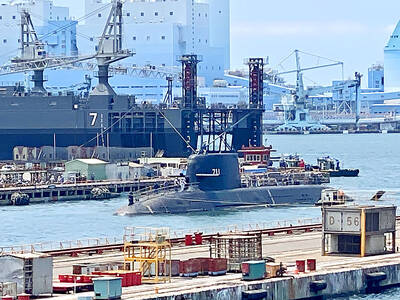
AGING: While Japan has 22 submarines, Taiwan only operates four, two of which were commissioned by the US in 1945 and 1946, and transferred to Taiwan in 1973 Taiwan would need at least 12 submarines to reach modern fleet capabilities, CSBC Corp, Taiwan chairman Chen Cheng-hung (陳政宏) said in an interview broadcast on Friday, citing a US assessment. CSBC is testing the nation’s first indigenous defense submarine, the Hai Kun (海鯤, Narwhal), which is scheduled to be delivered to the navy next month or in July. The Hai Kun has completed torpedo-firing tests and is scheduled to undergo overnight sea trials, Chen said on an SET TV military affairs program. Taiwan would require at least 12 submarines to establish a modern submarine force after assessing the nation’s operational environment and defense

Yangmingshan National Park authorities yesterday urged visitors to respect public spaces and obey the law after a couple was caught on a camera livestream having sex at the park’s Qingtiangang (擎天崗) earlier in the day. The Shilin Police Precinct in Taipei said it has identified a suspect and his vehicle registration number, and would summon him for questioning. The case would be handled in accordance with public indecency charges, it added. The couple entered the park at about 11pm on Thursday and began fooling around by 1am yesterday, the police said, adding that the two were unaware of the park’s all-day live
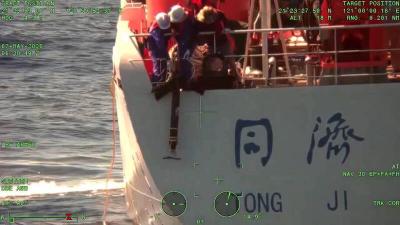
The coast guard today said that it had disrupted "illegal" operations by a Chinese research ship in waters close to the nation and driven it away, part of what Taipei sees a provocative pattern of China's stepped up maritime activities. The coast guard said that it on Thursday last week detected the Chinese ship Tongji (同濟號), which was commissioned only last year, 29 nautical miles (54km) southeast of the southern tip of Taiwan, although just outside restricted waters. The ship was observed lowering ropes into the water, suspected to be the deployment of scientific instruments for "illegal" survey operations, and the coast

A former soldier and an active-duty army officer were yesterday indicted for allegedly selling classified military training materials to a Chinese intelligence operative for a total of NT$79,440. The Taipei District Prosecutors’ Office indicted Chen Tai-yin (陳泰尹) and Lee Chun-ta (李俊達) for contravening the National Security Act (國家安全法) and the Anti-Corruption Act (貪污治罪條例). Chen left the military in September 2013 after serving alongside then-staff sergeant Lee, now an army lieutenant, at the 21st Artillery Command of the army’s Sixth Corps from 2011 to 2013, according to the indictment. Chen met a Chinese intelligence operative identified as “Wang” (王) through a friend in November


 RSS
RSS